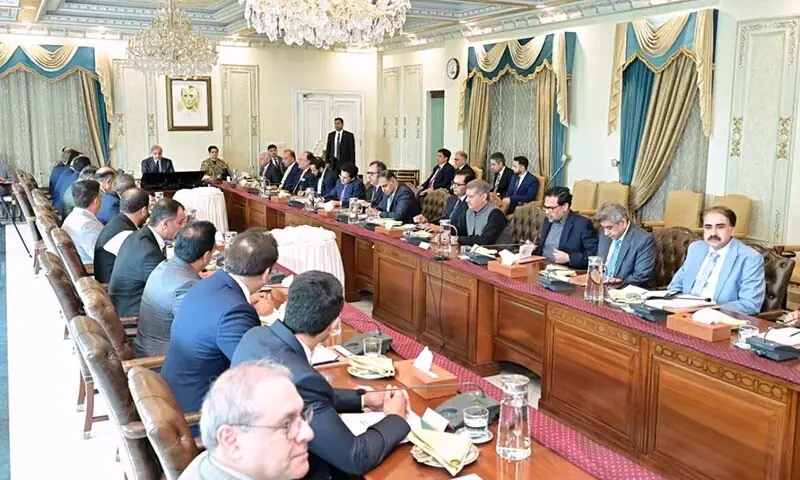
PM Shehbaz assures businessmen, industrialists of measures to boost industrial growth in upcoming budget
ISLAMABAD: Prime Minister Shehbaz Sharif on Monday assured businessmen and industrialists that measures were being taken to make the forthcoming federal budget conducive to industrial growth and production. The government is expected to approve a consolidated national development programme of over Rs3.5 trillion and a macroeconomic framework envisaging economic growth of 4.1pc and inflation of 8.5pc for FY2026–27. The premier made these remarks while meeting presidents of chambers of commerce and industries to seek their suggestions for the 2026-27 federal budget, scheduled to be announced on June 5. During the meeting, PM Shehbaz directed the Federal Board of Revenue (FBR) to dispose of all pending cases of tax refunds by June 15. He further ordered moving the headquarters of Pakistan Revenue Automation Limited (PRAL) to Karachi, in order to enhance exports and facilitate the business community and exporters. The establishment of an office of the Immigration and Passport Department in Gujrat was also ordered. Moreover, the premier urged Pakistani investors to promote e-vehicle production in the country through joint ventures. PM Shehbaz noted that consistent efforts and hard work had helped stabilise the economy. He said additional measures would be taken in the upcoming budget to promote industrial development, boost production and support the business community. The premier assured the delegation of the government’s commitment to creating a more favourable environment for investment and economic growth. The delegation, in turn, assured the PM that the entire business community and industrialists were standing by the government and supporting its economic policies. It presented recommendations regarding the upcoming federal budget and measures aimed at supporting the country’s overall economic growth. ‘New era’ in Pak-China economic partnership Earlier, PM Shehbaz said the extraordinary increase in business engagements between the private sectors of Pakistan and China heralded a new era in economic partnership between the two countries. He emphasised that enhanced industrial, agricultural and technological cooperation with China would boost Pakistan’s exports and create new employment opportunities. The premier was presiding over a review meeting to assess progress on the agreements and memoranda of understanding (MoU) signed at the Pakistan-China Business-to-Business (B2B) conference held during his recent visit to China , the Prime Minister’s Office (PMO) said in a press release. In the meeting, he directed the relevant authorities to ensure that the MoUs signed in Hangzhou are swiftly transformed into formal agreements and joint ventures. PM Shehbaz also decided to personally chair monthly review meetings to monitor progress on the outcomes of the B2B conference. He further ordered that cooperation between the China Academy of Agricultural Sciences and the Pakistan Agricultural Research Council (PARC) be implemented effectively. The premier observed that agricultural research, modern technology and joint ventures between Pakistan and China could bring about a revolutionary transformation in the country’s agricultural sector. During the briefing, participants were informed that a total of 123 Pakistani companies and 436 Chinese companies attended the B2B conference on May 24, where 207 MoUs worth approximately $7.54 billion were signed. Those MoUs were signed in several key sectors, including battery energy storage systems, artificial intelligence (AI), mobile phones and handheld devices. Significant agreements were also reached in the areas of fertilisers, seeds, modern irrigation equipment, fisheries, and food processing. Additionally, MoUs were signed to promote joint investment in advanced industrial sectors, including biotechnology and vaccine manufacturing. The meeting was attended by Federal Ministers Rana Tanvir Hussain, Ahsan Iqbal, Ahad Khan Cheema and Shaza Fatima Khawaja, along with other senior government officials. Last week, the Federation of Pakistan Chambers of Commerce and Industry (FPCCI) released a set of four independent “shadow” policy studies proposing an alternative economic framework to accelerate growth, broaden the tax base, and reduce fiscal imbalances. The documents were prepared by the Economic Policy and Business Development Think Tank (EPBD) and released at the FPCCI office and focused on structural reforms to lift Pakistan’s economy onto a higher, more sustainable growth path. The documents — ‘Tax Policy and Administration Reforms’, ‘Shadow Federal Budget 2026-27’, ‘Shadow Economic Survey of Pakistan 2026’, and ‘Shadow Five-Year Development Plan 2026-31’ — collectively set out a reform agenda centred on private-sector-led growth, fiscal consolidation, and institutional restructuring.
Source: Dawn
More from newsGlobal

Supreme Court orders Judicial Council to recommend vacant judges to Supreme Court one month in advance and to higher courts within three…

What is happening with the investigation into Oli and the author?
