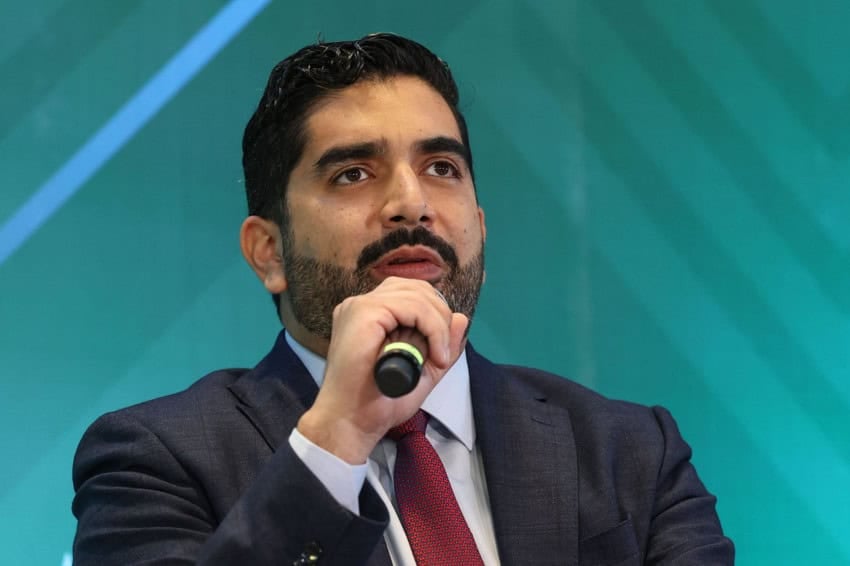
Who is Roberto Lazzeri, Mexico’s next ambassador to the US?
A little over a year ago, we published a profile here at MND of Ambassador Ronald Johnson , and we made the point plainly: that appointment was, without question, a message to the Mexican government. A CIA and special-ops man, a former ambassador to Guatemala with an intense track record on security matters, signaled clearly what Washington’s priority was in its relationship with Mexico. A few months ago, we reported on President Sheinbaum’s new appointments and what they told us about how she was moving the pieces on the board ahead of the USMCA renegotiation. Among those moves is the designation of Roberto Lazzeri as Mexico’s ambassador to the United States. Who is Roberto Lazzeri Montaño? Mexico’s new ambassador to the U.S., Roberto Lazzeri, has a finance rather than a foreign service background. (Galo Cañas/Cuartoscuro) By training, he is an economist trained at CIDE (Centro de Investigación y Docencia Económicas), one of Mexico’s top public institutions for economics. The same year he graduated, in 2005, his career took off, and it has since unfolded almost entirely inside Mexico’s public finance machinery. He began at the Mexico City finance ministry, managing the capital’s local debt portfolio; he moved through the national public-works bank Banobras, structuring subnational debt; he stepped away into the private sector for a while; and then he joined the federal Finance Ministry (Hacienda) in late 2020. There, he ran the directorates of public debt and of fundraising before becoming chief of staff to the finance minister, a post he held from 2022 to 2025 under then-secretary Rogelio Ramírez de la O. What takes up a single paragraph on paper was, in reality, a complex job. It involved refinancing operations exceeding 300 billion pesos (US $17.3 billion) in the domestic market and US $10 billion abroad, along with his role in the Mexican government’s acquisition of Iberdrola power assets in 2023, a deal valued at roughly US $6 billion. These are high-stakes, deeply complex transactions that require negotiating with international banks, regulators and lawyers all at once. In August 2025, he was named to the directorship of Nacional Financiera (Nafin) and the Banco Nacional de Comercio Exterior (Bancomext), Mexico’s development and foreign-trade banks. Beyond his appointment to Nafin and Bancomext, he was named vice president of Alide, the Latin American Association of Development Financing Institutions, for the 2025–2027 term. Why is a banker being named ambassador? First, we have to answer another question to understand why the president chose an economist as ambassador. The question is: what does the job actually involve? The ambassador in Washington runs one of Mexico’s most important diplomatic missions, and the portfolio is far broader than trade alone: it covers political relations, the consular network serving millions of Mexicans, migration, security cooperation and bilateral economic policy. Lazzeri would replace Esteban Moctezuma Barragán, who has held the post since February 2021. But the timing makes one thing unavoidable. The USMCA review begins in July 2026 and while the Economy Ministry is the body that will lead the negotiations, Lazzeri’s job will be to serve as Mexico’s permanent, on-the-ground presence — accompanying and giving support to the trade talks while managing the relationships in the Capitol, the White House, federal agencies and the business community that determine whether a deal can land. Representatives of Mexico and the Economy Ministry hold discussions regarding the review of the USMCA with the U.S. Trade Representative and his team in March 2026. The review itself will take place in July. (@m_ebrard/X) The substance ahead is hard. Analysts and officials anticipate friction over rules of origin, the auto industry, energy, steel, aluminum, telecommunications and regional content — many of the same sectors already entangled in tariff disputes. Why the new ambassador needed a non-foreign service profile Now that we’ve established the ground Lazzeri is going to be playing on, we can easily explain why, this time, the country needs an economist rather than a career diplomat. And to grasp the scale of that ground, it helps to look at the numbers. The trade relationship between Mexico and the United States is not just one more item on the bilateral agenda: it is, to a large degree, the backbone of the Mexican economy. In 2025, Mexico remained the United States’ top trading partner, with total goods trade valued at US $872.8 billion , ahead of Canada and China. More telling still is how lopsided that dependence is for each country: Mexico’s exports to the United States amount to nearly 30% of its GDP. Put another way, more than 83% of Mexican exports are destined for the U.S. market. For Mexico, this relationship isn’t an optional one, but something that forms the backbone of the domestic economy. The economic stakes are high for Mexico and the US But it would be a mistake to read the treaty as something that matters only south of the Rio Grande. The figures carry weight on the U.S. side too: more than 13 million American jobs depend on trade with Mexico and Canada, and the bloc as a whole is no small thing in global terms. The USMCA represents a market of more than 500 million people and accounts for 30% of global GDP. In terms of combined GDP, it is the second-largest trade agreement on the planet, valued at US $25.8 trillion in 2024, behind only Asia’s RCEP. For millions of workers, companies and consumers on both sides of the border, what gets discussed starting in July is anything but abstract: it shapes supply chains, prices and jobs. That is the weight Lazzeri carries with him as he arrives in Washington. Sheinbaum’s reasoning, as she has framed it, is that the dominant issues with the Trump administration are commercial, and that the relationship will be driven by tariffs, sanctions and finance — terrain Lazzeri knows intimately. He has dealt directly with U.S. financial counterparts and he has experience in anti-money-laundering matters that have become newly relevant as Washington presses Mexico on security and illicit financial flows. Where things stand now The U.S. government granted its beneplácito — the host country’s formal sign-off on an incoming ambassador — on May 20, clearing the most uncertain hurdle in Lazzeri’s path. But the approval does not make him an ambassador just yet. The nomination still must go through Mexico’s Senate: the sending of the appointment, his appearance before senators and the floor ratification. Moctezuma remains in his post until the administrative handover is complete and is expected to take another role in the federal government. Just as the appointment of Ronald Johnson (left) last year as U.S. ambassador to Mexico signaled the Trump administration’s prioritization of security, President Sheinbaum (right) has signaled her most important priority, trade, by naming Lazzeri. (Presidencia/Cuartoscuro) And here the circle closes. If the appointment of Ronald Johnson was Washington’s message about what its priority was — security — the designation of Lazzeri is Mexico’s answer about its own: trade. He’ll arrive at the precise moment the trade relationship that underpins North America’s economy goes under review — a banker, not a diplomat, carrying Mexico’s brief into the room. Mexico News Daily The post Who is Roberto Lazzeri, Mexico’s next ambassador to the US? appeared first on Mexico News Daily
Source: Mexico News Daily
More from newsGlobal

This was explained by a bench of Supreme Court Justices Balkrishna Dhakal and Shrikant Poudel in the full text of the verdict of 13 Jesth…

A CIB team arrested Om Prasad Pandey from Janaki Medical College in Ramadaiya, Chireshwornath-1, Dhanusha.
