How Kalpasar project seeks to improve socio-economic conditions of Gujarat’s Saurashtra
Being a drought-prone state, Gujarat has faced scarcity of water almost 30 times since the year 1900. The proposed Kalpasar Project seeks to address the long-term water needs of Saurashtra and Central Gujarat by creating a dependable, large-scale freshwater reservoir that can supply water for irrigation, industrial and domestic use throughout the year.
During his recent visit to the Netherlands, Prime Minister Narendra Modi also visited the country’s Afsluitdijk dam, a global benchmark in flood control and water management measures. The two countries also signed a Letter of Intent for technical cooperation on the proposed Kalpasar Project.
But what explains India’s keen interest in Dutch water engineering to implement its most ambitious water infrastructure project. What are the key objectives of the Kalpasar Project, also known as the Gulf of Khambhat Development Project? In addition to addressing water scarcity, what are the other multiple benefits expected from the project?
How Kalpasar seeks to address Gujarat’s water scarcity
Gujarat covers approximately 6 per cent of India’s total geographical area and can be divided into three major parts:
a) Central and South Gujarat (the fertile, industrialized mainland regions)
b) Saurashtra and Kutch (the western peninsula and salt plains)
c) North Gujarat (the northern plains)
Story continues below this ad
The state is primarily dependent on the south-west monsoon for the rainfall, which is often unequally distributed across these regions.
The regions of Saurashtra, Kutch, and North Gujarat face water scarcity every third year. As mentioned earlier, Gujarat is a chronic drought prone state, and has faced scarcity of water almost 30 times since the year 1900, according to the Water Resources Department, the government of Gujarat.
The proposed Kalpasar Project in Gulf of Khambhat (earlier known as Cambay) is intended to address the long-term water needs of Saurashtra and Central Gujarat by creating a dependable, large-scale freshwater reservoir that can supply water for irrigation, industrial and domestic use throughout the year.
The project is expected to rejuvenate local channels and groundwater, and replenish more than 60 existing dams with fresh water, according to the Kalpasar Pre-Feasibility Report (2022). This project has been on the government’s agenda since 1986 and is now expected to be completed with the cooperation from the Netherlands.
Story continues below this ad
Why Gulf of Khambhat is suitable for Kalpasar
Moreover, the feasibility of the project is closely linked to geographical features of the Gulf of Khambhat. Gujarat has the longest coastline (2,340.62 km) among all Indian states. The Gulf of Khambhat separates the Saurashtra region from the south-eastern part of Gujarat. It is home to many important ports, including Surat, Bharuch, and Dahej, and has historically played a significant role in connecting India with West Asia.
The Gulf of Khambhat’s geography makes it suitable for the Kalpasar dam. It has a very high tidal range of approximately 13 meters. The tidal range is defined as the difference in height between consecutive high tide and low tide levels. It is also characterised by strong tidal currents with the velocity often crossing more than 3m/s.
Furthermore, the gulf has a wide mouth of about 180 km on the southern side, which narrows down to approximately 5 km on the northern side. This geometry makes it a feasible dam site.
Key objectives and benefits
The Kalpasar Project is a multipurpose initiative aimed at providing water for irrigation, industrial and domestic use in the water-stressed Saurashtra region of Gujarat.
Dam and reservoir infrastructure
Story continues below this ad
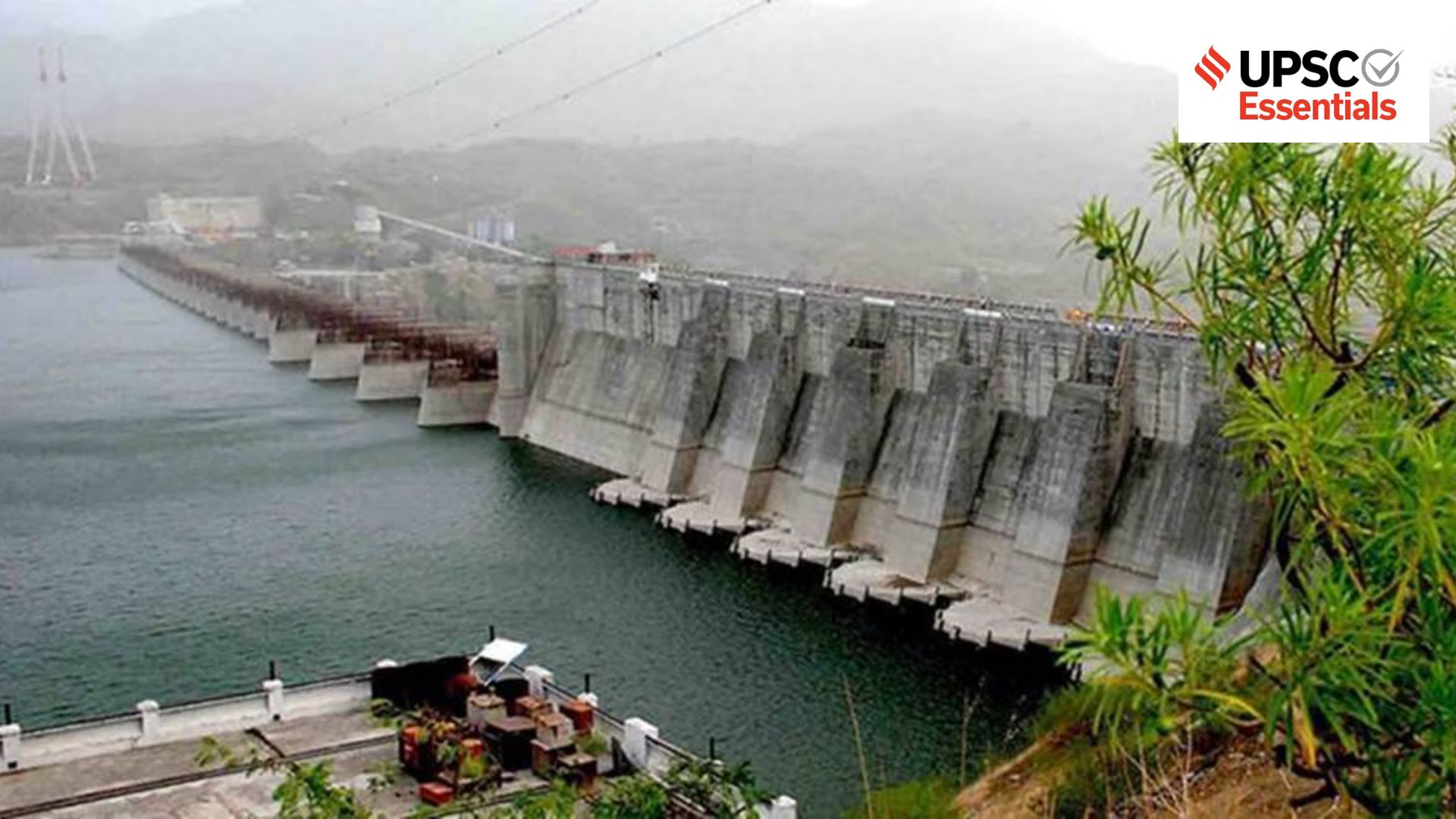
The project includes the construction of a 60.13 km long dam across the Gulf, from Aladar (eastern side) to near Bhavnagar (western side). Out of which about 26.7 km length will be in the Gulf (sea portion), and 33.43 km length is extended on both flanks up to the nearest road across the Gulf of Khambhat.
Freshwater storage and irrigation
According to the project’s pre-feasibility report, the dam will create one of the largest global freshwater reservoirs with 7800 million cubic meters of capacity. It will provide irrigation water to nine districts of Saurashtra, covering a total of around 10.54 lakh hectares of land.
River integration and water diversion
This reservoir will receive water from four major rivers – Sabarmati, Mahi, Dhadhar and Narmada – and seven minor rivers – Wadhwan Bhogavo, Limbdi Bhogavo, Sukhbhadar, Utavli, Keri, Ghelo, and Kalubhar. For this, a diversion canal is planned at the Bhadbhut barrage on the Narmada River to divert its additional water into the reservoir.
Environmental and coastal benefits
This is expected to improve groundwater conditions in the surrounding districts, protect tidal-affected areas, and reduce salinity in the coastal region. In addition, the project estimates suggest land reclamation of approximately 1.76 lakh hectares.
Renewable energy, fisheries, tourism
Story continues below this ad
Kalpasar also holds immense renewable energy potential through solar (1000 MW) and wind (1500 MW) power development, and can even fulfil the project’s energy needs. The creation of the freshwater reservoir will replace marine fisheries with freshwater fish, with annual fish production estimated to increase from 2,000 tons in the initial stages to 20,000 tons at full developmental scale. This project also aims to boost development and tourism in the region.
Transport and connectivity
There are also plans to build a flood regulator to discharge excess water and 16-lane roadways with a 4-lane permanent way for rail transport to connect the districts on both eastern and western sides. This will reduce travel distance from 240 km to 60 km (when cutting across the Gulf).
Historical background of the project
Notably, the origins of the Kalpasar concept can be traced back to 1955, when a Dutch company, Netherlands Engineering Consultants (NEDECO), while working on land reclamation in the Saurashtra region, floated such an idea. In 1962, Bhogilal Shah, a Rajya Sabha MP (1952-56), proposed the idea of dam construction across the Gulf of Khambhat and suggested the freshwater lake be named ‘Gandhisar’.
Subsequently, personalities such as Dr Viththubhai Patel, an engineer, and Professor E M Wilson, UNO Tidal Power Expert, gave further shape to this idea. In 1986, the Government of Gujarat formally proposed the development of a fresh water reservoir, as well as road and rail transport infrastructure across the Gulf. However, the approval for feasibility studies was given only in 2003.
Story continues below this ad
Why the Afsluitdijk stands out as a global benchmark
The Dutch started developing their water management capabilities very early on and built sophisticated systems of dams, dikes, and storm barriers for flood control, as about one-third of their country lies below sea level.
Among these, the Afsluitdijk stands out as a global benchmark in flood control and land reclamation. Built in 1932, the 32-km-long dam separates the Wadden Sea from the IJsselmeer freshwater lake in the Netherlands. In addition to protecting large parts of the Netherlands from the North Sea, it supports freshwater conservation, connectivity via inland navigation and road, and renewable energy generation.
The IJsselmeer lake receives 70 per cent of its water from the river IJssel, a tributary of the Rhine River, and the rest from rainwater and other streams and small rivers. To address the current requirements, Afsluitdijk is being modernised and upgraded to withstand waves during a superstorm that occurs only once every 10,000 years.
Global experiences and the way forward for Kalpasar
Gujarat’s coastline faces many challenges similar to those historically encountered by the Netherlands, including salinity intrusion, droughts, and rising sea levels. This explains India’s keen interest in Dutch water engineering to implement its most ambitious water infrastructure project, the Kalpasar Project.
Story continues below this ad
Another relevant example is South Korea’s Saemangeum Project. It was launched in 1991 after the global food crisis of the 1970s and the poor harvest of the 1980s. An indented shoreline, with a gently sloping sea bottom, and tidal range of approximately 6 m provided favourable geographic and hydraulic conditions to develop this tideland reclamation project.
Now that India has international technical collaboration and other global examples, the implementation of the ambitious Kalpasar project is expected to be expedited. The project has the potential to improve the socio-economic conditions of Saurashtra and Gujarat.
Post read questions
The Kalpasar Project has been described as one of India’s most ambitious water infrastructure initiatives. Discuss its objectives, potential benefits, and major implementation challenges.
Analyze the significance of Indo-Dutch technical cooperation in the context of the Kalpasar Project. How can international collaboration strengthen India’s water management capabilities?
Story continues below this ad
Explain the geographical characteristics of the Gulf of Khambhat that make it suitable for a project like Kalpasar.
Evaluate the renewable energy potential associated with the Kalpasar Project. How can integrated infrastructure projects contribute to India’s energy transition?
Assess the potential impact of the Kalpasar Project on agriculture, groundwater recharge, and regional development in Gujarat.
(Abhinav Rai is a Doctoral candidate at the Department of Geography, Delhi School of Economics, University of Delhi.)
Share your thoughts and ideas on UPSC Special articles with [email protected].
Click Here to read the UPSC Essentials magazine for May 2026. Subscribe to our UPSC newsletter and stay updated with the news cues from the past week.
Stay updated with the latest UPSC articles by joining our Telegram channel – IndianExpress UPSC Hub, and follow us on Instagram and X.
View original source — Indian Express ↗
More from newsGlobal
At a program organized in Kavre, Speaker Dol Prasad Aryal said that citizens have not yet realized that the state and government are for…

Tulsa, a single woman, came to the limelight by commenting on current affairs on TikTok. She was also promoting her jewelry-related busin…