‘Explosive, fearless, world-class’: Gopichand on doubles talent Hariharan
5 min readUpdated: Jun 4, 2026 11:53 PM IST
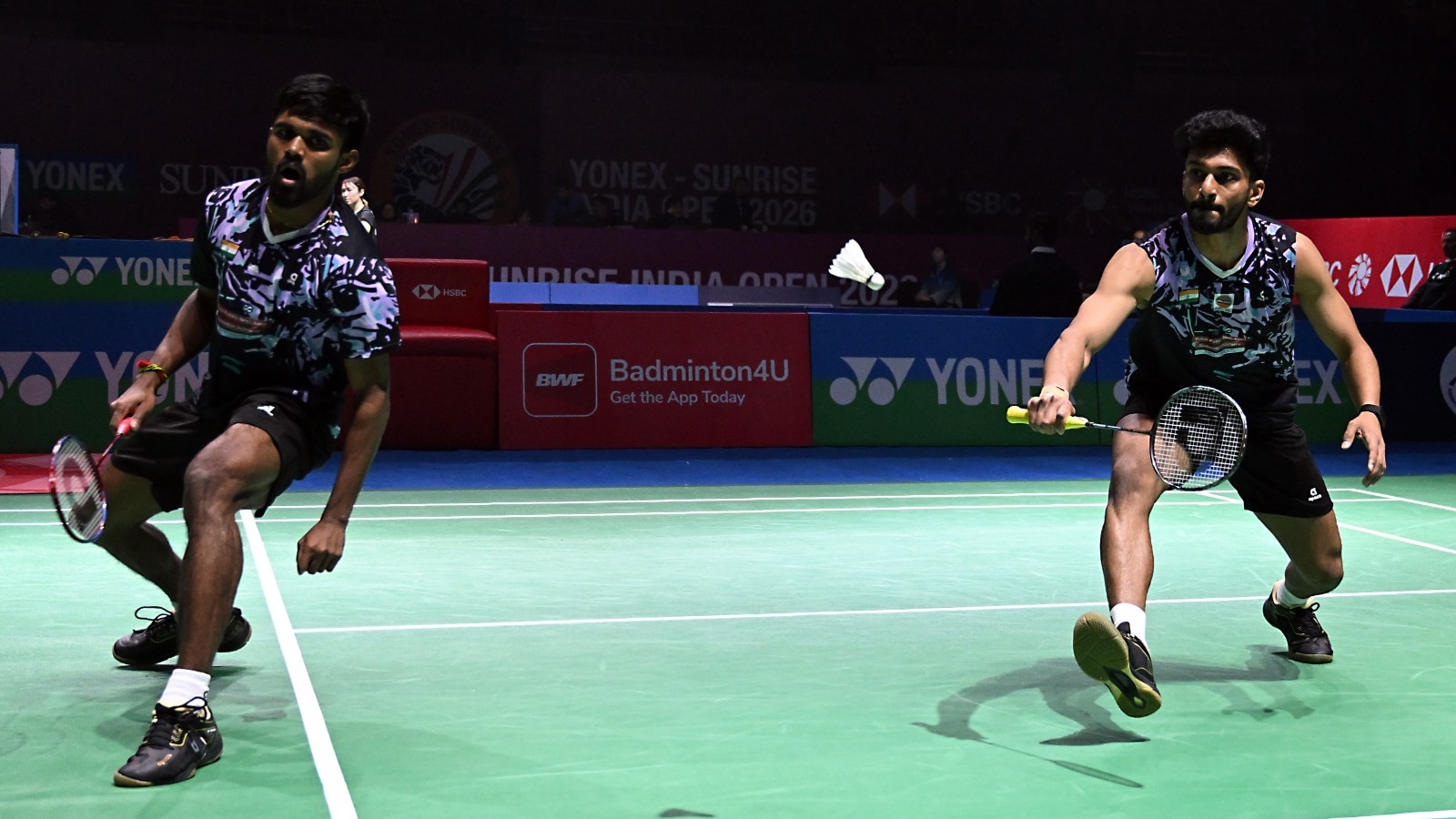
MR Arjun (right) and Hariharan Amsakarunan (left) in action. (BAI Photo/File)
India’s Malaysian doubles coach Tan Kim Her has a talent for Kintsugi, the age-old Japanese art of patching precious things back with powdered gold. He did it with Satwik-Chirag. He is now doing it again.
After returning to India from Japan following Paris, Tan set about pairing the experienced MR Arjun with young Hariharan Amsakarunan, breaking up Hari’s existing partnership with Ruben Rethinasabapathi to do so. The vision was a combined style: Arjun’s experience and net craft alongside Hari’s explosive backcourt power. Arjun confirms that Tan saw the opportunity straight away when they were paired together. Working their way up to World No 30, the pair reached their first ever quarterfinals of the Super 1000 Indonesia Open, scoring a gutsy 16-21, 21-15, 21-19 win over Malaysian World No 23 Aaron Tai and Kang Khai Xing, keeping India rolling into Friday. India had a second men’s doubles pairing at a Super 1000, a week after Satwik-Chirag won at Singapore.
“Hari is very explosive and strong from the back court, and combines well with Arjun’s experience,” national head coach Pullela Gopichand says. “Not only does he have the power and gamesense, he has the quality to back it up on court. He has a lot of energy from the back of the court and is fearless.” Are we looking at the next big thing in doubles? “He is world-class,” Gopichand simply states.
Tan has been reshaping Indian doubles ever since Jwala Gutta and Ashwini Ponappa, torpedoing opponents with his reading of techniques and styles. Before leaving for Japan to work with Park Joo-bong, he had paired Satwik and Chirag together, with the man left behind being MR Arjun. The 30-year-old from Kochi spent a considerable time managing injuries and rebuilding a career that hinges on a partner. After Chirag, his pairing with Dhruv Kapila hadn’t taken off. But Tan saw something in him combining with Hariharan, and after Arjun and Hari medalled alongside the Thomas Cup bronze winning team, the coach was ready to take the pair further.
Hari had come a long way to get here. He grew up in Mannargudi, Thiruvarur, where his father worked in the transport sector around the rajagopuram temple economy. The finances were not much, but his sister Deepika played badminton. “He also started in 6th standard. He always had a very good smash,” she says. He moved to Coimbatore for three years before being picked for the Gopichand Academy. His earlier pairing with Ruben Rethinasabapathi had to be dissolved for Tan’s vision to take shape, and even as the coach steadied Satwik-Chirag and brought Tanisha-Dhruv to a fairly good level, it was the MD2 slot that needed the most careful patching.
The Indonesia win did not happen by accident. The Malaysian junior World champions, considered wonderkids, had beaten the Indians at Syed Modi last winter, largely through the dreaded spin serve that both players in the pair possess. Most pairs have one. “Usually one player has the spin serve. Here both of them have it. So they get a continuous stream of points,” Arjun told the BWF. Tan was determined to neutralise it. “Coach Tan helped us to deal with their spin serve receivings. We had lost to them because of that at Lucknow,” Arjun added. In Singapore the previous week, Arjun had taken an unusual step, sitting on the coaching chair alongside Tan as Satwik-Chirag played the same Malaysian pair. “I sat with coach Tan for the Satwik-Chirag game, so we knew what to expect,” he said.
Even so, the Indians trailed 6-11 in the decider. Arjun sensed an opening once sides changed and they got onto the slower end of the court. Though he was personally struggling with his rhythm and poking at the serve, Tan told them to stick it out and stay sturdy. They didn’t back off. The dribbles turned into acute brushing affairs. Hari, who plays flat-fast rallies, defends fearlessly and jump-smashes from an L-shape on the left, said he felt pressure building but Arjun brought composure. “It was a drive-drive game in the end, but we were catching up which put pressure on them,” Hari told BWF. From 12-16 the Indians clawed back to 16-16. At 14-16, Hari charged forward for a backhand tap scythe. On match point, Arjun went after Kang, pinning him back, and then in a classic 1-2 Hari finished with a smash kill of his own to Kang. Just like that, with Tan’s foresight, India had their answer.
Story continues below this ad
“We just wanted to hold our nerves in the first three strokes. We knew if we executed that we had a chance,” Arjun told The Indian Express.
In a famous May-June week for Indian badminton, Satwik-Chirag winning at Singapore and Arjun-Hari following in Jakarta, the dreaded spin serve neutralised and a quarter-final reached, the question that has hung over Indian doubles for years was quietly being answered.
Shivani Naik is a senior sports journalist and Assistant Editor at The Indian Express. She is widely considered one of the leading voices in Indian Olympic sports journalism, particularly known for her deep expertise in badminton, wrestling, and basketball.
Professional Profile
Role: Assistant Editor and Columnist at The Indian Express.
Specialization: While she covers a variety of sports, she is the primary authority on badminton for the publication. She also writes extensively about tennis, track and field, wrestling, and gymnastics.
Writing Style: Her work is characterized by "technical storytelling"—breaking down the biomechanics, tactics, and psychological grit of athletes. She often provides "long reads" that explore the personal journeys of athletes beyond the podium.
Key Topics & Recent Coverage (Late 2025)
Shivani Naik’s recent articles (as of December 2025) focus on the evolving landscape of Indian sports as athletes prepare for the 2026 Asian Games and beyond:
Indian Badminton's "Hulks": She has recently written about a new generation of Indian shuttlers characterized by power and physicality, such as Ayush Shetty and Sathish Karunakaran, marking a shift from the traditionally finesse-based Indian style.
PV Sindhu’s Resurgence: A significant portion of her late-2025 work tracks PV Sindhu’s tactical shifts under new coaching, focusing on her "sparkle" and technical tweaks to break out of career slumps.
The "Group of Death": In December 2025, she provided detailed tactical previews for Satwiksairaj Rankireddy and Chirag Shetty’s campaign in the BWF World Tour Finals.
Tactical Deep Dives: She frequently explores technical trends, such as the rise of "backhand deception" in modern badminton and the importance of court drift management in international arenas.
Legacy and History: She often revisits the careers of legends like Saina Nehwal and Syed Modi, providing historical context to current Indian successes.
Notable Recent Articles
BWF World Tour Finals: Satwik-Chirag have it all to do to get through proverbial Group of Death. (Dec 2025)
The age of Hulks in Indian badminton is here. (Dec 2025)
Treadmill, Yoganidra and building endurance: The themes that defined the resurgence of Gayatri and Treesa. (Dec 2025)
Ayush Shetty beats Kodai Naraoka: Will 20-year-old be the headline act in 2026? (Nov 2025)
Modern Cinderella tale – featuring An Se-young and a shoe that fits snugly. (Nov 2025)
Other Sports Interests
Beyond the court, Shivani is a passionate follower of South African cricket, sometimes writing emotional columns about her irrational support for the Proteas, which started because of love for Graeme Smith's dour and doughty Test playing style despite being a left-hander, and sustained over curiosity over their heartbreaking habit of losing ICC knockouts.
You can follow her detailed analysis and columns on her official Indian Express profile page. ... Read More
Tags:
Indonesia Open
View original source — Indian Express ↗
More from newsGlobal
He was taken into custody by the Valley Crime Investigation Office, Teku, on the orders of the Office of the Prime Minister and Council o…
A high-ranking source at the Ministry of Home Affairs has confirmed that he was taken into custody by the Valley Crime Investigation Offi…