‘Part of a larger struggle’: As elections loom, thousands march to Knesset for Jerusalem Pride
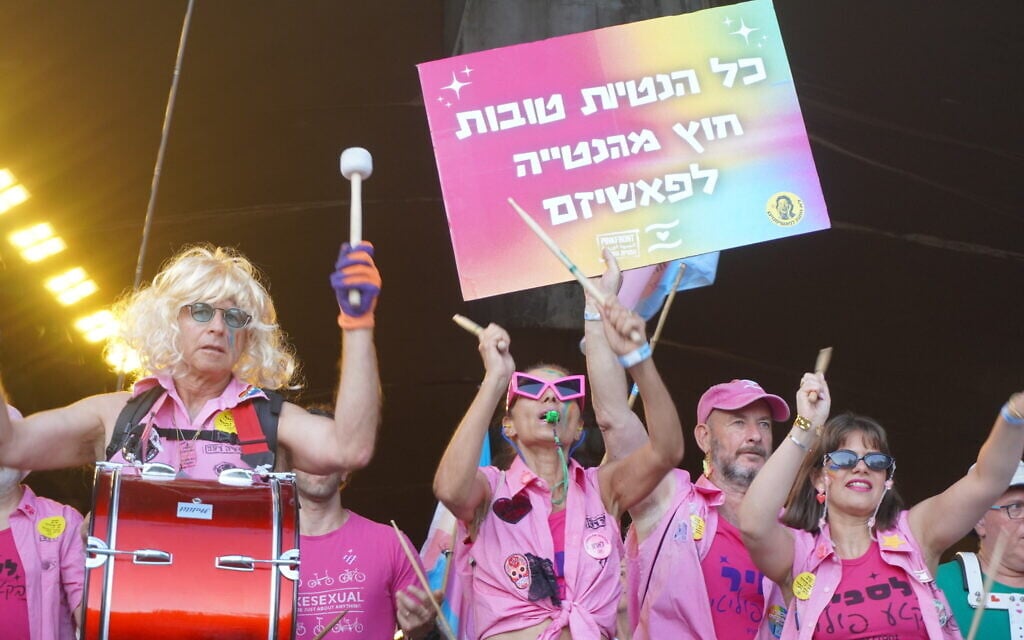
Thousands marched under tight security Thursday to the Knesset’s gates as part of Jerusalem’s annual LGBTQ Pride March, whose route this year was altered to end at the parliament building.
Participants decked out in gay and transgender pride flags gathered on the grassy expanse of Sacher Park before marching to Wohl Rose Garden, which overlooks the Knesset.
In previous years, the march has set out from Liberty Bell Park, passing Paris Square, the Jerusalem Great Synagogue and the Jewish Agency building before ending at Independence Park.
This time the route was altered to conclude outside the Knesset. Many marchers were pleased with the change, seeing it as a way to vent opposition against the government in power since late 2022, which includes a number of lawmakers allied with homophobic figures.
“I love the old route, but times are different and we need to show that we’re not going to be erased, like the government’s been trying to do for four years now. There’s no getting rid of us,” said Ash Segal, a 21-year-old from Modiin, attending the march for their fourth year.
Get The Times of Israel's Daily Edition
by email and never miss our top stories
By signing up, you agree to the terms
Jerusalem, a city with a strong conservative bent, boasts a small yet mobilized liberal faction that comprises the bulk of attendees at the capital’s Pride March, with the event tending to take on a slightly more serious political tone than in other cities.
This year, as participants set out to the Knesset with elections on the horizon, anti-government slogans and speeches featured more prominently.
Marchers calling to replace the current right-wing coalition led by Prime Minister Benjamin Netanyahu waved ballot boxes in the air while chanting “democracy” to the beat of drums.
“Tel Aviv pride feels like a party, it’s disconnected from the rest of the country. There’s scarcely anyone religious, I’m very happy to be marching with religious communities, Jews wearing kippahs, not just gays from Florentin,” Segal said, referencing a bohemian neighborhood of south Tel Aviv.
The event, which is organized annually by the Jerusalem Open House, was held for its 24th year under the slogan, “Demanding Change.”
Hadas Blumental, the head of Jerusalem Open House, said the march was not “simply a protest, it is a declaration of the society we want to live in.”
“The rights of the LGBTQ community are not a marginal issue, they are part of a larger struggle for Israel’s character as a democratic state, and we will not cease demanding our place in it,” she added.
While most protesters trickled into Wohl Rose Garden at the march’s conclusion, a far-left bloc of around one hundred people remained outside the Knesset, chanting against Israel’s military rule in the West Bank and ongoing evictions in East Jerusalem.
The march took place under tight security, with over 2,000 police officers deployed in the area. The event has been heavily guarded due to fears of anti-LGBTQ violence since an ultra-Orthodox man carried out a stabbing attack during the march in 2015, killing a teenage girl and injuring several others, days after being released from prison over an attack on the parade a decade earlier.
As part of the security measures this year, Sacher Park was surrounded by tall metal fences on all sides, meant to keep out anyone without a wristband handed out to marchers at the entrance.
As marchers gathered, a small group of counterprotesters with the far-right Lehava group set up camp across the street, chanting, “Jerusalem is not Sodom” and deriding the event as an “abomination march.”
The keynote speaker at the march was Omer Ohana, the bereaved fiance of Maj. Sagi Golan, who was killed while fighting off Hamas terrorists in Kibbutz Be’eri on October 7, 2023.
“Nine hundred and seventy-one days have passed since the day my life turned upside down… since my Sagi, Maj. Sagi Golan, went out to save lives in Be’eri. After Sagi was killed, the state didn’t recognize me, didn’t recognize our love,” he said.
When Golan was killed, Ohana had to fight to be recognized by the state as a widower since his partner was a man. After intense lobbying over the issue, the Knesset passed a law extending that recognition to same-sex partners of slain soldiers.
“We are at the beginning of a fateful election campaign,” Ohana said. “The votes of the gay community, our families, our friends and the liberal public in Israel are a tremendous force. We will not be satisfied with empty promises.”
Many of the speakers addressing the crowd before the march were liberal and left-wing politicians, some of whom noted the the upcoming elections.
Opposition leader Yair Lapid said that the gay community’s fight in Israel is “the struggle of everyone who believes in freedom, love and democracy. It is also a struggle for Judaism that is not hateful, which instead accepts and embraces the other.”
To Lapid’s left, The Democrats MK Naama Lazimi urged LGBTQ Israelis to cast an “ideological vote” for a party that wouldn’t compromise on their rights.
“For too many years, the political system has treated you as a sector whose votes are bought right before the elections, and whose rights are sold immediately after them,” she said. “In the next elections, the most strategic vote is an ideological vote.”
View original source — Times of Israel ↗
More from newsGlobal

Mustang Customs Chief says,
He was taken into custody by the Valley Crime Investigation Office, Teku, on the orders of the Office of the Prime Minister and Council o…