Are we heading for communism after the budget? The Tele’s editor thinks the needle is moving | Weekly Beast
Reporters at most news outlets are being encouraged to embrace video as a way of sharing their stories online. One editor, the Daily Telegraph’s Ben English, has embraced the trend with relish.
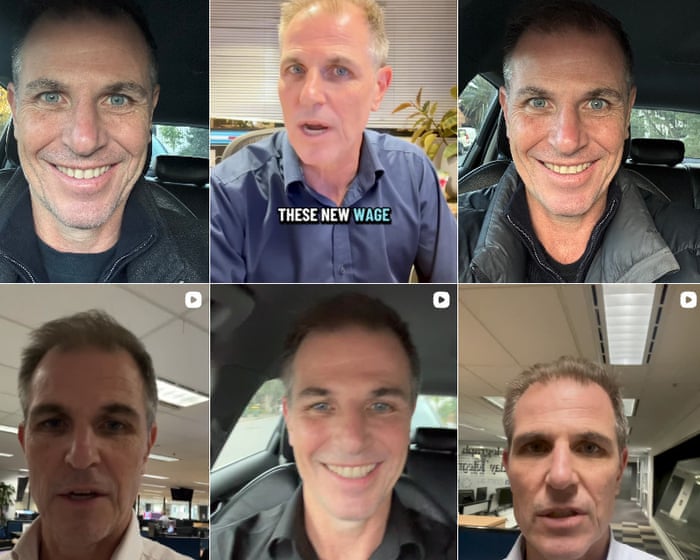
Every day since the Daily Tele declared the federal budget a “Communist manifesto”, English has filmed a video – often while sitting in his car – to spruik the paper’s front page. With a broad grin and unblinking eyes, he says: “Morning, everyone, check out today’s front page.” Then he unveils the fruits of his brilliance.
Tele editors take pride in their front pages, even though the printed newspaper is a relic. Publishers stopped counting print copies 10 years ago but we estimate the number of copies sold each day would be about 50,000 (it was 220,000 in 2017).
English was so keen to talk about his Communist front page – which featured a hammer and sickle – he dropped his usual reticence to talk to non-News Corp media and appeared on 2SER’s Fourth Estate media show. When the host, Tina Quinn, asked him to explain his understanding of communism and how it related to the budget, he said: “It’s pretty basic and it’s a philosophical and ideological basis. And that is a redistribution of capital from asset owners to workers, to the proletariat, which is very faithful to the article of Karl Marx. And that’s what we’re looking at here.”
But when challenged about what elements of the budget screamed communism, English appeared to backtrack.
Quinn: “When people think of communism, they generally think of the abolition of private property, state ownership of industry and centrally planned economies. This budget doesn’t propose any of those things though, does it?”
English: “No, 100% it doesn’t, but it does actually, if you think about at one end of the spectrum, laissez-faire, zero government involvement in the economy, and at the other end of the spectrum, a command economy that is entirely run by the government, this budget does move the needle strongly towards the latter.”
Good news for 2SER
Still on the community radio station 2SER, there is good news.
Sydney Educational Radio, which is owned by UTS, was struggling to stay afloat beyond July after failing to find a new backer when it was abandoned by its funding partner Macquarie University last year.
The 2SER board now says it has approved a model that will enable the much-loved station, which has fostered dozens of broadcasting careers over decades, to continue operating, albeit with a smaller staff and funding pool.
Sign up to get Guardian Australia’s weekly media diary as a free newsletter
A transitional director, Tony Duke, has been appointed to conduct an independent review. Prof James Bennett, the dean of the faculty of design and society and a 2SER board member, said: “Feedback and input of station staff, volunteers and the community has been critical in this process.
“The board is urgently working through the finer details of the model, UTS governance processes and undertaking further consultation with staff and will provide further details as soon as they are available.”
Politico in … Perth?
The US political news site Politico is establishing an Australian outlet this year, and the Axel Springer-owned outlet has started to advertise for staff to work in the Canberra press gallery.
The Canberra Playbook editor sounds like a tough gig, with the recruit required to be “comfortable operating in a startup-style environment with limited resources” and to be “able to push reporters to be better without slowing them down”.
But first, Politico has to work out where the national capital is located in this wide brown land.
Advertising for the position of Canberra Playbook editor on LinkedIn, Politico described Canberra as “in the Greater Perth area”.
Pickering’s ‘problematic’ interview
The comedian Charlie Pickering has had a shocker of a first week as the new Drive host for ABC Radio Melbourne. A former host of Ten’s The Project, Pickering stepped into the Drive slot on Monday and by Thursday was forced to address on air why he was the subject of widespread bad press.
Pickering’s mistake was to wander outside the ABC’s Southbank studio on Tuesday and find himself subjected to a barrage of questions from the rightwing live streamer Avi Yemini, who was wielding a big Rebel News Australia microphone.
Part of an anti-ABC protest, Yemini spotted Pickering in the crowd and asked him what he thought about that days’s announcement that the ABC had hired Grace Tame to host a four-part podcast about autism, Autistic AF. Tame’s hiring has been criticised in some quarters because of her comments about Israel and Gaza in an ABC interview, particularly that claims of Israeli women being raped by Hamas on 7 October 2023 had been “debunked”.
Pickering said: “I do actually think it’s problematic, that’s my personal opinion. I think, as a Jewish Australian, there’s a complete misunderstanding of a lot of the words that are said and what [the] true meanings of them are.”
If you watch the whole conversation, Pickering did a good job of batting away some of Yemini’s questions – such as why the ABC doesn’t hire One Nation supporters – but the “problematic” comment about Tame was the one that Yemini clipped up, and it went viral.
Pickering came under fire for legitimising Yemini, a former Israeli soldier and self-styled journalist for Rebel News Australia, by giving him his time.
The ABC undertook a fast-tracked investigation into whether Pickering had breached its code of conduct or its new public comment guidelines, and issued a statement clearing him. “Pickering made clear that the views he expressed were his personal views,” an ABC spokesperson said. “They do not affect his ability to perform his role or the integrity of ABC content.”
After the 3pm bulletin Pickering made his own statement of contrition. “I’ve always been a big fan of Grace Tame,” Pickering told his listeners. “She’s an outstanding advocate for those on the autism spectrum, for survivors and for women, and for all of us.
“Unfortunately, I was ambushed by a known provocateur and pressed into a conversation that was not planned and that I definitely had no intention of being a part of. I would never have agreed or planned to be interviewed by that person.”
Brittany Higgins v The Australian
There is a chilling scene in the new documentary Silenced, which had its Australian premiere at the Sydney film festival on Wednesday, that shows what it was like for Brittany Higgins to be hounded by the press in rural France, where she fled in late 2023 with her partner, David Sharaz.
A doorbell camera shows reporters in front of the property in the French village of Lunas as Higgins says: “We didn’t realise the level we were being stalked.”
Then mobile phone footage shows The Australian’s Europe correspondent, Jacquelin Magnay, trying to ingratiate herself with the couple after she is caught hanging around. One review of the film, on ScreenHub, describes the moment Magnay is confronted and tries to take control of the situation, “her face set in a ghoulish rictus of a smile”.
Magnay’s story in The Australian, headlined “First pictures: Joyous Higgins, Sharaz arrive at new French mansion estate”, described the scene thus: “Ms Higgins and Mr Sharaz were spotted outside their new home early on Thursday wearing co-ordinated beige outfits. The pair had earlier arrived in Paris, disembarking from their flight wearing matching black outfits, in contrast with the all-white clothes in which they left Australia, in a nod to the suffragette movement.”
On Thursday The Australian’s own four-star review of Silenced, by Nikki Gemmell, also referred to the scene in France, without mentioning it was The Australian’s reporter who had tracked Higgins down.
Gemmell: “She moves to France. ‘We didn’t realise the level we were being stalked.’ We see doorbell footage.”
View original source — The Guardian ↗
More from newsGlobal
The ministry has made it clear that legal action will be taken against employees who do not report to the office even…
Karnali Chief Minister Yamlal Kandel criticizes the federal government for neglecting Karnali in the budget, similar to…