Indian Express
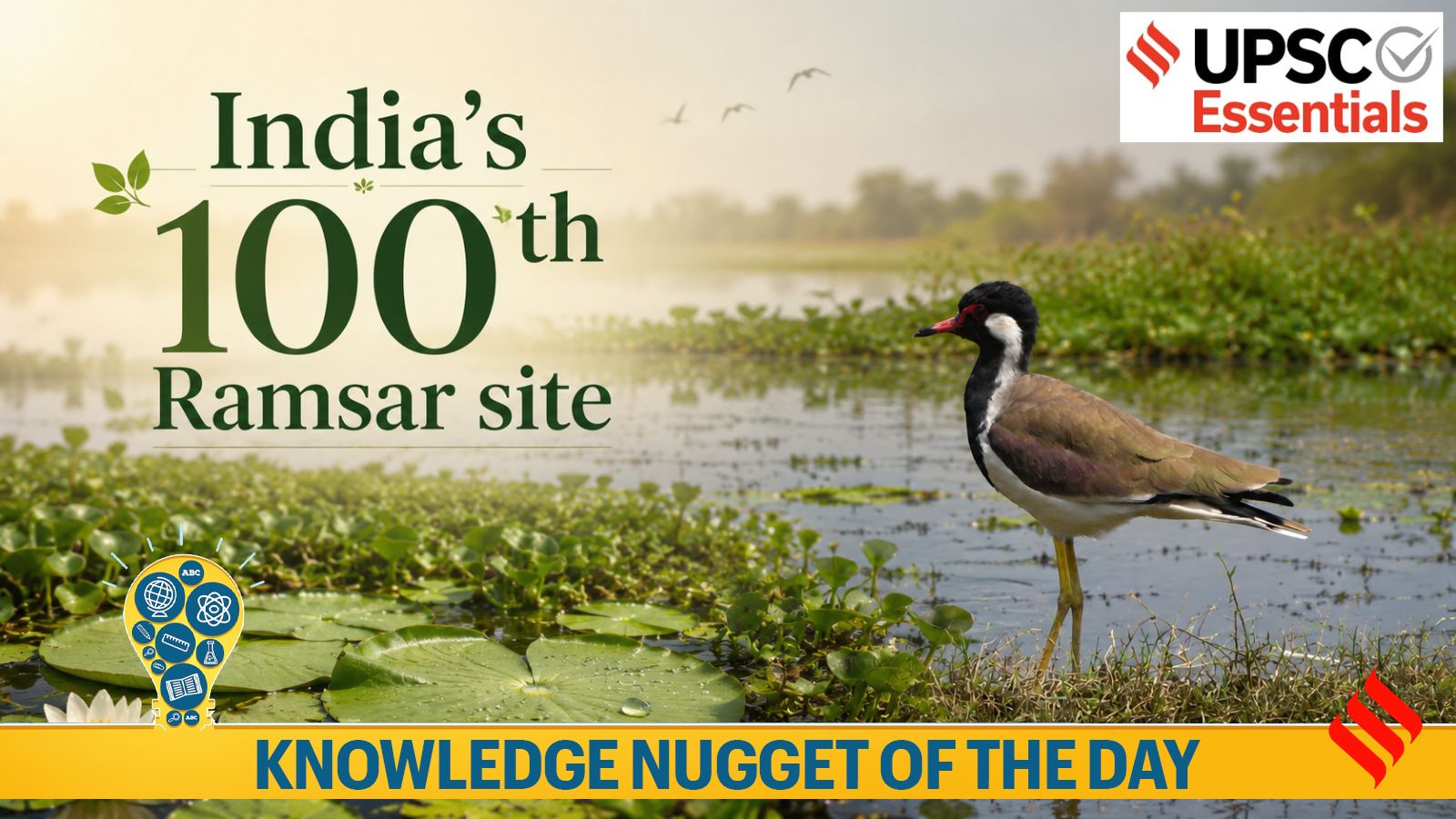
Knowledge Nugget: India adds its 100th Ramsar site — Why are wetlands important?
Take a look at the addition of India’s 100th Ramsar site to the list of Wetlands of International Importance for your UPSC Current Affairs. Understand the definition of wetlands and why the Ramsar Convention was formed in the first place.
On the occasion of World Environment Day, Prime Minister Narendra Modi announced on X the addition of India’s 100th Ramsar site – Jai Prakash Narayan Bird Sanctuary (Surha Tal) in Ballia, Uttar Pradesh, on the list of Wetlands of International Importance. The inclusion of a wetland on the list reflects the government’s commitment to take the necessary steps to ensure its ecological character is maintained.
This achievement highlights India’s growing commitment to wetland conservation—but what makes these ecosystems so crucial?
Key takeaways:
1. In 1991, ‘Surha Taal’ was created with the consolidation of the land area of 45 villages of Baansdih in Ballia town area, aggregating to a total of 3432.93 hectares area. In 2002, its name was changed to “Jai Prakash Narain Bird Sanctuary”.
2. It is situated a distance of 10 kms away from the Ballia City area, stretching up to Bhikampur village to its west, Singhauli in the north-east and bounded by Dulwara Village in the south-east direction. It falls under the jurisdiction of Ballia and Baansdih town area.
3. Surah Taal is a natural perennial oxbow lake (also called a meander lake) which serves as a critical wintering ground for avian species traveling along the Central Asian Flyway. According to UP Eco tourism, it is also a major source of irrigation and groundwater recharge, supporting both wildlife and the nearby farming landscape.
What are wetlands?
1. The Ramsar Convention on Wetlands defines wetlands as “areas of marsh, fen, peat land or water, whether natural or artificial, permanent or temporary, with water that is static or flowing, fresh, brackish or salt, including areas of marine water the depth of which at low tide does not exceed six meters.”
Story continues below this ad
2. However, the Indian government’s definition of wetland excludes river channels, paddy fields and other areas where commercial activity takes place. The Wetlands (Conservation and Management) Rules, 2017 notified by the Union Ministry of Environment, Forest and Climate Change definition of wetlands “does not include river channels, paddy fields, human-made water bodies/ tanks specifically constructed for drinking water purposes and structures specifically constructed for aquaculture, salt production, recreation and irrigation purposes.”
How did the Ramsar Convention come into being?
3. The Ramsar Convention was adopted in 1971 in the city of Ramsar in Iran and came into force in 1975. It was the first intergovernmental agreement focused exclusively on a specific ecosystem, i.e. wetlands.
Do you know?
February 2 is observed annually as World Wetlands Day to raise awareness about conserving one of the most critical ecosystems on the planet. The theme for this year is “Wetlands and traditional knowledge: Celebrating cultural heritage”.
4. The convention rests on the three main pillars: conservation of wetlands of international importance, promotion of the wise use of all wetlands within a country’s territory and international co-operation on shared wetland systems and migratory species.
Infographics by NotebookLM
5. The Convention has 172 signatory countries. They are obligated to create wetland reserves and promote the wise use of wetland habitats. India joined it in 1982, initially designating the Chilika Lake in Odisha and Keoladeo National Park in Rajasthan.
Story continues below this ad
What is the significance of wetlands?
6. Wetlands are one of the most productive ecosystems on the planet. They are the transitional ecosystems between terrestrial and aquatic environments, characterised by the presence of water-either permanently or seasonally- that supports diverse plant and animal life. They are rich in biodiversity and play a crucial role in maintaining the ecological balance.
Although wetlands constitute only around 6 per cent of the Earth’s Land surface, they provide habitat and breeding grounds for nearly 40 per cent of all plant and animal species.
They also provide natural protection to nearly 60 per cent of the global population living along coastlines by mitigating the impact of storm surges, hurricanes and tsunamis.
Wetland also provide provisions to human beings, such as food and fodder, mainly rice and fish, and it also supports livelihoods through fisheries, agriculture and eco-tourism.
They act as natural sponges, absorb excess rainfall, thereby reducing the risk of floods.
As effective carbon sinks, wetlands store carbon in both soil and biomass.
They are often called the ‘kidneys of the landscape’ due to their ability to filter pollutants, purify water and maintain water quality.
What are the threats to wetlands?
7. Despite their significance, wetlands are also one of the earth’s most threatened ecosystems. According to the Ramsar Convention’s Global Wetland Outlook (2025) at least 400 million hectares of wetlands have been lost since 1970, with nearly a quarter of those remaining in a degraded state.
8. “Wetlands provide society with up to $39 trillion in benefits each year—but we continue to lose them at a rate of 0.52% annually”, as per Global Wetland Outlook Report (2025).
“Wetland loss is the reduction in the space where water is available and of sufficient quality for wetland species (and sub-species) to shelter, feed, rest, and reproduce, caused by human activities that significantly alter the ecological character of the wetland. Wetland loss is caused by converting natural wetlands to other land uses, for example, agriculture, aquaculture, forestry, urbanisation, industrialisation, and increasingly for recreational activities.”Story continues below this ad
Global Wetland Outlook Report (2025)
9. Land conversion for agriculture, urbanisation and infrastructure development are the leading reasons behind declining wetland areas. Also, industrial and domestic waste pollute water bodies, and unsustainable farming practices disrupt hydrology. Climate change exacerbates these challenges by altering rainfall patterns and increasing the frequency of extreme events.
BEYOND THE NUGGET: Mangroves
1. Mangrove swamps are coastal wetlands found in tropical and subtropical regions. The Global Wetland Outlook Report 2025 has evaluated eleven broad wetland types that include Mangroves. As per Global Mangrove Watch, 15.11 million ha area is under mangroves.
2. Mangroves are salt-tolerant trees and shrubs typical of estuarine and intertidal regions, meaning they grow in areas where freshwater and saltwater meet. Mangroves typically have aerial, breathing roots and waxy, succulent leaves, and are flowering plants. They thrive in high-rainfall areas (1,000–3,000 mm) with temperatures ranging from 26°C to 35°C.
Do you know?
July 26 is celebrated as the International Day for the Conservation of the Mangrove Ecosystem. It was adopted during the 38th session of the general conference of UNESCO held in 2015.
3. The unique characteristic of mangroves is the way their seeds/propagules germinate. The seeds actually germinate on the tree itself, and then fall off from the tree into the water, taking root only when encumbered by mud and sediment. This is a very unique adaptation in the mangroves that helps them perpetuate in the harsh saline conditions. This phenomenon is scientifically termed vivipary.
Story continues below this ad
4. In 2023, the Ministry of Environment, Forest & Climate Change launched the ‘Mangrove Initiative for Shoreline Habitats & Tangible Incomes (MISHTI)’. It aims to promote and conserve mangroves as a unique, natural ecosystem having very high biological productivity and carbon sequestration potential, besides working as a bio shield.
5. From Gujarat to Andaman & Nicobar Islands, MISHTI brings together 13 coastal States and Union Territories under a common vision of resilient coastlines, ecological restoration, better livelihood opportunities, biodiversity conservation, blue economy growth, and climate action.
Post-Read Question
Which of the following best explain(s) the rationale for protecting mangrove ecosystems in the context of climate resilience? (UPSC CSE 2026)
1. Mangroves reduce tidal energy and store freshwater, making them ideal sites for paddy cultivation in saline estuarine belts.
Story continues below this ad
2. Their salt-sensitive roots filter seawater, making mangroves key to converting coastal land into freshwater aquaculture zones.
3. By withstanding tidal surges and offering biomass resources, mangroves function both as natural bio-shields and livelihood bases for rural communities.
Select the answer using the code given below:
(a) 1 only
(b) 1 and 2
(c) 2 and 3
(d) 3 only
Answer key
(d)
(Sources: upecoboard.up.gov.in, India’s integrated approach to wetland sustainability, What are wetlands, why do they matter for the environment?, What are Ramsar Sites, and what is the significance of the listing?, UPSC Issue at a Glance | Mangroves in focus: Understanding significance, threats and conservation)
Subscribe to our UPSC newsletter. Stay updated with the latest UPSC articles by joining our Telegram channel – IndianExpress UPSC Hub, and follow us on Instagram and X.
Story continues below this ad
🚨 Click Here to read the UPSC Essentials magazine for May 2026. Share your views and suggestions in the comment box or at [email protected]🚨
View original source — Indian Express ↗
More from Technology

Indian Express
TechnologyJun 5, 2026 · 1 min
JVPD flyover work gathers steam
Indian Express

The Local
TechnologyJun 5, 2026 · 1 min
Florence extends tourist let ban to wider city neighbourhoods
The Local
The Guardian
TechnologyJun 5, 2026 · 1 min
Typhoon Jangmi sweeps northwards leaving 23 injured in Japan
The Guardian