The Next Web
Mira Murati resurfaces after 18 months with a warning about AI governance and a product no one expected
TL;DR
Former OpenAI CTO Mira Murati made her first major public appearance in 18 months, previewing Thinking Machines Lab’s “interaction models” and arguing that the AI industry lacks structural governance checks. She also addressed researcher departures and reflected on the 2023 Altman firing.
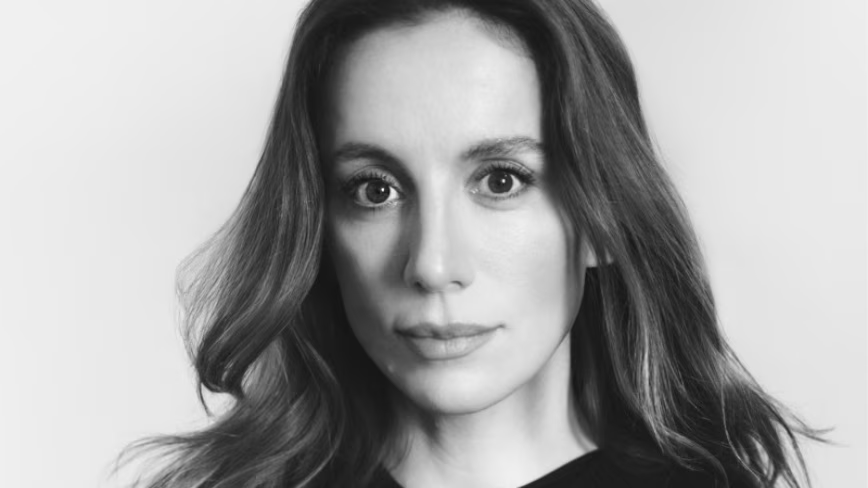
For someone who helped ship ChatGPT, DALL-E, and Codex, Mira Murati has been remarkably quiet. On Thursday, she broke the silence. Sitting down with Bloomberg’s Emily Chang in San Francisco, the CEO of Thinking Machines Lab gave her first major media appearance in roughly 18 months, a carefully managed re-entry into a conversation that has moved at breakneck speed without her.
The timing was not accidental. Thinking Machines has spent that year and a half raising $2 billion, securing a gigawatt of Nvidia Vera Rubin compute, shipping one product, and losing a troubling number of the researchers it hired to build the next one. The AI landscape Murati left behind when she departed OpenAI in September 2024 looks nothing like the one she re-entered on Thursday.
The product: interaction models
Murati used the appearance to preview what Thinking Machines is calling “interaction models,” a fundamentally different kind of AI interface. Rather than the prompt-and-response format that defines most AI products, the company’s models are designed to process continuous streams of audio, text, and video in 200-millisecond intervals.
The pitch is that these models can pick up on the texture of human communication: interruptions, mid-thought corrections, pauses. The technical term is “full duplex,” and the company claims its TML-Interaction-Small model responds in 0.40 seconds, roughly the speed of natural conversation. It fits Thinking Machines’ founding thesis that powerful AI requires closer human collaboration, not less of it.
Murati was careful to frame this as a first step. She declined to put a release date on anything, and she positioned the work alongside Tinker, the company’s API for fine-tuning open-source models, which launched in October 2025 and remains its only shipping product.
The departures
Chang pressed Murati on what has quietly become the company’s most visible problem: a string of high-profile departures. Co-founder and CTO Barret Zoph, co-founder Luke Metz, and founding team member Sam Schoenholz all returned to OpenAI in January. Five founding members have gone to Meta, reportedly lured by compensation packages that reach into nine figures.
Murati downplayed the exits. Building a frontier AI lab from scratch compresses years of normal organisational volatility into months, she said. She acknowledged that the nine-figure packages now standard in the AI talent war capture imaginations, but suggested compensation is rarely the whole story.
“When I wake up in the morning, I am not thinking about how to kill the competitor,” she said, drawing laughter from the audience. The line was disarming, but the competitive reality is stark. OpenAI is everywhere. Anthropic has raised $30 billion and reportedly attracted investor offers at an $800 billion valuation. Elon Musk’s xAI has been folded into SpaceX ahead of a record IPO. In that environment, staying quiet has costs.
The Altman firing, revisited
Chang asked about the episode that first made Murati a public figure: the chaotic five days in November 2023 when OpenAI’s board fired Sam Altman and Murati became interim CEO. Inside OpenAI, the incident came to be called “the blip.”
Murati said she felt clear about her decisions in each moment, that protecting the mission and the team was the thread that made the choices feel obvious even as the situation looked like it was falling apart from outside. She said the company would have “imploded” without her involvement through that stretch. But she acknowledged that clarity of intent is not the same as clarity about consequences, and said she would have pushed harder for more information, a better transition plan, and more transparency.
Asked whether she still trusts Altman, she sidestepped. What she offered instead was more interesting: a broader argument about the concentration of consequential decisions in too few hands, not just at OpenAI but across the industry. Her concern, she said, is less about the character of any individual leader and more about the absence of structural checks. Good people make bad calls. Well-intentioned organisations drift.
The harder question
On the future of AI broadly, Murati pushed back on both the dystopian and utopian framings. Neither outcome is predetermined, she argued. The period we are in right now is the one that will determine which way things go.
But she returned, more than once, to a theme that connects her governance critique to her product philosophy: if humans take their hands off the wheel too soon, the future will look very different, and not better. It is a position that sits comfortably with her company’s thesis about human-AI collaboration. Whether it can survive contact with a market that rewards speed, scale, and tens of billions in capital over caution is the question Murati did not answer on Thursday.
She does not need to answer it yet. But with one product shipping, a team that keeps shrinking at the top, and competitors that grow louder by the week, the window for quiet conviction is closing.
View original source — The Next Web ↗
More from Technology

The Punch
TechnologyJun 5, 2026 · 1 min
Ukrainian sea drone explodes in Romanian port
The Punch

TechRadar
TechnologyJun 5, 2026 · 1 min
This $1.33 per month VPN is the most customizable option out there
TechRadar
The Guardian
TechnologyJun 5, 2026 · 1 min
Anthropic urges ‘temporary pause’ on AI development to discuss risks
The Guardian