Indian Express
Maulana Barkatullah: The ‘first prime minister of India’, whose name Bhopal university wants to drop
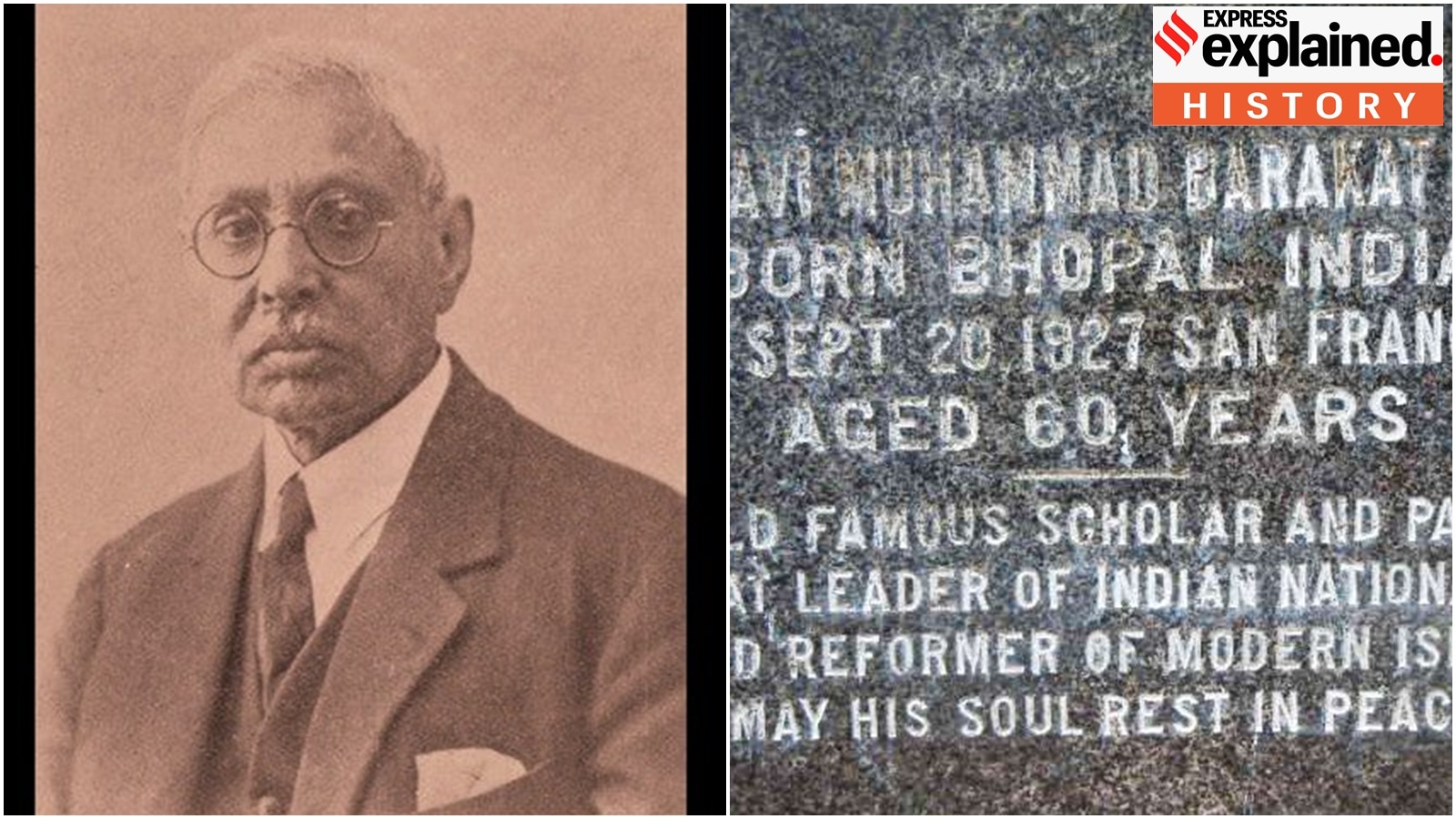
Maulana Barkatullah Bhopali was a freedom fighter and the ‘first prime minister of independent India’, as he along with some associates, most notably Raja Mahendra Pratap, set up India’s first ‘government in exile’ in Kabul in 1915.
“Maulana Barkatullah devoted his life to working for India’s freedom abroad. From Japan to England to US to Germany to Russia to Afghanistan, he travelled to several countries, creating awareness for and building alliances to usher in India’s independence. He died in 1927 in the US, which is probably why his activities weren’t widely known back home. The recognition given to him in 1988, by naming a university after him in his hometown, had been a long-due honour,” said Chaman Lal, Honorary Advisor, Bhagat Singh Archives and Resource Centre, New Delhi, and retired JNU professor.
Lal said instead of changing the university’s name, more should be done to popularise the legacy of Barkatullah.
Maulana Barkatullah’s beliefs, ideals
Maulana Barkatullah is believed to have been born on July 7, 1854, in Bhopal. A meritorious student, he went to Bombay and then London for studies. He then started teaching in Liverpool, where he came into contact with Indian revolutionaries. His articles and speeches attracted negative attention of the British government, after which he left for the US in 1899. Here, he corresponded with the freedom fighter Maulana Hasrat Mohani (who coined the slogan Inquilab Zindabad). The letters give a clear idea of his views.
An article by Iqbal Husain that appeared in the Proceedings of the Indian History Congress, Vol. 66 (2005-2006), quotes from one of the letters. “Nearly 20 million people have perished due to starvation and hunger. These poverty-stricken people were both Hindus and Muslims… an entire country has perished due to hunger,” Barkatullah wrote.
Barkatullah firmly believed that the British could be driven out of India only if Hindus and Muslims fought shoulder to shoulder and resisted the divide-and-rule ploy.
Story continues below this ad
“What makes Barkatullah special is his strong belief that India could only be free if all its communities stood together. He worked closely with Hindus, Muslims, Sikhs, and people from every region,” Ali Nadeem Rezavi, Secretary, Indian History Congress and Professor of History at Aligarh Muslim University (AMU), said.
“The best example of this is the Provisional Government of India that was set up in Kabul in 1915. He, along with Raja Mahendra Pratap, a Hindu prince, and Maulana Ubaidullah Sindhi, a great Islamic thinker, formed a government in exile. Raja Mahendra Pratap became president, and Barkatullah became prime minister. This was one of the first times that Indians had set up their own independent political body outside British control. This story is important not just because it challenged the British, but because it showed a vision of India where people of different faiths fought side by side for a common goal,” Rezavi added.
Incidentally, Mahendra Pratap, the Raja of Hathras, worked hard for the formation of AMU and gave land to the college.
Government in Kabul, meeting Lenin
During World War I, Barkatullah and his associates travelled to Germany and tried to convince Indian soldiers captured by the Germans to form an army to fight the British. He also worked prominently for the Ghadar Party, founded by Lala Har Dayal in 1913, which wanted to win India’s independence through armed struggle.
Story continues below this ad
Then on December 1, 1915, the ‘Provisional Government of India’ was formed in Kabul. Four years later, the leaders of this ‘government’ travelled to Moscow to meet Vladimir Lenin, the head of government of Soviet Russia. In Russia, Barkatullah made the statement, “I am neither a Communist nor a Socialist, but my political programme entails the expulsion of the British from Asia. I am an implacable foe of the capitalisation of Asia by Europe, the principal representatives of which are the British. In this I approximate to the Communists, and in this respect we are natural allies,” as cited in the Indian History Congress journal mentioned above.
After the British victory in the First World War, the Indian revolutionaries’ plans suffered major reverses. However, Barkatullah kept travelling, to Brussels, Switzerland, France, etc., working for his cause.
“Unlike many freedom fighters who worked from inside the country, Barkatullah spent most of his life in exile. He connected with anti‑colonial movements around the world and became one of the most well‑known Indian revolutionaries of his time. Inspired by resistance efforts in the Muslim world, he believed that justice was a global cause and that India’s freedom was part of that larger fight,” Rezavi said.
In 1927, despite his failing health, he travelled to California in the US for a Ghadar Party event. This is where, in September 1927, he breathed his last. He was laid to rest in Sacramento, with Raja Mahendra Pratap by his side till the end.
Story continues below this ad
Both Rezavi and Chaman Lal pointed out that the central government is working to popularise Raja Mahendra Pratap, and as his close associate, Barkatullah should get the same treatment.
View original source — Indian Express ↗
More from Technology

The Punch
TechnologyJun 5, 2026 · 1 min
Ukrainian sea drone explodes in Romanian port
The Punch

TechRadar
TechnologyJun 5, 2026 · 1 min
This $1.33 per month VPN is the most customizable option out there
TechRadar
The Guardian
TechnologyJun 5, 2026 · 1 min
Anthropic urges ‘temporary pause’ on AI development to discuss risks
The Guardian