Indian Express
Can spring groundnut mitigate Punjab’s groundwater crisis?
Punjab is battling one of the country’s worst groundwater crises, first from paddy cultivation and now the rapid expansion of spring/summer maize.
Spring/summer maize, a highly irrigated crop, is grown between the rabi (early winter) and kharif (monsoon) seasons during the hottest months of the year, before paddy transplantation. It is different from kharif maize, a diversification alternative to paddy which is cultivated during the monsoon, when there is ample water.
Concerns over spring maize cultivation— which has touched an all-time high area of eight lakh acres this year — has prompted scientists at Krishi Vigyan Kendra (KVK), Kapurthala, under Punjab Agricultural University (PAU), Ludhiana, to promote spring groundnut as a more sustainable alternative.
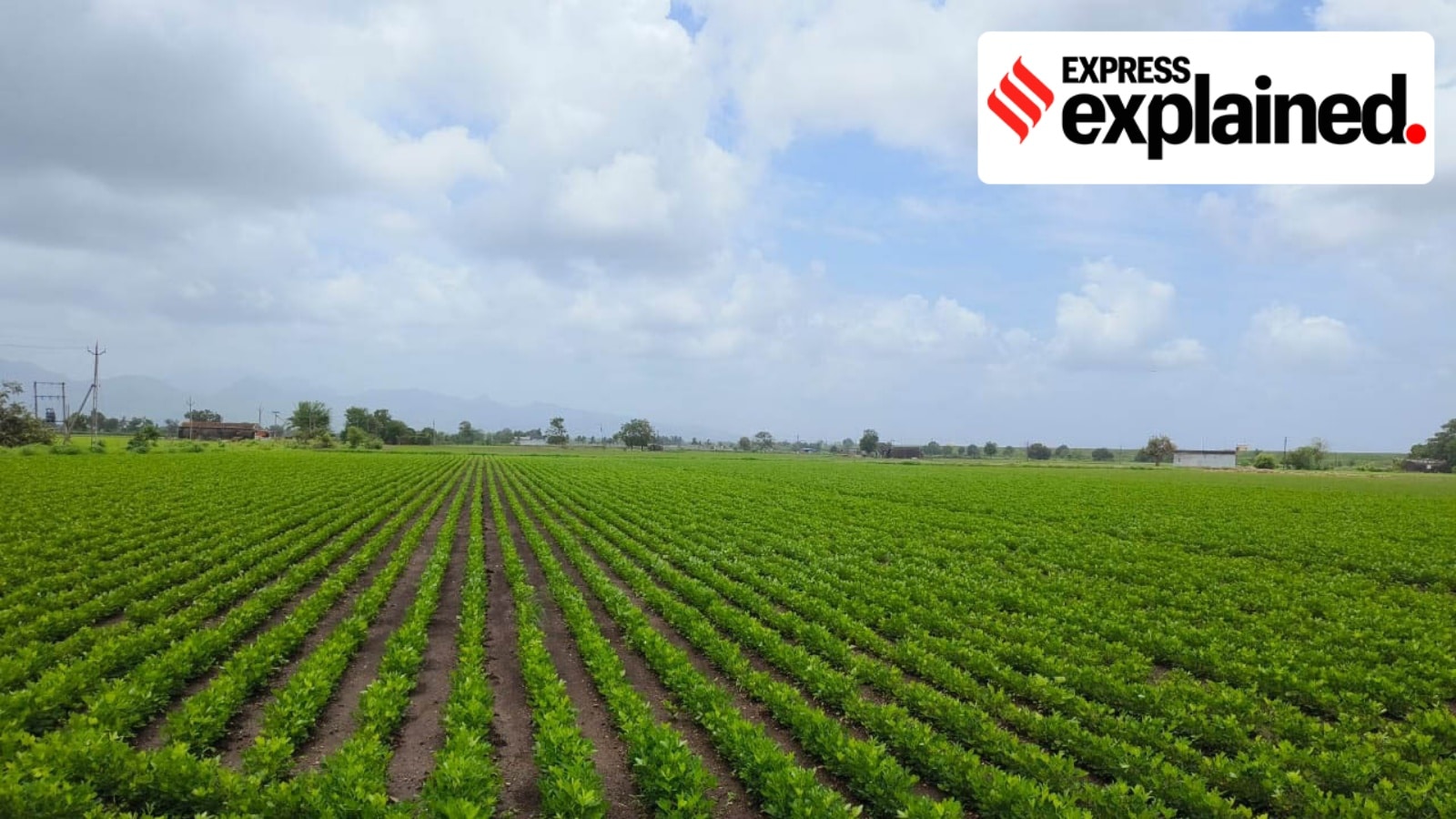
The crop is grown during the same period as spring maize but requires substantially less irrigation while offering higher profitability and significant soil-health benefits.
Here’s a look at why scientists and environmentalists are promoting spring groundnut as an alternative to spring maize.
Consumes much less water
Depending on soil type and sowing time, spring maize requires 12-19 rounds of irrigation and, in many instances, as many as 18-22 rounds during a crop duration of barely 90-100 days. At a time when groundwater levels continue to decline across large parts of Punjab due to its paddy cultivation, agricultural experts argue that the state cannot afford another water-guzzling crop.
Spring groundnut requires only a fraction of the water consumed by spring maize.
Story continues below this ad
According to demonstrations conducted by KVK Kapurthala, spring groundnut requires only three to six irrigations and, in most cases, performs successfully with just four irrigations. This is much lower than the irrigations required for spring maize.
The crop is particularly suited to light and medium-textured soils with proper drainage. Since Punjab’s spring-summer season often experiences high humidity, good drainage management becomes important for achieving optimum yields.
Better economics
Dr Harinder Singh, in-charge, KVK Kapurthala, says Punjab’s groundwater situation requires alternatives that can reduce water extraction without reducing farm income.
This is where spring groundnut appears to have a distinct advantage.
Story continues below this ad
According to KVK Kapurthala demonstrations, spring groundnut can generate additional profits of Rs 15,000-20,000 per acre over spring maize.
Cultivating spring maize generally requires between Rs 18,500 and Rs 22,500 per acre. Spring groundnut, by comparison, costs only Rs 8,000-10,000 per acre, largely because of lower irrigation requirements and reduced input costs with mechanisation.
Groundnut yields of 15-16 quintals per acre have been consistently recorded in demonstration plots, with some farmers obtaining yields as high as 16 quintals per acre. At prevailing market prices of about Rs 7,200 per quintal, farmers can earn gross returns of around Rs 1,15,000 per acre.
Story continues below this ad
Spring maize generally yields around 40 quintals per acre and, even when sold at the minimum support price (MSP) of Rs 2,410 per quintal, generates gross returns of about Rs 96,000 per acre.
As a result, net returns from spring maize generally range between Rs 74,000 and Rs 78,000 per acre. Spring groundnut, meanwhile, delivers net returns of more than Rs 1 lakh per acre.
Dr Singh highlights another advantage: Groundnut residue is highly valued as fodder for horses and goats and can fetch Rs 1,200-1,300 per quintal, generating an additional income of Rs 5,000-6,000 per acre.
Farmer Jarnail Singh, who cultivated groundnut on 26 acres at Mothanwali village this year, and his fellow farmers Jagtar Singh and Balbir Singh, who dedicated 10 and five acres respectively to the crop, all told The Indian Express that groundnut required fewer inputs and delivered better profitability than spring maize.
Boosting soil health
Story continues below this ad
Scientists point out that one of groundnut’s biggest strengths lies beneath the soil surface.
“Being a leguminous crop, groundnut fixes atmospheric nitrogen through root nodules. The crop can fix between 25 and 60 kg of nitrogen per hectare. This allows farmers to save approximately one to one-and-a-half bags of urea in the following crop,” said Dr Mandeep Singh, Assistant Professor, KVK Kapurthala.
He said that biological nitrogen fixation not only reduces fertiliser costs but also strengthens long-term soil sustainability. For farmers facing rising fertiliser prices, this hidden benefit significantly improves overall profitability.
“Unlike maize, which continuously removes nutrients from the soil and creates humid conditions that can adversely affect subsequent crops, groundnut enriches soil fertility, improves microbial activity and helps break pest and disease cycles in intensive cropping systems. It also benefits melon crops that are grown during the same season,” he said.
Why groundnut matters beyond diversification
Story continues below this ad
Scientists say that promoting groundnut is not merely about crop diversification. It is also linked to nutritional security, edible oil security and export earnings.
India accounts for nearly 18% of global groundnut exports and earns approximately Rs 7,000 crore annually in foreign exchange through exports of groundnut and value-added products.
According to the Agricultural and Processed Food Products Export Development Authority, India exported 7,46,319 metric tonnes of groundnut worth $794.97 million during 2024–25.
Story continues below this ad
Groundnut kernels contain about 26% protein and nearly 50% oil, making them an affordable and nutritious food source.
The crop supports a wide range of industries producing peanut butter, peanut milk, peanut flour, edible oil, roasted peanuts and traditional snack products.
Are farmers likely to adopt it?
Scientists believe so. The recommended J-87 variety developed by PAU is generally sown during the second half of February, particularly after the potato harvest. Under Punjab’s conditions, the crop matures in about 110-115 days.
Importantly, farmers can also grow another groundnut crop during the kharif season. This creates an opportunity to replace the conventional paddy crop, which typically requires 22-30 irrigations during the kharif season.
Story continues below this ad
On Saturday, KVK Kapurthala organised a field day to promote the crop. PAU Vice-Chancellor Dr Satbir Singh Gosal, and environmentalist and Rajya Sabha MP Baba Balbir Singh Seechewal participated and spoke with farmers.
“The main objective of the field day is to educate farmers about the environmental and economic advantages of replacing spring/summer maize with spring groundnut,” said Dr Gosal.
“Punjab needs maize during the kharif season as part of crop diversification, not during the summer season,” he said, citing its high water requirement.
For a state searching for sustainable alternatives, the crop presents an opportunity to align farm profitability with groundwater conservation, said Seechewal.
View original source — Indian Express ↗
More from Technology

Lovin Malta
TechnologyJun 6, 2026 · 1 min
Two Vehicles Engulfed In Flames In Żebbuġ Fire
Lovin Malta

Indian Express
TechnologyJun 6, 2026 · 1 min
Maharashtra puts proposed Devasthan land law on hold after objections, hearings till Aug 15
Indian Express

Dawn
TechnologyJun 6, 2026 · 1 min
Hundreds join protest led by India's viral 'Cockroach Party'
Dawn