CNA
CNA··5 min read
My nine-year-old spends more time at ballet than tuition. And I'm not worried
The average Singaporean primary schooler spends three hours a week in tuition.
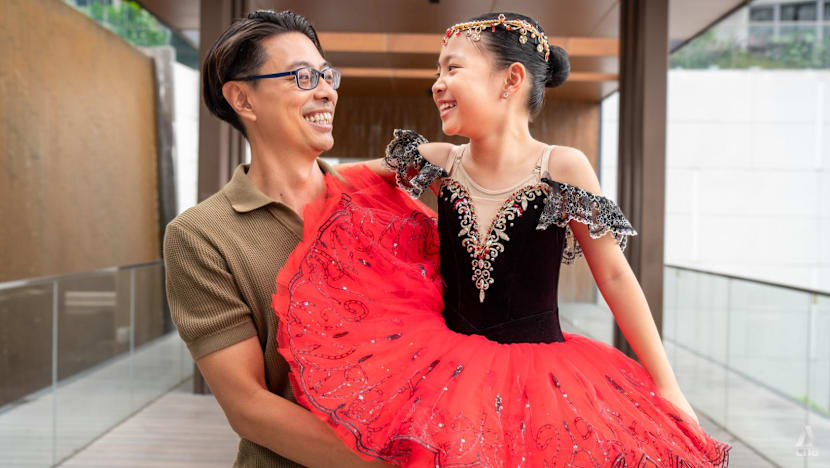
My nine-year-old daughter Claire spends double that time in a dance studio.
At 8pm on a Friday night, she's volunteering to stay behind after her ballet class. Not to practise her dance moves, but to be a teaching apprentice instead.
Shadowing her teacher, Claire helps younger dancers correct their posture and maintain their ballet poses, among other things.
In a society built on efficiency, risk aversion and ROI (return on investment), backing my daughter to spend that much time developing an interest or a potential career outside the typical Singaporean aspiration list of doctors and lawyers raises plenty of eyebrows.
This is especially evident during family dinners and gatherings, when questions about her apprenticeship focus on how it'll affect her job prospects in adulthood.
"But what's she really going to do in the future?"
"I hope you're not neglecting her schoolwork."
"You should shift some of your budget to enrichment classes instead."
Although these are well-meaning critiques, we're holding fast to our belief that this decision to let her spend more time at her ballet school rather than in a tuition class will serve her well in an uncertain future.
Our belief isn't based on blind idealism or the "follow your passion" cliche.
In a future where analytical reports, illustrations, videos and mathematical problems can be generated with artificial intelligence (AI) and solved in a matter of seconds, a pertinent question is whether current curricula are adequate or even relevant for her future.
And so, will surviving, or even thriving, in the current system really deliver education's implicit promise?
WHAT I SEE IN THE EDUCATION REALM
To be clear, I'm definitely not neglecting my daughter's education. She attends weekly Chinese tuition classes with her eight-year-old brother.
Every day, I see the value of a strong academic foundation, as my wife and I run an online education centre helping students who struggle with their science subjects.
When our students first enrol, we notice that they are often unsure about the subject and have little confidence in engaging in discussions about science. Then, as they learn and gradually build their mastery of the subject, they begin to speak up, share their opinions and carry themselves with confidence.
But from my vantage point, I also see the cracks.
In an uncertain future, the advantage people will have won't be from memorising a textbook or just academics.
Rather, what will give my daughter a leg up is to specialise in something that is difficult to replicate – perhaps a skill set like being able to communicate well with different audiences – paired with interpersonal intelligence and the values required to lead a room.
FROM DIRECTING CHILDREN TO FOLLOWING THEIR LEAD
There is an assumption that parents know what Is best for our children's futures, be it the subjects they take in class, how they spend their free time and the careers they should pick.
That we're the directors, and our children are merely following our script.
But I've learnt that it doesn't need to be the parents taking charge.
With Claire, we're not pushing her to leap high at the ballet studio; we're often the ones trying to keep up with her pace.
She often asks for more time to observe other dancers' routines, or to help her dance teacher guide younger students through their routines.
My Friday evenings were once spent unwinding from the week. Now, I find myself stuck in my car waiting for her to complete her ballet class.
And when I do get a chance to peek at her sessions, I see her showing empathy for the younger girls' problems and struggles.
I see her experimenting with different forms of communication to lead, encourage and instruct others.
I see her developing the ability to think and feel beyond her own goals and challenges – to fully experience and share in the collective emotions of successes and failures on stage with her fellow dancers.
So when Claire initiated a conversation about how excited she would be to open her own ballet school one day, my wife and I were confident.
Our confidence is not from a place of arrogance, but from witnessing hours of almost torturous repetition, the discipline to show up even when it hurts and the grit to power through tough times while maintaining poise and elegance.
Values that would certainly put her in good standing to learn, build or improve any soft or hard skill sets required in the future – even if it's not starting her own ballet school.
Her current ballet school's motto is "Dance as an Education", and I couldn't agree more.
FINDING THE COURAGE TO GO OFF SCRIPT
The scepticism we face at family gatherings about Claire's dedication to ballet is understandable. It comes from a place of love, but also from a fear that walking off the beaten path leads one straight off a cliff.
However, what I fear more is raising my children to be generic.
If we continue to push our children toward a safe middle ground, we are preparing them for a world that AI will likely make obsolete.
We're betting they'll take up traditional jobs that will not be affected by technological advancements, without the fail-safe ability to adapt in a rapidly changing world.
What our children really need is the confidence and ability to move away from what we see today as "safe options" for a stable career. Because the reality is, there's no clear image of what a stable career will look like in the future.
What it may require is a fundamental shift in the Singaporean parenting mindset – from being the stage director of our children's lives to being their stagehands.
It may mean providing the financial, emotional or logistical means to support a vision they believe in; trusting that letting them pursue what their curious minds envision will allow them to learn something that textbooks can't teach.
Choosing this path is uncomfortable, yes.
You will be judged at dinners, but you have to keep faith that the specialised mastery your child chooses and the experiences lived outside of school are every bit as important as being a top scorer in English, mathematics or science.
If we want our children to stay resilient and thrive in the future, that change has to start at home. We have to be willing to let go of our own outdated scripts to let them write their own.
And as a parent in the education industry, I'm starting with the man in the mirror.
Roystonn Loh is an entrepreneur and father of three who manages an education business in Singapore.
More from newsGlobal

Portugal Resident
PoliticsJun 6, 2026 · 1 min
People power mobilises against solar/ wind mega-projects
Portugal Resident

Straits Times
PoliticsJun 6, 2026 · 1 min
Israeli strike in Gaza kills seven people, including two women, medics say
Straits Times

Al Jazeera
PoliticsJun 6, 2026 · 1 min
‘I’m a cockroach’: Gen Z protest movement lands in Indian capital
Al Jazeera