Indian Express
Indian Express··6 min read
No textbooks, just life skills: How 2-year-olds in Punjab are learning independence via Montessori
Two-year-old Sahib Kaur enters the classroom with purpose.
Inside a brightly arranged Anganwadi centre in Hoshiarpur district, the toddler walks to a corner, picks up her neatly rolled mat and carefully spreads it on the floor. She then gestures to her teacher, Gitika, asking her to sit nearby.
A few moments later, she brings two cups — one containing pulses and the other empty. Settling down on the mat, she slowly pours the pulses from one cup into the other with remarkable concentration, ensuring that hardly a grain falls outside.
For most adults, it may seem like a simple childhood exercise. For Montessori educators, however, it represents much more: hand-eye coordination, concentration, fine motor development, independence, patience and confidence.
Sahib is among hundreds of children participating in a pioneering Montessori Education Project launched by the District Red Cross Society (DRCS), Hoshiarpur, across 50 government Anganwadis and pre-primary schools in the district.
The same spirit of purposeful activity can be seen in other centres. Tiny children carefully roll and unroll mats, return learning materials to designated shelves after use, fold cloth pieces, clean tables and chairs with dusting cloths, wash and dry their hands independently, and care for plants. Others sort objects, identify colours and shapes, and engage in activities designed to build concentration and self-reliance.
These are not conventional classroom lessons. Instead, they form part of a child-centred approach that encourages youngsters to learn through experience, movement and exploration while developing independence, discipline, hygiene habits, problem-solving abilities and practical life skills.
Story continues below this ad
A quiet revolution in early learning
“It is the first initiative of its kind in Punjab’s government Anganwadis,” says Gitika, an MA, BEd, who works as an Anganwadi worker in Nandachaur village.
Though the Montessori Education Project was conceived only this year, it has begun taking shape under the leadership of Deputy Commissioner-cum-President of the DRCS, Hoshiarpur, Aashika Jain.
Traditionally associated with blood donation drives, disaster response, first-aid training and humanitarian assistance, the Red Cross in Hoshiarpur has ventured into an entirely different domain — early childhood education.
The initiative is being described as the first structured effort to introduce Montessori-based learning on such a scale in Punjab’s government Anganwadis and pre-primary schools.
Story continues below this ad
Implemented through the DRCS, the project is supported by Kuantum Papers Limited, Saila Khurd, under its Corporate Social Responsibility (CSR) programme. Academic and technical guidance is being provided by Vivek High Montessori Institute (VHMI), Chandigarh, one of North India’s leading Montessori training institutions. VHMI is affiliated with international Montessori organisations and has extensive experience in educator training.
“This project was conceived with the belief that every child, irrespective of economic background or geographical location, deserves access to quality early childhood education,” says Aashika Jain.
“The first six years of life are critical for a child’s cognitive, emotional and social development. Through this initiative, we are creating learning environments where children learn naturally through exploration, activity and experience rather than rote methods. Our objective is to transform government Anganwadis, which cater to children from birth to two years, and pre-primary schools for children aged three to under six years into vibrant centres of learning and child development,” she says.
By equipping remote Anganwadis with international-standard Montessori materials and specialised teacher training (Express photo/Special arrangement).
Learning by doing, not memorising
The philosophy behind Montessori education differs significantly from traditional classroom practices, where learning is often centred on books, instructions and repetition.
Story continues below this ad
At participating centres, activities are carefully designed for each child’s age and developmental stage.
“They learn how to carry materials carefully, return them after use, clean their surroundings, care for plants, wash their hands, fold cloths, identify shapes and colours, sort objects into different categories, improve hand-eye coordination and develop concentration,” says Gitika.
Rajni Devi, who teaches the pre-primary class at Government Primary School, Singariwal, says the difference becomes visible very quickly.
“Children begin displaying confidence and independence at a very young age. This system introduces essential life skills at the very beginning of their lives. Parents also need to understand its importance because these lessons go far beyond academics,” she says.
Story continues below this ad
She adds that such activities help strengthen children’s grip, improve hand movements and reinforce personal hygiene habits.
A Montessori trainer associated with the programme explains: “The idea is not simply to teach children a task but to help them develop life skills. When a child learns to roll a mat, clean a table, pour material from one container into another, or fold a handkerchief, they are also learning responsibility, order, focus and self-confidence.”
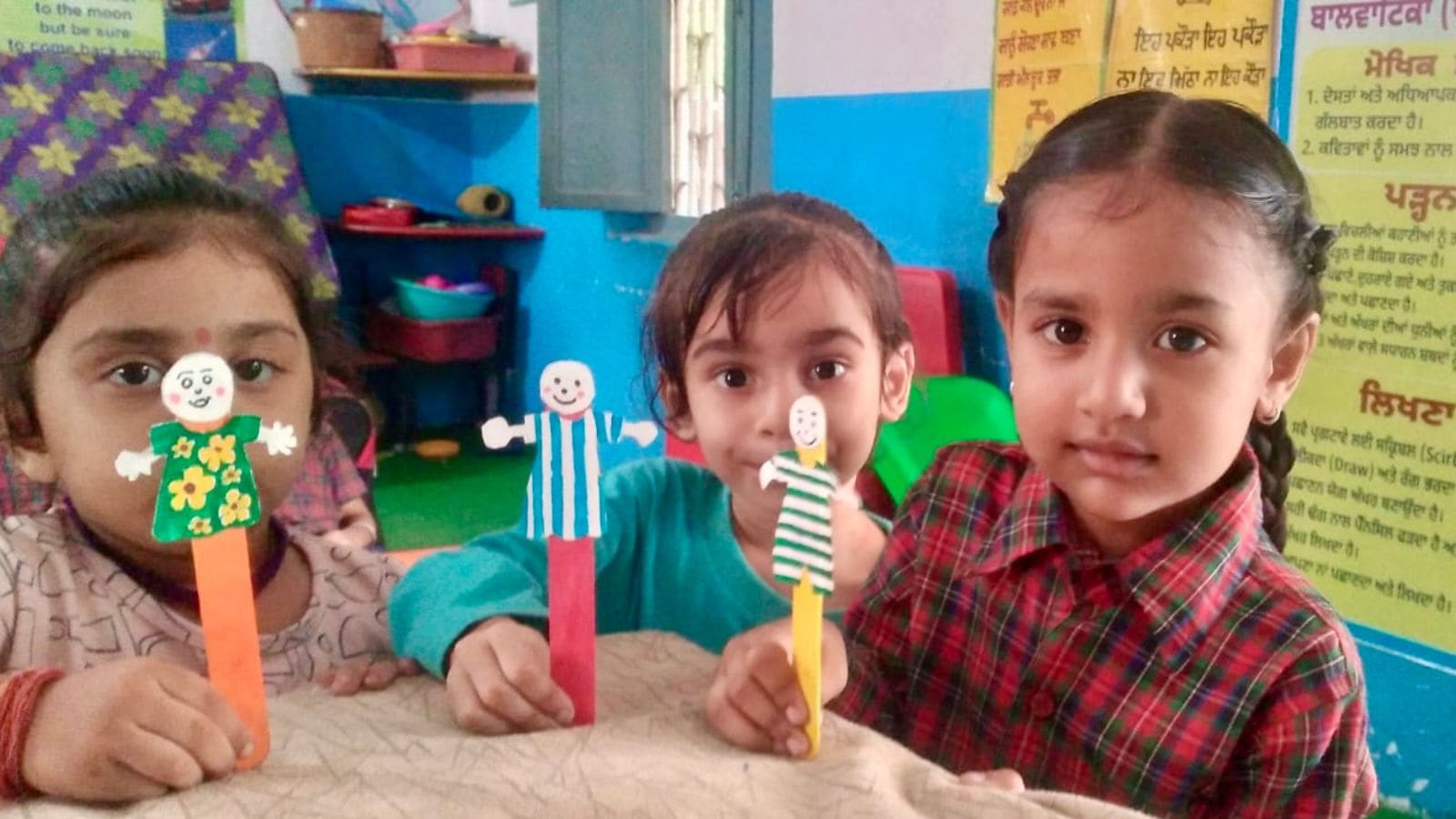
The programme aims to bridge the systemic quality gap for thousands of children long before they open their first textbook (Express photo/Special arrangement).
Building a model for Punjab
According to Mangesh Sood, Secretary of the District Red Cross Society, the programme has been launched as a pilot covering 25 Anganwadis and 25 pre-primary schools across Hoshiarpur district.
“The model has been designed not merely as a pilot but as a blueprint for future expansion across the district,” he says.
Story continues below this ad
The initiative is particularly significant in Hoshiarpur, a predominantly semi-hilly district with a large Kandi belt.
“Many children in remote villages have limited access to quality early childhood education because of geographical constraints, scattered settlements and limited educational resources,” says Aditya Rana, Joint Secretary, DRCS.
“By introducing Montessori education directly within local Anganwadis and schools, we can help bridge these gaps and ensure that children receive strong foundational learning regardless of where they live or the family they come from.”
Each selected institution is being redesigned as a Montessori learning centre equipped with age-appropriate furniture, educational apparatus, teaching-learning materials and specialised resources. The aim is to create stimulating spaces that nurture curiosity, creativity and independent exploration.
Story continues below this ad
The equipment is being procured through CSR funding, while VHMI Chandigarh will support the initiative for one year through training, mentoring and technical assistance. The overall project cost is estimated at nearly Rs 1 crore.
Changing teachers, changing classrooms
Recognising that meaningful educational reform begins with educators, the programme places strong emphasis on capacity building.
Nineteen Anganwadi supervisors have already undergone intensive hands-on classroom training.
Training sessions for Anganwadi workers and pre-primary teachers are being conducted in phases and cover Montessori philosophy, classroom management, child psychology, practical life activities and activity-based teaching methodologies.
Story continues below this ad
VHMI Chandigarh is also providing continuous mentoring, classroom observation and academic support to ensure that Montessori principles are implemented effectively and consistently.
“We are not merely changing classrooms; we are changing the entire approach to early childhood education,” says Aashika Jain.
“Teachers are becoming facilitators of learning. Children are being encouraged to explore, discover and learn independently. This shift has the potential to significantly improve school readiness and long-term learning outcomes.”
Alongside the district-wide pilot, the existing Balvatika Crèche operated by the DRCS is being upgraded into a state-of-the-art Montessori Model Centre. The facility will serve as a demonstration hub where teachers, supervisors and Anganwadi workers can observe best practices and gain practical exposure to Montessori methodologies.
The first phase of the project will soon be evaluated.
From 2,000 children to 20,000
In its initial phase, the initiative is expected to directly benefit nearly 2,000 children. If successful, it could eventually be expanded to cover all Anganwadis in Hoshiarpur district, potentially reaching close to 20,000 children.
“Our aim is to create a model that can be replicated across the entire district. Every child deserves the opportunity to learn in an environment that nurtures curiosity, confidence, independence and creativity. If we invest in children during their formative years, we are investing in the future of society itself,” she says.
Back in the classroom, Sahib Kaur carefully gathers her materials after completing the pouring exercise. The cups are returned to their place. The mat is rolled up once again.
The task may seem small, but it reflects a larger transformation underway in Hoshiarpur — one that seeks to build confidence, responsibility and a love for learning long before children open their first textbook.
View original source — Indian Express ↗
More from newsGlobal

The Punch
PoliticsJun 7, 2026 · 1 min
NANS slams LAUTECH over student suspensions, plans Monday protest
The Punch
The Punch
PoliticsJun 7, 2026 · 1 min
Shettima visits Ekiti to inaugurate projects Tuesday
The Punch

Euronews
PoliticsJun 7, 2026 · 1 min
European leaders to meet Zelenskyy at Downing Street as pressure mounts on Russia
Euronews