The Guardian
A priceless book of Yiddish songs from the Holocaust lay in a Sydney cupboard for decades – now it has been rescued
Even under conditions of extreme inhumanity, humanity has the capacity to find solace in creative expression.
In the concentration camps and ghettoes of Europe under the Nazi regime, music became a sanctuary, a way to preserve Jewish identity, process trauma and maintain a historical record. A small chapter of this vast record, which resurfaced in Sydney, represents one of the earliest printed collections of Holocaust songs.
Australia became home to one of the world’s largest populations of Holocaust survivors outside Israel after the second world war. The influx of refugees fundamentally shaped the postwar multicultural fabric of Sydney and Melbourne, importing deep, intergenerational trauma along with extraordinary stories of endurance and survival.
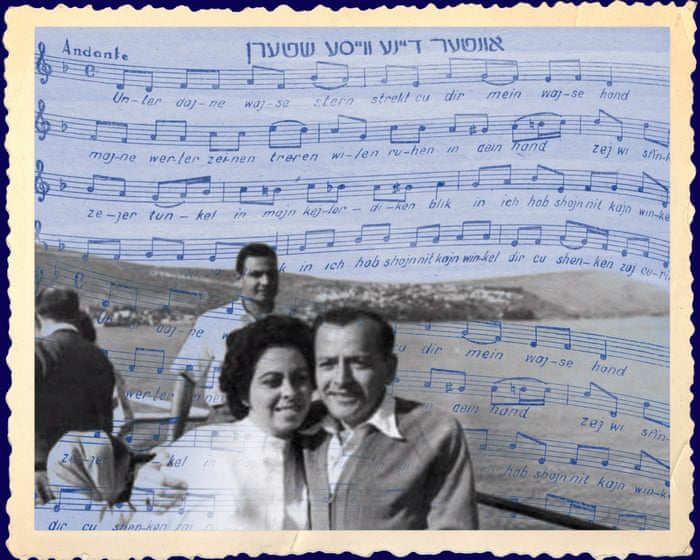
It was into this postwar environment that one survivor quietly brought a small Yiddish songbook, that then lay concealed for almost six decades. Printed on fragile acid paper, the poignant lyrics and musical notes of Mima’amakim (Out of the Depths) – a collection of 20 songs written by ghetto inhabitants, camp prisoners, people in hiding and partisan fighters between 1939 and 1944 – lay pressed between the pages of an old music score locked away in a Sydney cupboard. One of only five known surviving copies in the world from an original print run of 500, it narrowly missed being thrown in the recycling bin after its owner, Olga R, died at the age of 98 in 2013 (her family requested that her full name be withheld).
Sign up for a weekly email featuring our best reads
But there was something about the cover of this manuscript that her family, who did not speak Yiddish, thought looked too unusual to ignore.
It was the Russian constructivist look of it, the Soviet-style geometric shapes, diagonal lines, and stark black-and-red palette, that prompted Olga’s daughter to send a photograph to a Jewish music academic at the University of Sydney, Dr Joseph Toltz.
He forwarded the image to the United States Holocaust Memorial Museum in Washington DC, where its cultural value and rarity was immediately recognised.
Thirteen years on, Toltz and Associate Prof Anna Boucher, a public policy expert and global migration scholar at the University of Sydney, have completed the first English translation of Mima’amakim and tracked down descendants of its contributors scattered throughout the Jewish diaspora.
Survival stories
The origins of the songbook lay in postwar Bucharest, the Romanian capital that served as a key transit hub for Jewish refugees. Up to 100,000 refugees crossed through Hungary and Ukraine into Romania in the months following liberation, but because very few countries were willing to repatriate survivors or facilitate their safe passage, the city became a major processing site where organisations discreetly coordinated undocumented and illegal migration routes to Palestine.
It was in this transient environment, at a refugee processing house on Calea Moșilor 128, that a survivor named Yehuda Eismann established an office to document Nazi war crimes. Working alongside three secretaries, Eismann transcribed close to 1,000 wartime survival stories, a collection known as the Bucharest Protocols. Olga R, who would arrive in Australia 11 years later, was one of those secretaries.
She had survived the German occupation of Poland by completely discarding her Jewish identity, using false identity papers under a non-Jewish name to pass herself off as a Polish Roman Catholic woman. She memorised Christian customs and prayers, which later saved her life when she was detained by the Gestapo in Kraków and was forced to recite them during a two-week interrogation.
As refugees moved through the processing office, Eismann discovered that many had carried the songs they had created and sung in the forced labour camps and ghettoes of Poland, Lithuania, Latvia and Ukraine. Believing these songs captured a raw psychological dimension of the Holocaust that formal legal testimonies could not, he gathered 20 of the works and categorised them into three distinct emotional arcs: Yiesh (Despair), Bitokhn (Hope/Safety), and Kamf un Nitsokhn (Battle and Victory).
When Eismann left Europe for Palestine in October 1945, he gave a copy of the manuscript to Olga.
Eismann’s handwritten dedication, penned in Polish on the book’s title page, reads: “To a beloved and friendly co-worker, a token of memory and sympathy from the publishing house and author on the occasion of his departure to Palestine. Bucharest, 20 October 1945. Engineer J. Eismann.”
To unlock the personal history behind each song, Boucher and Toltz combed through the records of the International Tracing Service, verified names on gravestones and navigated postwar displaced persons registries. To identify living relatives, they cross-referenced historical data with entries in Yad Vashem’s Hall of Names, tracing descendants through the testimonies written by survivors of exterminated families.
One of those survivors was Ayzik Flaysher, who was just 13 when he composed the song Der Driter Pogrom (The Third Pogrom). After witnessing the murder of his parents and all 10 of his siblings in Ukraine, the teenage orphan survived by hiding in a self-dug dirt pit in a forest for two years. He stayed completely concealed during the daytime to avoid Nazi patrols and emerged only under the cover of night, surviving by eating cooked potato leftovers meant for farmers’ pigs. The prolonged confinement in total darkness severely deformed his bones, leaving his physical growth permanently stunted. He eventually walked to Bucharest, escaped to Palestine as a ship stowaway in 1945, and built a successful life as an Israeli factory manager despite his severe physical disabilities.
“He would sing his song every single morning,” his son Fredi told Boucher. When asked why he sang all the time, he replied that he had only two choices: “Sing all the time, or cry and die. He preferred to sing.”
The global tracking yielded a surprising level of cooperation from the families of the contributors, Boucher says. Many readily opened private archives and gave deeply emotional interviews. Eismann’s grandchildren possessed some knowledge of his postwar escape from a family batmitzvah scrapbook, but other families were entirely unaware of their ancestors’ creative legacies or underground resistance efforts.
The researchers were also able to record a face-to-face interview in Jerusalem with the last living contributor, the internationally renowned concert pianist Alexander Tamir. As an 11-year-old boy named Aleksander Wolkowyski in the Vilna ghetto, Tamir had anonymously submitted his composition called Ponar into a ghetto music competition. Picked by a panel of celebrated adult musicians who were blind to his age, the childhood melody, later known as Shtiler, Shtiler (Quiet, Quiet), evolved into one of the most widely performed hymns of Holocaust remembrance in Israel.
Gallows humour
Many of the other songs in Mima’amakim have remained silent since 1945. Unlike later, more polished anthologies, the unedited raw trauma and at times dark gallows humour – the mocking of camp guards set to upbeat marches, the mourning of a beloved wife’s murder set to a popular interwar tango rhythm – make the Mima’amakim unique.
By preserving the musical notations and the raw text, the translation reveals that music inside the camp structure was frequently used by prisoners to build emotional resilience.
It is a historic collection that carries direct, practical relevance for contemporary immigrants and refugees dealing with displacement, Boucher says.
The findings have been shared with the Refugee Advice and Casework Service, whose caseworkers tell her that clients fleeing current conflict zones continue to use music to process severe trauma.
Navigating the painful aftermath of the Bondi Beach massacre, a population already carrying deep intergenerational trauma has been deeply shaken, she says.
“I think the Jewish community in Sydney right now needs healing. Maybe we need a bit of the strength of these Holocaust survivors.”
Later this year, the researchers will bring the rediscovered song back to the public stage at a dedicated live performance at the Bondi Pavilion, a location they hope can provide a unique space for reflection.
“This book channels the incredible resilience of people who lost everything but still chose to save their songs. It says something about how humans have the capacity to juxtapose complete beauty against utter horror, and that’s something that we need right now.”
So why did Olga keep the book a secret for so many decades? Boucher has several theories, including the possibility of a love affair with Eismann.
“But with a lot of these things, people didn’t really understand the significance … they were in the process of surviving, creating, and they just made these things because they felt compelled to, out of a need to be creative in times of utter despair, and they didn’t reflect on how significant they were.”
View original source — The Guardian ↗
More from Politics

The Punch
PoliticsJun 7, 2026 · 1 min
Ekiti 2026: SDP gov candidate demands issue-based campaigns
The Punch
The Punch
PoliticsJun 7, 2026 · 1 min
CAN urges FG to declare state of emergency on insecurity
The Punch

The Hindu
PoliticsJun 7, 2026 · 1 min
South Korea's President orders probe into ballot shortage issue
The Hindu