Indian Express
Maa Behen: The male gaze, female rage and Madhuri Dixit’s choli
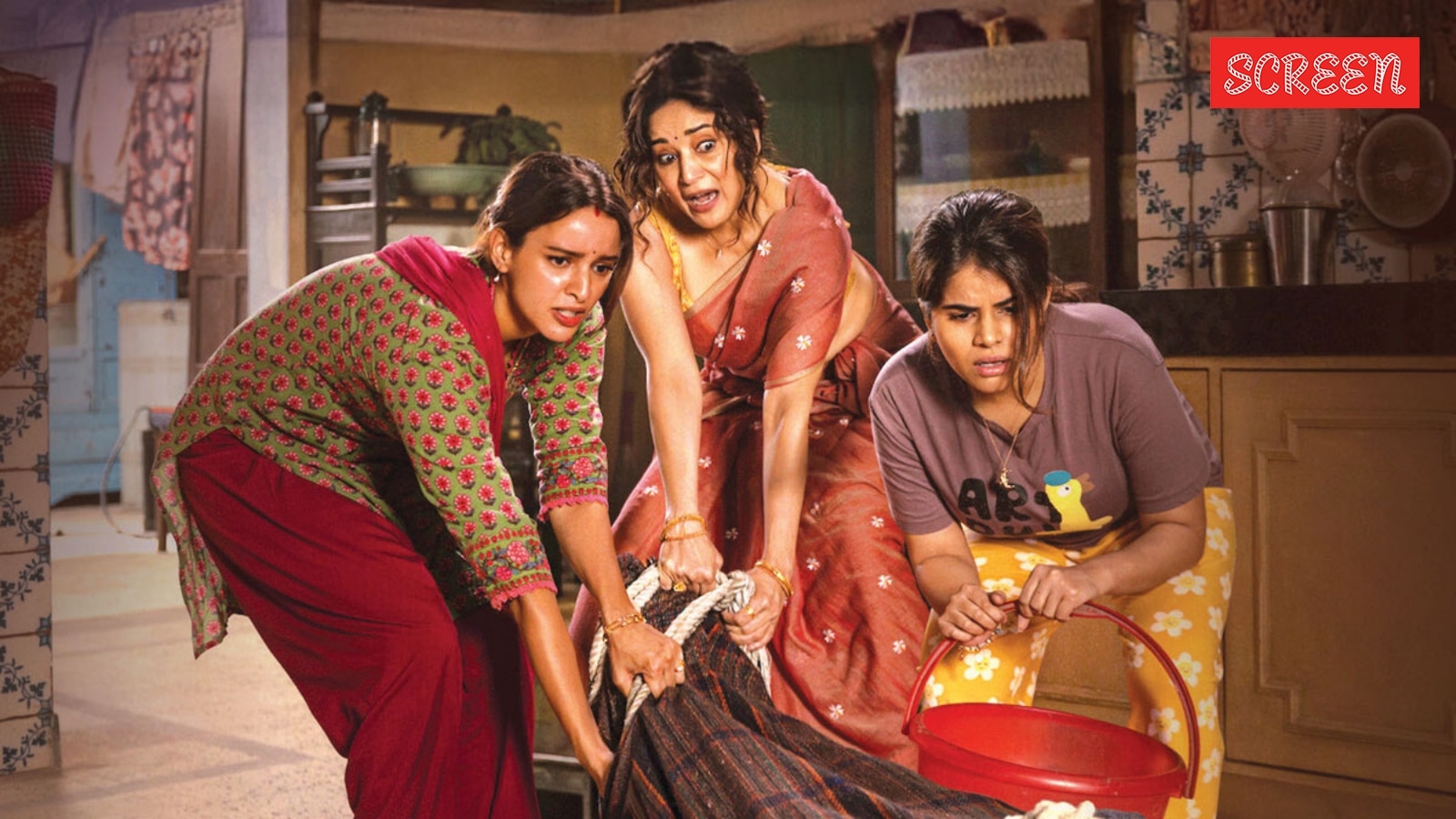
In 1993, Madhuri Dixit shocked and seduced a country by dancing to “choli ke peeche kya hain” (what is behind the blouse), only to counter our lewd assumptions by saying “choli mein dil hain mera” (my blouse conceals my heart). Now, thirty-three years later, in the Netflix film Maa Behen, her character Rekha’s sleeveless blouse becomes an instant character certificate. To the nosy neighbours in the ironically named Adarsh Colony, representative of our society at large, the blouse reveals not only skin but also her immorality and dark intentions. Madhuri Dixit’s beauty and smile have long held people under their spell. But director Suresh Triveni and writer Pooja Tolani cleverly subvert her enduring charm by turning her good looks into a source of lifelong misery for Rekha. Her beauty attracts the male gaze and incites rage amongst women who feel threatened by her. She is simultaneously objectified and slut-shamed by those around her, and over time, the rumours become her reputation. Perhaps it’s no coincidence then that Madhuri’s character shares her name with a yesteryear diva who was also maligned and misunderstood in the past, especially when it came to her romantic equations with men.
Neighbours repeatedly label her a ‘dayan’ (witch), amongst other words in the vast vocabulary we have created to define a woman’s morality in the public domain. It’s almost as if a woman who resists pouring herself into the moulds of acceptable female behaviour or a blouse with long sleeves cannot be allowed her humanity. Rekha’s refusal to dress more demurely, especially after her husband’s death, and her choice to have a second child out of wedlock only seal her reputation as a characterless, dangerous woman who has bewitched (pun intended) the poor hapless men around her. Men write slogans like “Rekha ka dekha” (Did you see Rekha’s…) on the walls of her house, but she is the one considered morally bankrupt. Interestingly, Rekha’s troublesome neighbour, played by actor Ravi Kishan, is named Charitra (character) Kumar Gupta, while her boss at work is Sanskaar (values) bhaiyya. Rekha is constantly at odds with both of them, both literally and metaphorically.
Suresh Triveni and Pooja Tolani make clever use of actor and anchor Shrivardhan Trivedi of Sansani fame. In Maa Behen, Shrivardhan, playing the narrator, spoofs himself and his long-running crime show to narrate the story of Rekha (Madhuri Dixit) and her two daughters, Jaya (Triptii Dimri) and Sushma (Dharna Durga), who have all been maligned by their neighbours. In his trademark hyperbolic style, he explains why, in addition to Rekha, Jaya and Sushma are also twisted like their ‘dayan’ mother’s feet.
Jaya is labelled a wily vixen because she allegedly enticed a wealthy groom and his family with balls of dough and perfectly round chapatis. Now Jaya spends her entire day cooking and cleaning for the five men in her household. There is a clock in her home with the image of a roti as its background. It is a powerful symbol of the many hours or entire lifetimes women spend cooking for entitled men who then sit in judgment of their character. It is only when Jaya finally unleashes her repressed rage that we learn the truth of what happened that day and why she chose to get married. Perhaps Jaya hoped that by trying to conform, she could save herself from Rekha’s fate. But she realises that in trying to appear respectable, she has slowly lost all respect for herself.
While Jaya is judged for how she snared a groom, her sister Sushma is judged for seeking popularity on social media. Dharna, who plays Sushma, is a content creator herself and knows the pressure of keeping the algorithm happy while dealing with nasty trolls. Sushma has been forced to leave her home after a video of her kissing a boy went viral. Though the kiss was consensual, the boy escaped scot-free, but Sushma faced the wrath of her neighbours. Netizens label her shameless, characterless and a r**** for the videos she posts with her brother-in-law, but he is never judged for flirting with his wife’s sister. It’s the sort of moral hypocrisy and double standards we see every day.
It’s not only the men who judge the Maa-Behen trio in this film. The writer and director show us how women in the neighbourhood, represented by Guptain/Mrs Gupta (Geetanjali Kulkarni), have also participated in defaming Rekha and her daughters. In a telling scene, Mrs Gupta notices a car outside Rekha’s home and asks the milkman if she has found a new man to prey on. A few seconds later, she greets a passerby, saying ‘Radhe Radhe.’ One woman, a goddess, worshipped in temples, the other is deemed a witch worthy of ostracisation. But whether a woman is a devi or a dayan is sadly determined not by her choices but by people’s perception of them. Perception, the film tells us, is the prison women in a patriarchal society are forced to live in and over generations, we have normalised the restrictions imposed on us.
Sadly, even Jaya and Sushma say incredibly harsh things to their mother, questioning why she chooses to keep wearing sleeveless blouses, whether the rumour of her burying the bodies of the men she traps in her garden is true and telling her that, given how her reputation is, they can’t trust her. It’s almost as if they have internalised the labels and accusations flung at them over the years and joined the brigade that has turned their mother into a social pariah.
Story continues below this ad
Most of Maa Behen is shot indoors, and within confined spaces like a car or the narrow lanes between homes. Though this limits the film’s dramatic scope, it mimics the suffocation a woman feels as she keeps trying to fulfil everyone’s expectations of her. So, when you hear the three women cackling with laughter together, choosing to be themselves instead of being ‘adarsh’, you can’t help but cheer for them. At a point in the film, they step out into the night dressed in saris and sleeveless blouses, dancing and laughing together. They reminded me of the three witches in Macbeth, only this time they have taken charge of their own destiny, instead of helping a man find his.
View original source — Indian Express ↗
More from Entertainment

Variety
EntertainmentJun 8, 2026 · 1 min
Tonys Snubs and Surprises: Alden Ehrenreich Beats Tight Competition, Nathan Lane Loses for ‘Salesman’ and More
Variety

The Hollywood Reporter
EntertainmentJun 8, 2026 · 1 min
‘Schmigadoon!’ Wins Best Musical at 2026 Tony Awards as ‘Liberation’ Wins Best Play
The Hollywood Reporter

Pitchfork
EntertainmentJun 8, 2026 · 1 min
Musicians Union Sues Universal and Warner Over AI Use
Pitchfork