Indian Express
Indian Express··5 min read
Court quashes anti-Islamic speech case against BJP leader, says ‘not a theatre for political rivalry’
5 min readNew DelhiUpdated: Jun 8, 2026 05:04 PM IST
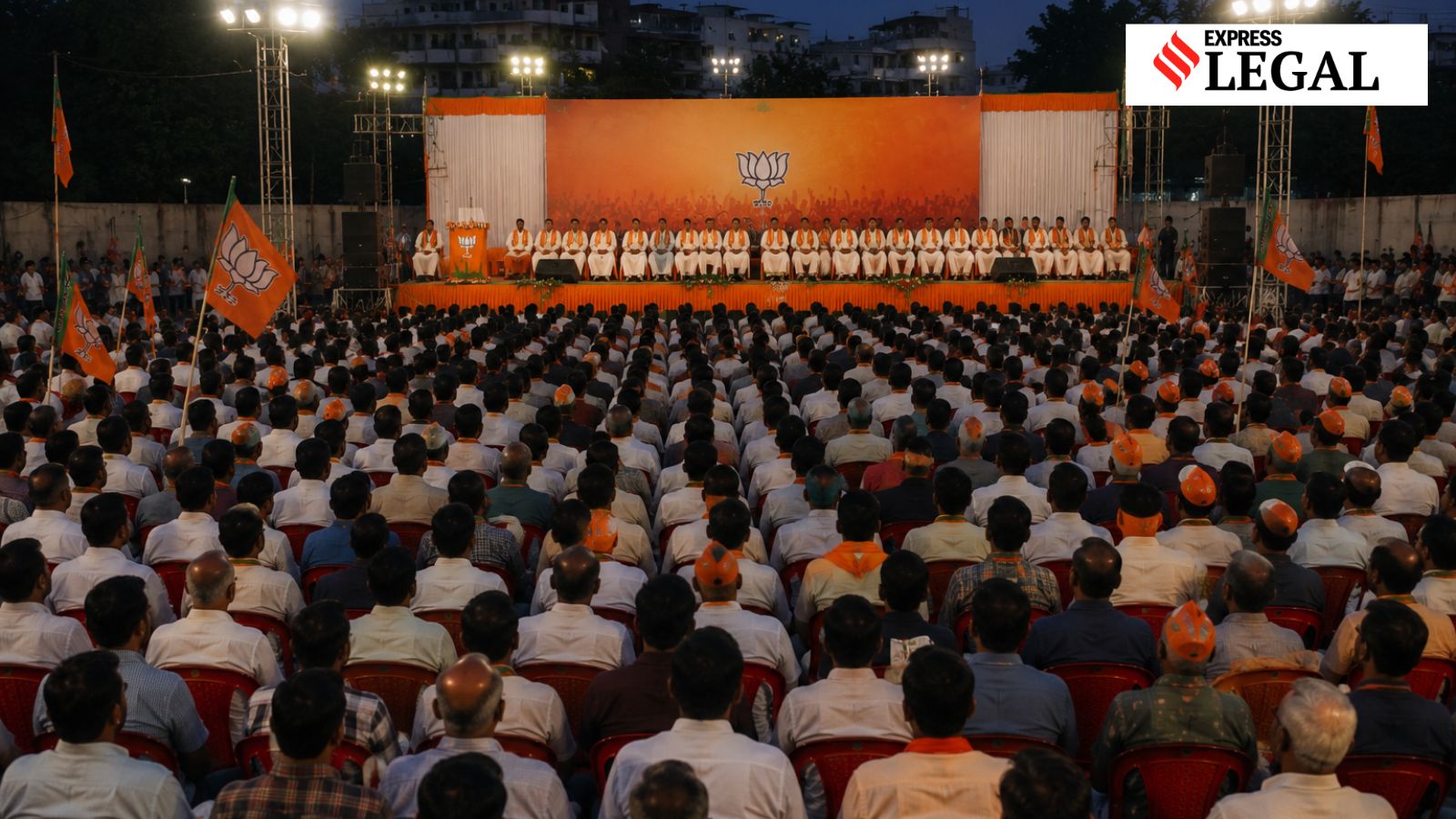
The Madras High Court observed that communal harmony is undoubtedly a constitutional value of high order. (AI -generated image)
The Madras High Court recently quashed criminal proceedings against a BJP functionary and a Hindu Munnani office-bearer accused of delivering anti-Islamic hate speech, observing that criminal courts cannot be used as “theatres for political rivalry” and that prosecutions founded on vague allegations cannot be allowed to proceed.
Justice L Victoria Gowri further observed that courts cannot be used to suppress public speech merely because it is inconvenient, disagreeable or ideologically opposed to another viewpoint.
“The criminal Court is not a theatre for political rivalry. Nor is it an instrument to sterilise public speech merely because such speech may be inconvenient, disagreeable or ideologically opposed to another point of view. The majesty of criminal law lies in its disciplined invocation,” the June 1 order read.
Justice L Victoria Gowri stated that speeches tending to promote communal hatred must be dealt with sternly.
The high court was hearing a petition filed by the Karaikudi district secretaries of the Bharatiya Janata Party (BJP) and Hindu Munnani, A Nagarajan and Agni Bala, seeking quashing of criminal proceedings initiated against them over alleged anti-Islamic remarks made during a public meeting held on September 9, 2024.
‘Secular fabric can’t be torn by calculated hate speech’
The Madras High Court observed that communal harmony is undoubtedly a constitutional value of high order.
However, it was added that the protection of communal harmony cannot be achieved by prosecutions founded on vague allegations.
The court highlighted that it must rest on precise facts, lawful procedure and scrupulous adherence to statutory safeguards.
The court added that the Constitution protects both social peace and individual liberty and it should be ensured that neither is sacrificed at the altar of expediency.
The court stated that speeches tending to promote communal hatred must be dealt with sternly.
It added that the secular fabric of the Constitution cannot be permitted to be torn by calculated hate speech.
However, it was emphasised that every political criticism or every speech containing sharp ideological expression cannot be straightaway converted into a criminal prosecution unless the statutory ingredients are clearly disclosed.
The court stated that the mere fact that the petitioners belong to political or religious organisations cannot by itself lead to a presumption of criminal intent.
It was added that political speech may be critical, harsh or provocative in the ordinary sense of public debate.
‘Only bare allegations’
The court highlighted that no member of the public has complained and no person from the allegedly affected community stated that the speech caused hatred, fear, disharmony or resentment.
The court pointed out that the prosecution must disclose the exact statement, its context, its tendency, its public impact and the legal ingredients of the offence.
The court noted that the final report does not disclose any material showing that the alleged speech was circulated, published or electronically transmitted so as to create public mischief.
It was noted that the report does not disclose any public reaction, communal tension or law-and-order consequence.
The court found that the final report only had bare allegations without disclosing the words spoken, the public mischief caused, the enmity promoted, the disturbance created or the sanction obtained.
The court, therefore, held that a criminal trial cannot be permitted to proceed on such an uncertain and infirm foundation.
The Madras High Court held that the majesty of criminal law lies in its disciplined invocation.
It was added that when invoked without the indispensable statutory foundation, it ceases to be an instrument of justice and becomes an instrument of oppression.
A public meeting in September 2024
The prosecution case stated that on September 9, 2024, at about 6 pm, the first petitioner, stated to be the Karaikudi District Secretary of the Bharatiya Janata Party, and the second petitioner, stated to be the Karaikudi District Secretary of Hindu Munnani, participated in a public meeting.
It was alleged that in the said meeting, the petitioners spoke against persons belonging to the Islamic community and that the said speech was made with an intention to create disharmony between religious groups and to incite public disturbance and riot.
Later, based on the complaint of a sub-inspector of police, the police registered a case for the alleged offences under Sections 196(1)(a) and 353(2) of the Bharatiya Nyaya Sanhita, 2023 (crimes related to hate speech, communal disharmony).
Story continues below this ad
Arguments
The petitioners, represented by advocate K Kharikharadas, submitted that no material was produced to show that the alleged speech resulted in communal disharmony, public disturbance, violence, riot, breach of peace or any law-and-order situation.
The petitioners further contend that mere political criticism or expression of opinion in a public meeting cannot be criminalised unless the speech has a direct and proximate tendency to incite violence, create hatred or disturb public tranquillity.
It was also contended that the final report did not reproduce the exact words allegedly spoken by the petitioners.
The counsel added that, in the absence of the actual speech, its context, its audience, its effect and its proximate consequence, the prosecution cannot proceed on vague and omnibus allegations.
Story continues below this ad
The state was represented by Additional Public Prosecutor S Ravi.
Richa Sahay is a Legal Correspondent for The Indian Express, where she focuses on simplifying the complexities of the Indian judicial system. A law postgraduate, she leverages her advanced legal education to bridge the gap between technical court rulings and public understanding, ensuring that readers stay informed about the rapidly evolving legal landscape.
Expertise
Advanced Legal Education: As a law postgraduate, Richa possesses the academic depth required to interpret intricate statutes and constitutional nuances. Her background allows her to provide more than just summaries; she offers context-driven analysis of how legal changes impact the average citizen.
Specialized Beat: She operates at the intersection of law and public policy, focusing on:
Judicial Updates: Providing timely reports on orders from the Supreme Court of India and various High Courts.
Legal Simplification: Translating dense "legalese" into accessible, engaging narratives without sacrificing factual accuracy.
Legislative Changes: Monitoring new bills, amendments, and regulatory shifts that shape Indian society. ... Read More
Tags:
Madras High Court
View original source — Indian Express ↗
More from newsGlobal
Times of India
PoliticsJun 8, 2026 · 1 min
The INDIA bloc divide: Why Mamata is all in but Stalin is walking her 'ekla chalo' path
Times of India

The Hindu
PoliticsJun 8, 2026 · 1 min
Armenian PM Nikol Pashinyan claims victory in election seen as test of Russia’s influence
The Hindu

TASS
PoliticsJun 8, 2026 · 1 min
Russian troops liberate Khimik community in Donetsk region over past day — top brass
TASS