Times of Israel
EU sanctions two Iranians, IRGC unit for participating in Hormuz blockade
IRGC deputy commander and representative for Iranian oil union placed on blacklist; 1st time bloc uses new powers to sanction for restricting freedom of navigation
NICOSIA, Cyprus — The European Union said on Monday it had imposed sanctions on two Iranian individuals and a unit of the Islamic Revolutionary Guard Corps for threatening the freedom of maritime traffic in the Strait of Hormuz, through which around a fifth of the world’s oil flows.
The move marked the first time the bloc has used new powers to sanction Iran for restricting freedom of navigation.
The EU said in a written statement that it had added the Hormozgan Provincial Command of the Islamic Revolutionary Guard Corps (IRGC) Navy to its sanctions list, as well as Mohammad Akbarzadeh and Hamid Hosseini.
It said Akbarzadeh is deputy commander for political affairs of the IRGC Navy, and Hosseini is a representative of Iran’s Oil, Gas and Petrochemical Products Exporters’ Union.
Iran moved to close the Strait of Hormuz after US-Israeli strikes on Iran began on February 28. The Iran war and the closure of Hormuz have sent ripples across the global economy, sending energy prices soaring.
Get The Times of Israel's Daily Edition
by email and never miss our top stories
By signing up, you agree to the terms
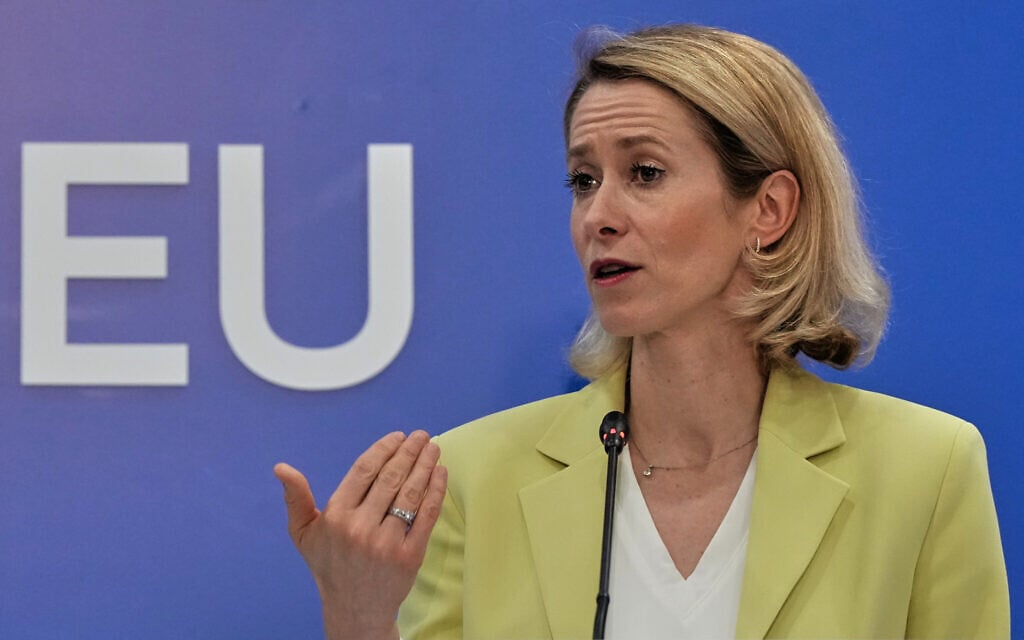
“Iran’s actions are unacceptable. In response, member states have approved sanctions against Iranian entities and individuals involved in disrupting transit through the Strait of Hormuz,” Kaja Kallas, the EU’s foreign policy chief, said earlier at a news conference in Cyprus.
“This is the first time the EU has applied its new freedom of navigation regime, and when necessary, we will apply it again,” added Kallas.
Last month, the EU said it was advancing sanctions on Iranian officials and others responsible for blocking the Strait of Hormuz, saying the measures would consist of travel bans and asset freezes.
EU citizens and companies will also be banned from making funds, financial assets, or other economic resources available to those listed.
Kallas’s announcement came after the Islamic Republic launched ballistic missile attacks on Israel in retaliation for an IDF strike on Beirut’s southern Dahiyeh suburb earlier in the day, prompting Israeli airstrikes in Iran. Those strikes in turn led to further missile attacks on Israel from Iran and Yemen’s Houthis.
Brussels’s punitive measures on Iran previously targeted the country’s military support for Russia in its war against Ukraine and for armed groups across the Middle East.
The European Union has also imposed sanctions over human rights violations in the country, and in January agreed to include the Islamic Revolutionary Guard Corps on the bloc’s list of terrorist organizations, putting the powerful Iranian military force in a category similar to that of Islamic State and al Qaeda.
AFP contributed to this report.
If you’d like to comment, join
The Times of Israel Community.
View original source — Times of Israel ↗
More from Politics

Daily Trust
PoliticsJun 8, 2026 · 1 min
Banditry: Stop stereotyping Fulanis, Obi tells Nigerians
Daily Trust

TASS
PoliticsJun 8, 2026 · 1 min
Pressure on opposition affects outcome of Armenian election — political bloc
TASS
Rio Times
PoliticsJun 8, 2026 · 1 min
Brazil Renames Army Command to Guard Its New Oil Frontier
Rio Times