BBC Sport
How can athletes play with ICDs, and what happens when it goes off?
The need for an ICD - which is around half the size of a mobile phone - to be fitted can be caused by a variety of different health conditions, including heart failure, coronary heart disease, and arhythmias.
Depending on the exact illness an athlete is suffering from, a return to competition is possible.
"All cases are individual," says Dr. Amanda Lahti, a doctor and researcher in sports medicine.
"It is a shared decision model – you take opinions from the club, the player, their agent, and medical experts, looking at the risks and the potential benefits. You then take a collective decision about whether a player can continue with their career or if they should stop.
"The difficulty with that is the athlete themselves has the final word, and they will never say 'stop'. They are willing to take risks that perhaps you or I would not."
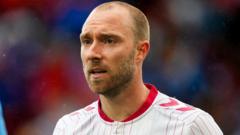
When Eriksen suffered his cardiac arrest in June 2021, he was playing his club football for Inter Milan in Italy's Serie A, one of a minority of leagues which prohibits players fitted with an ICD from competing.
Eriksen made his return first with Brentford and then Manchester United in the Premier League, where there is no blanket rule, and players must undergo individual testing to assess whether they are healthy enough to play.
"I don't see any risk, no," he told BBC Sport in 2022. "I have an ICD, if anything would happen then I am safe."
ICDs can also cause what are known as inappropriate shocks - instances where the device is erroneously activated.
"I was on holiday once in Antigua and the ICD picked up what it thought was my heartbeat going at 500 beats per minute, but it was actually the pool pump.
"I was suddenly blown through the water and didn't know what happened. After a few seconds I realised my device had gone off and thought I must be really unwell.
"You can do a mobile download – I put a device over my chest and then it sends all the info to my doctors, and they told me my heart was fine and it shouldn't have gone off. I wasn't aware that could even happen."
Overall, though, Taylor's ICD provides him with reassurance and allows him to feel confident playing sports like golf and padel.
"It's a scary place to be when your life could change at any second," he says.
"It can isolate you, because if it goes off you lose your independence. For example, you can't drive because you lose your license for a certain amount of time.
"But I lead a great life and I use my coping mechanisms from being an international sportsman. You don't always succeed, and have to be prepared for setbacks to keep yourself in a consistent headspace."
View original source — BBC Sport ↗


