Times of Israel
How do Israelis in the north feel about renewed fighting with Iran? Check out the supermarket
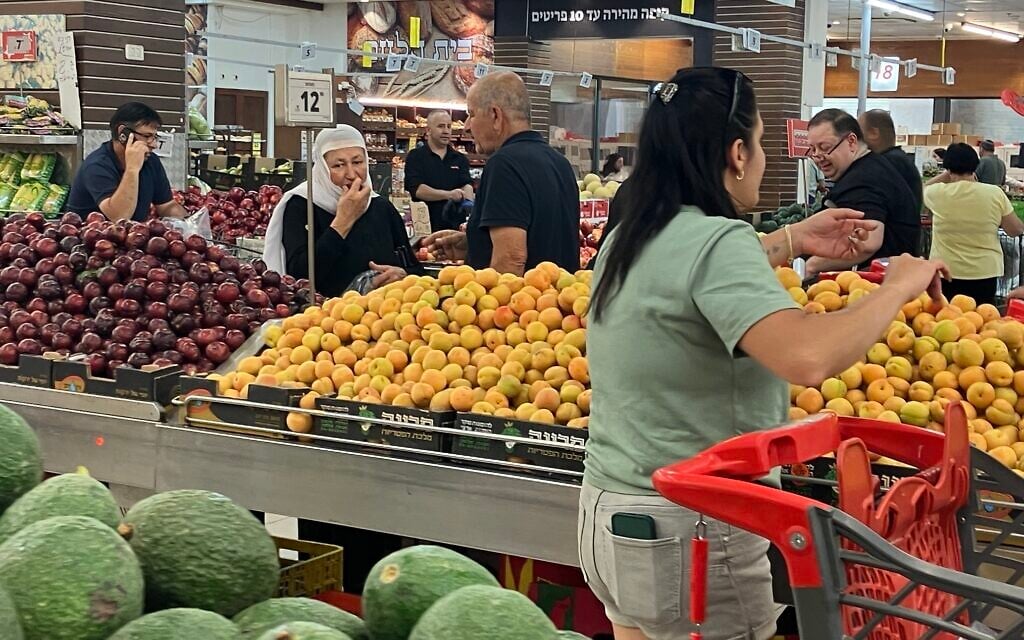
Ruti Reinhold rolled her shopping cart, loaded to the brim, through the aisles of Souq Faisal. The supermarket is located in the Arab town of Mazra’a, about six miles from Lebanon, just outside the western Galilee city of Nahariya.
The grocery is usually packed with a diverse crowd of shoppers. But on Monday, business was slower than usual.
On Sunday night, Iran fired a volley of ballistic missiles at northern Israel, catapulting the region back to the cusp of all-out war after two months of a shaky ceasefire. However, the reignited conflict with Iran didn’t drive residents of Israel’s war-battered border to stockpile goods.
“This is my regular shop every two weeks,” she said. “It isn’t because of the war.”
Shoppers — a mix of Jews, Muslims, Druze, and Christians — moved up and down the aisles of the large store, appearing less focused on the “matzav,” the Hebrew word for situation, and more interested in the selection of cherries, watermelons, and apricots.
Get The Times of Israel's Daily Edition
by email and never miss our top stories
By signing up, you agree to the terms
Some people brought their children, since school was canceled for the day due to the Iranian missile attacks, while others did their regular shopping. The shelves were packed with items, and nobody seemed to be stocking up on essential supplies any more than on ordinary days.
Reinhold said she has continued to shop here for over two years, since the war with Hezbollah broke out when the terror group attacked Israel on October 8, 2023. Occasionally, she has waited in the supermarket’s protected room when sirens indicated incoming rockets from Lebanon.
“We’ll see what happens now,” she said, undeterred. “Life continues.”
According to the Iranian regime, Sunday’s attack was in response to an IDF strike on the Iranian terror proxy Hezbollah in Beirut earlier in the day. Israel’s Air Force responded overnight Sunday, and Monday morning saw another wave of Iranian and Houthi missile attacks.
While the IDF said it is prepared for a lengthy conflict, officials have told Hebrew media that “the sense is that this round of fighting is behind us.” Though they have also stressed that the military will not stop its offensive against Hezbollah in southern Lebanon, both Israel and Iran are reportedly halting their mutual attacks — for now.
The usually quiet coastal town has become all too accustomed to loss: In August 2024, Mikhael Sammarah, 27, was killed on the road just opposite the supermarket after an Iron Dome interceptor missile malfunctioned during a barrage of Hezbollah-fired drones.
Uri Peretz, a father of four, was killed during a Hezbollah rocket attack on Nahariya this past March, about a month into another round of war that began on February 28, when Israel and the United States launched a joint attack on Hezbollah’s state sponsor, Iran, to degrade its nuclear and ballistic missile capabilities.
Since the war with Iran and Hezbollah’s subsequent “solidarity” attacks, 30 IDF soldiers and one Defense Ministry civilian contractor have been killed in Lebanon while fighting the Iranian proxy. Two civilians were also killed by the terror group’s rockets, and an Israeli civilian was mistakenly killed in the north by Israeli artillery shelling.
Arie Zino, a resident of Shlomi, a town that abuts the northern border with Lebanon, had come to buy food for his mother.
“This isn’t a war?” he asked angrily, referring to the ostensible halt in hostilities between Israel and Hezbollah negotiated on April 16. “This is a ceasefire? When dozens of soldiers have been killed?”
He mentioned by name a female soldier who was recently killed by a Hezbollah-launched twin drone attack on May 28, Sgt. Rotem Yanai, a 20-year-old soldier welfare NCO in the Givati Brigade’s Rotem Battalion.
A shopper named Mona, who asked that her last name not be used, echoed his comments.
“We’re in a war again,” said the resident of the nearby town of Kabul. Last night, as sirens sounded throughout the western Galilee, she said, “nobody slept.”
But Kamal Hasboun, a Mazra’a resident, said that despite the war, “we still live well.” He stood outside a temporary bomb shelter in Mazra’a, a few streets from the supermarket.
“God gave the land to the Jews, and we’re cousins, and we’re here, too,” Hasboun said, adding that he was optimistic that the war would end soon, “perhaps for the better.”
“We live in a strong country,” he said. “People are all here together.”
Meanwhile in Nahariya…
Less than two miles away, in the Universe supermarket in downtown Nahariya, Sarah Danor carried a bag of onions and tomatoes as she leisurely browsed the produce section of the store.
“I’m not one of those stocking-up kind of people,” said Danor, who moved from New Jersey 15 years ago. She said she is also not a “big anxiety person.”
“We’re blessed to have a military and leaders who protect us,” she said.
Nearby, Shosh Rachamin, the store’s shift manager, said she had seen people stocking up on water bottles and other items.
“Kids are home from school,” she said. “They need food.”
On the main boulevard of downtown Nahariya, Moshe Levi, a Nahariya resident, said he had come to do some errands.
“Some people get hysterical,” he said, “but I continue my life as usual.”
He commented that Nahariya seemed quieter than usual, but then quipped, “It’s still hard to find a parking space.”
Still, he said, “We have to be careful but not lose our sanity.”
He said that every Wednesday, he goes to Souq Faisal to shop.
“I’m waiting for Wednesday, as always,” he said. “This week is no different.”
View original source — Times of Israel ↗