VnExpress
VnExpress··6 min read
Unrecycled construction waste raises pollution concerns in Hanoi
Construction and demolition waste in Hanoi that can be recycled into roadbed fill, concrete, and bricks are being dumped in landfills or illegally disposed of, causing severe pollution.
Hanoi is currently clearing land for 1,428 projects, including four new bridges spanning the Red River (Hong Ha, Me So, Van Phuc, and Ngoc Hoi), ring roads, and the widening of National Highways 1 and 6.
This is generating more than 10,000 tons of construction waste daily, including concrete, bricks, stone, mortar, metal, wood, plastic, glass, excavated soil, and sludge.
This is four to five times the normal volume of waste.
Unlike household waste, construction debris is a secondary resource because most of it retains value with proper sorting and processing.
Once crushed, screened, and treated, the waste can be transformed into aggregate for roads, land reclamation materials, non-fired bricks, concrete, and components used in manufacturing construction materials.
Nguyen Van Hoan, an expert at the Vietnam Institute for Building Materials' Cement - Concrete Center, says around 80% of urban solid waste is currently used in land fills, and only some 17% is recycled, mainly by crushing for use as fill material or road sub-base.
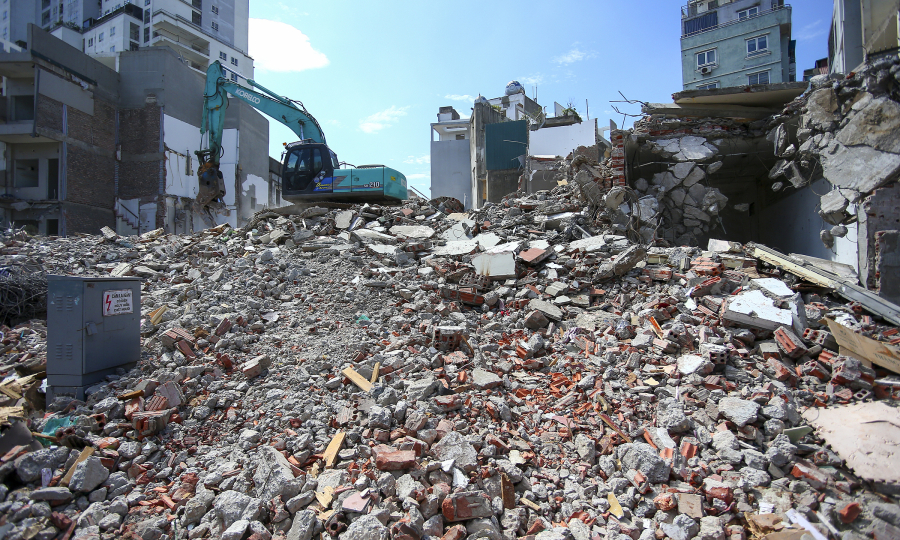
Contractors demolish houses on Van Kiep Street, an area within the Tran Hung Dao Bridge project in Hanoi, May 2026. Photo by VnExpress/Pham Chieu
This recycling rate remains far below the potential of construction and demolition waste, such as soil, rocks, concrete and broken bricks, which can be reused in a variety of applications.
Using recycled materials reduces the need to extract rocks, river sand, soil, and other minerals used in construction, he pointed out.
"At a time when sand and stone are becoming increasingly scarce, construction waste represents a highly valuable source of raw materials."
Demolition projects across Hanoi generate thousands of tons of solid waste every day.
At present, recycled aggregate used for roadbed filling, the lowest-value application, sells for VND70,000-100,000 (US$2.66-3.80) per ton. Recycled crushed aggregate and sand are priced at VND150,000-200,000 per cubic meter.
If Hanoi were to recycle all 10,000 tons of construction waste generated each day into fill materials, it could generate VND700 million to VND1 billion in revenues daily.
Studies show that recycled materials cost about 20% less than natural materials.
Associate Professor Tong Ton Kien, deputy director of the Institute for Research and Application of Tropical Building Materials at the Hanoi University of Civil Engineering, says construction waste recycling rates can exceed 90% by weight, while asphalt concrete and cement concrete can be reused almost entirely.
More importantly, recycled materials can replace natural resources, which are increasingly depleted. In Hanoi, numerous infrastructure projects require vast quantities of yellow sand, construction sand, and fill soil, he says.
The Ring Road 4 project alone faces a shortage of six million cubic meters of fill soil and large volumes of sand and stone.
Output at Hanoi's licensed quarries is insufficient, forcing contractors to source materials from neighboring Phu Tho Province, sharply increasing costs due to transportation, he adds.
Turning waste into wealth
The construction sector has spent years researching and testing recycled building materials after recognizing their potential value.
One of the earliest studies was launched in 2007 by Dr. Le Viet Hung of the Ministry of Construction-run Vietnam Institute for Building Materials.
The initial research focused on evaluating the feasibility of crushing and screening construction waste for use as input materials in mortar and concrete production.
A mouth of construction waste on Van Kiep Street in Hanoi, May 2026. Photo by VnExpress/Pham Chieu
In 2012, a trial project successfully established an industrial-scale recycled aggregate production line.
The system produced aggregates from concrete and brick from demolished structures. Fine aggregates were used to manufacture non-fired bricks and larger varieties measuring up to 40 millimeters replaced crushed stone in concrete production.
Kien said that at the Hanoi University of Civil Engineering, between 2012 and 2016, researchers conducted comprehensive studies on using recycled aggregates as crushed stone and sand for structural mortar and cement concrete production.
Between 2019 and 2021, they successfully manufactured precast reinforced concrete structures from recycled concrete waste under laboratory conditions, demonstrating its suitability for construction.
To facilitate the wider adoption of recycled aggregates, government agencies have rolled out a number of technical standards.
In 2023, national standard TCVN 13694 for grading requirements for recycled materials used in urban road foundations was issued.
Another, TCVN 11969:2018, regulates recycled coarse aggregates for concrete.
Others for fill materials, asphalt recycling, mix design, and construction practices were also approved by the Ministry of Science and Technology between 2020 and 2025.
But Hoan of the Vietnam Institute for Building Materials said the main challenge facing Hanoi today is not recycling technology, and many companies are willing to invest in modern recycling facilities and even deploy mobile crushing equipment right at construction sites.
He said the problem is the inconsistent demand for recycled products, as many developers and contractors remain concerned about their quality and durability.
Hanoi, like most localities in Vietnam, also lacks dedicated planning for construction waste management and designated collection and treatment sites except along river dikes, making recycling difficult.
High production costs are another obstacle. Construction waste is often dumped mixed with concrete, bricks, soil, metal, and sludge, meaning recycling companies need to spend additional resources on sorting before processing.
According to Global Production Services JSC, the cost of recycling fill material is VND100,000-110,000 per ton.
How can Hanoi unlock value of construction waste?
Kien says the first step in addressing the growing challenge of construction waste is for local authorities to designate land specifically for recycling facilities and waste collection sites.
If there is appropriate infrastructure to take in construction waste, processing is relatively straightforward, he says.
But the waste generators should be required to bear the cost of treatment, he says.
Another key requirement is stimulating the market for recycled materials, he points out.
While Vietnam has policies encouraging recycling, they are not specific or attractive enough to encourage significant investments, he says.
He says greater incentives should be offered to recycling companies, and treatment centers should be large with a capacity of at least 500-1,000 tons a day to ensure economic viability.
Public procurement policies can also play a big part, and so government construction projects should be required to use a minimum percentage of recycled materials, he says.
This is particularly relevant in big cities, where natural resources are scarce and often need to be transported from distant locations.
Drawing on experience from Japan and the U.K., Kien says cities often establish multiple collection points for construction waste. For pre-sorted materials, recycling facilities may even subsidize transportation costs or pay collection operators.
A construction waste crushing site near the Phap Van–Cau Gie interchange in Hanoi. Photo by VnExpress/Pham Chieu
Unsorted materials are sent to specialized facilities for sorting and recycling, with developers or waste generators responsible for the associated costs.
The government can also explore carbon credit mechanisms for recycled materials, recognizing their contribution to reducing emissions and creating an additional revenue stream for businesses.
At the same time, research, innovation, and technology transfer programs should be expanded to improve recycling efficiency and support the development of a circular economy in the construction sector.
Hoan believes Hanoi must simultaneously expand waste dumping sites, crack down on illegal dumping, mandate on-site waste sorting, and gradually incorporate recycled materials into public construction works.
He warns that, otherwise, in the next five to 10 years, the city might face growing landfill shortages, environmental pollution, and a declining supply of natural construction materials such as sand, stone, and fill soil.
View original source — VnExpress ↗
Related stories

The Punch
PoliticsJun 13, 2026 · 1 min
Nigerian inmates in Ethiopia celebrate prisoner transfer deal, thank Tinubu
The Punch

ESPN
SportsJun 13, 2026 · 1 min
Hurdles remain, but UFL upbeat in 2026: 'Didn't th...
ESPN

ESPN
SportsJun 13, 2026 · 1 min
How Giants WRs stack up with Nabers, Beckham & Co....
ESPN

ESPN
SportsJun 13, 2026 · 1 min
World Cup Daily LIVE: Brazil fans take over NYC ah...
ESPN