Indian Express
Indian Express··3 min read
Saket G Block Metro station work begins
3 min readNew DelhiJun 13, 2026 10:55 AM IST
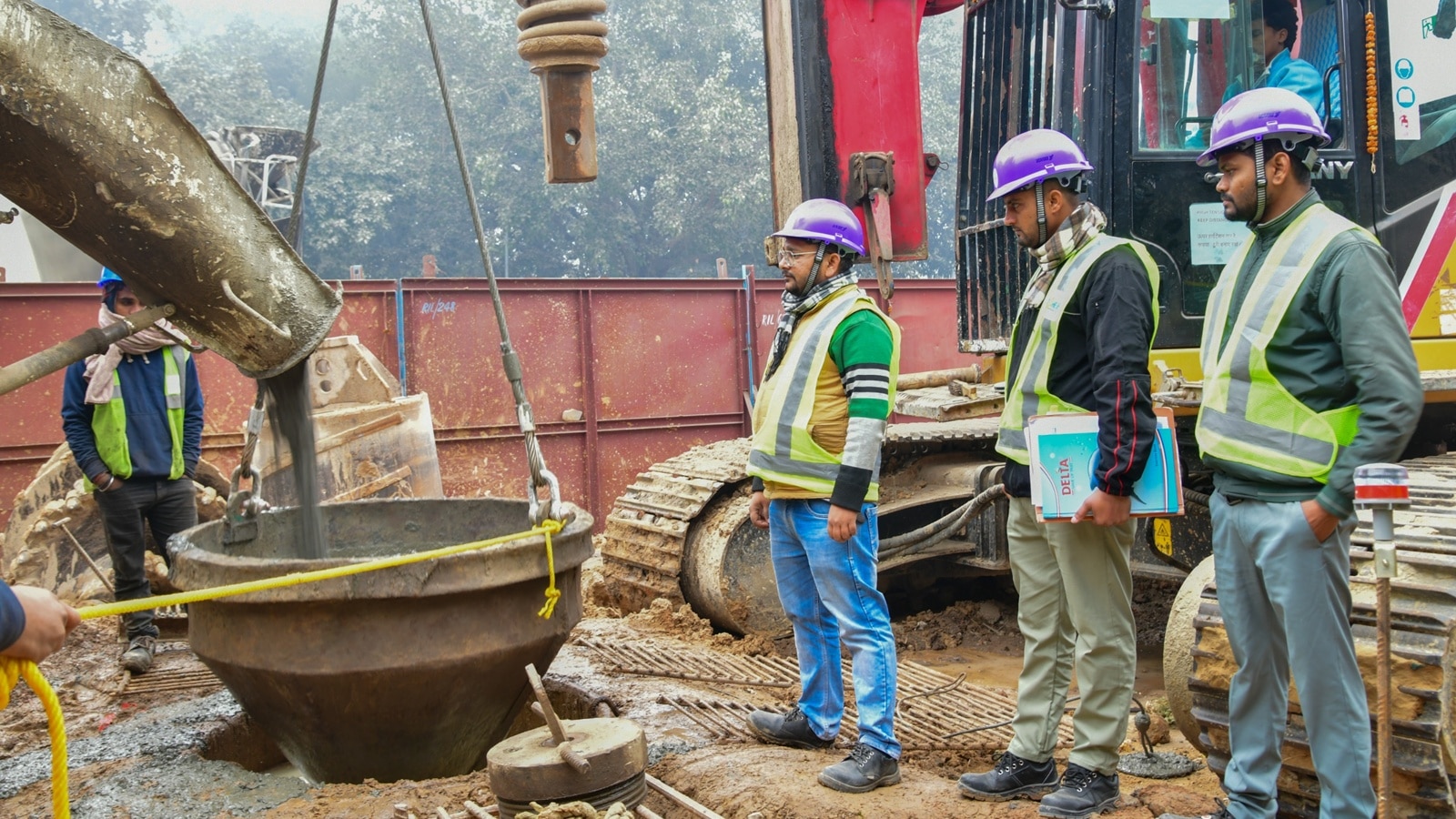
The corridor is expected to improve connectivity across several residential, commercial and institutional areas of South Delhi. (Express Photo)
Preliminary construction work for the proposed Saket G Block Metro station – a key interchange on Delhi Metro’s upcoming Golden Line corridor – has started, with activities related to the substructure, including piling, pile cap construction and pier works, currently underway, the Delhi Metro Rail Corporation (DMRC) said on Friday.
The station is part of the 8.385-km Lajpat Nagar-Saket G Block section of the Golden Line, which is scheduled to be completed by June 2029. The corridor will have eight stations – Lajpat Nagar, Andrews Ganj, Greater Kailash I, Chirag Dilli, Pushpa Bhawan, Saket District Court, Pushp Vihar and Saket G Block.
According to a DMRC spokesperson, the integrated interchange station at Saket G Block will be elevated and provide paid-area connectivity through a common concourse. It will have four platforms, including an island platform, facilitating movement in both directions and allowing seamless transfers between Metro corridors. They added that the corridor is expected to improve connectivity across several residential, commercial and institutional areas of South Delhi. Localities around Greater Kailash, Chirag Dilli, Pushp Vihar and Saket will get direct Metro access, while schools, government offices and business districts along the route are also expected to benefit.
A major feature of the project is its interchange connectivity. Lajpat Nagar will be a triple-interchange station, with passengers being able to switch between Golden Line, Violet Line and Pink Line. Chirag Dilli station will connect with Magenta Line, while Saket G Block will provide an interchange between Golden Line and proposed Aerocity-Tughlakabad corridor.
The spokesperson said these interchange facilities are expected to reduce travel time for commuters from South Delhi areas such as Tughlakabad, Vasant Kunj and Greater Kailash.
Further, the corridor will introduce India’s first three-coach Metro line. Designed primarily for short-distance urban travel, each train will be able to carry around 900 passengers – around 300 passengers per coach.
The spokesperson said the improved connectivity is expected to boost property values in areas such as GK, Saket and Pushp Vihar, while strengthening South Delhi as a hub for commerce, education and government services. The corridor is part of Phase IV expansion, which has six routes — Janakpuri West-RK Ashram, Majlis Park-Maujpur, Aerocity-Tughlakabad, Lajpat Nagar-Saket G Block, Inderlok-Indraprastha and Rithala-Narela. The entire Phase-IV network is expected to be completed by 2029.
© The Indian Express Pvt Ltd
Devansh Mittal is a Correspondent at The Indian Express, based in the New Delhi City bureau. He reports on urban policy, civic governance, and infrastructure in the National Capital Region, with a growing focus on housing, land policy, transport, and the disruption economy and its social implications.
Professional Background
Education: He studied Political Science at Ashoka University.
Core Beats: His reporting focuses on policy and governance in the National Capital Region, one of the largest urban agglomerations in the world. He covers housing and land policy, municipal governance, urban transport, and the interface between infrastructure, regulation, and everyday life in the city.
Recent Notable Work
His recent reporting includes in-depth examinations of urban policy and its on-ground consequences:
An investigation into subvention-linked home loans that documented how homebuyers were drawn into under-construction projects through a “builder–bank” nexus, often leaving them financially exposed when delivery stalled.
A detailed report on why Delhi’s land-pooling policy has remained stalled since 2007, tracing how fragmented land ownership, policy design flaws, and mistrust among stakeholders have kept one of the capital’s flagship urban reforms in limbo.
A reported piece examining the collapse of an electric mobility startup and what it meant for women drivers dependent on the platform for livelihoods.
Reporting Approach
Devansh’s work combines on-ground reporting with analysis of government data, court records, and academic research. He regularly reports from neighbourhoods, government offices, and courtrooms to explain how decisions on housing, transport, and the disruption economy shape everyday life in the city.
Contact
X (Twitter): @devanshmittal_
Email: [email protected] ... Read More
Stay updated with the latest - Click here to follow us on Instagram
Tags:
delhi
Saket
View original source — Indian Express ↗
Related stories

The Punch
NewsJun 13, 2026 · 1 min
Soldiers destroy terrorist camp, rescue three hostages in Zamfara
The Punch
The Punch
NewsJun 13, 2026 · 1 min
Police foil kidnap attempt, rescue nine victims in Katsina
The Punch
The Punch
NewsJun 13, 2026 · 1 min
Nigerian arrested in Turkey over $2.5m romance scam
The Punch
The Punch
NewsJun 13, 2026 · 1 min
VIDEO: Elections are rigged because Nigerians allow it – Obi
The Punch