Indian Express
Indian Express··3 min read
Who is Birender Yadav? The artist turning kiln workers’ hidden knowledge into contemporary art
Clay firing rule 101: The sculpture should be hollow or it will explode in the kiln. Yet somehow, a ‘nikashi’ worker manages to extract a fully baked solid brick every single time. This technical knowhow, which has never merited even a subconscious thought from anyone except, perhaps, the labourer, is at the heart of Birender Yadav’s practice.
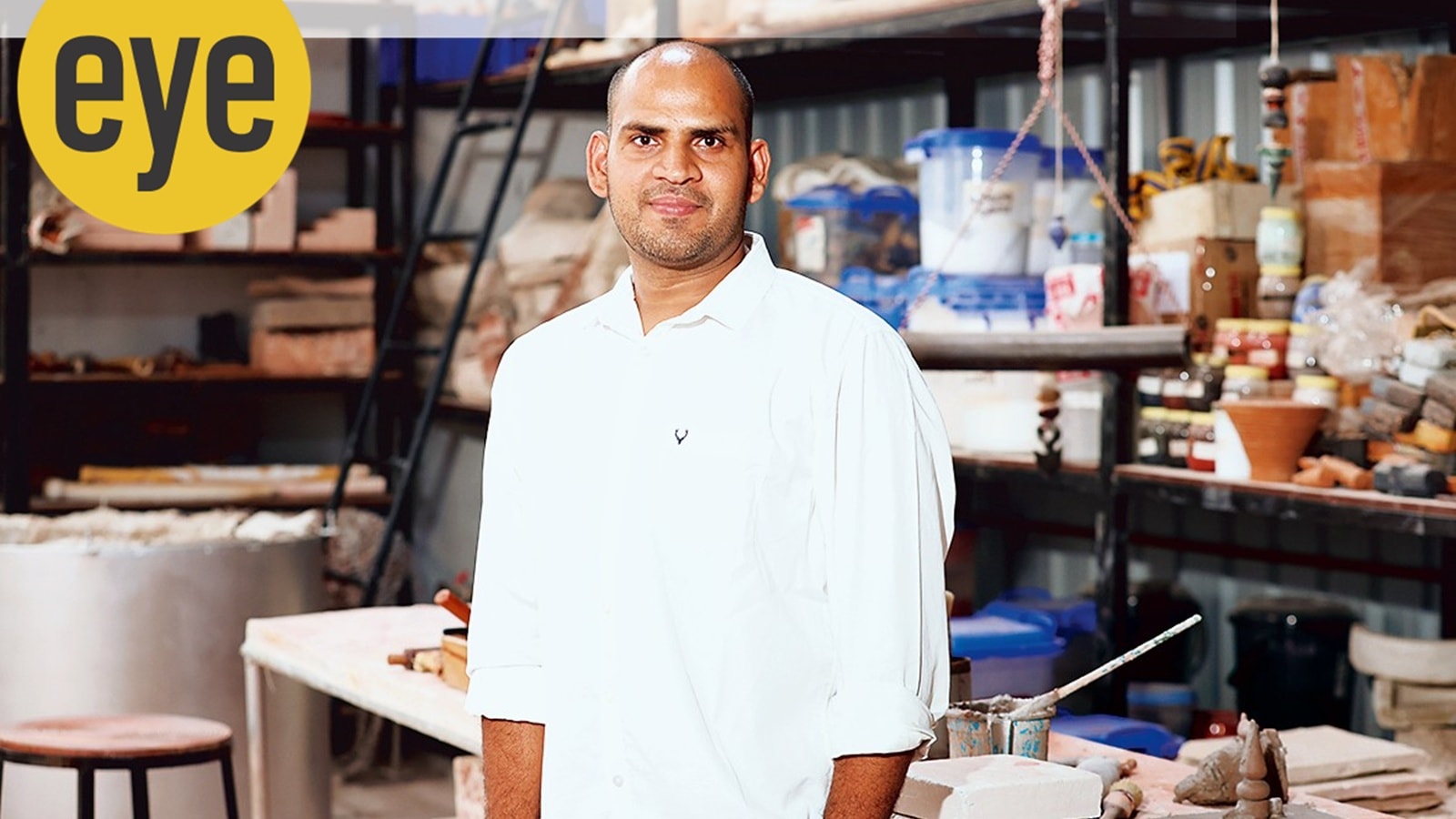
He, however, refuses to call them labourers. “They have so much knowledge. They can look at clay and tell you if it will crack or if it shouldn’t be fired. Only they know it. Yet, we don’t call them artisans, even though they are experts,” says the 34-year-old artist, as he opens one of the two kilns at his studio in Delhi’s Ghitorni to expose its snow-white insides.
The space will have you believe he is an alchemist of sorts. The kilns stand tall at the back. On the left is a shelf lined with bottles, their transparent bodies revealing the colourful condiments within. The labels read: soda ash, manganese dioxide, cobalt carbonate and so on. On the right, the shelves get bigger. So do the containers, storing larger quantities of many of the same substances — like a pantry. Strewn across the space are sculptures — a turban, a ‘potli’, a forearm, a skull — big and small, finished and in progress and, sometimes, the same piece in multiple colours.
The centre of attention, though, are the dismantled halves of two sculpted bodies, a quarter of which lies shattered in pieces. “This broke while returning from Kochi,” says Yadav, whose showcase at the sixth Kochi Biennale, ‘Only the Earth Knows Their Labour’, earned him full-time representation with the Mumbai-based gallery, Jhaveri Contemporary, with which he will have his first solo next year.
Yadav’s professional trajectory makes it seem as if he found his subject organically, but it was a rather winding road to his calling. Born in Ballia, Uttar Pradesh, he migrated to the mining town of Dhanbad in Jharkhand as a child with his blacksmith father. Having grown up around his father’s intricate drawings of tool lacing — which he recreated in clay as ‘Inherited Lines’ at last year’s Serendipity Arts Festival — he felt instinctively pulled towards art, an interest that found encouragement from his family. He went on to pursue a BFA at Banaras Hindu University (BHU, 2009-13) where, like most aspiring artists, he enrolled in painting. Unfortunately, it never spoke to him.
Things took a turn only in his final year after a chance encounter with a group of nikashi workers from Jharkhand. “They worked in the kilns in Mirzapur. We just naturally became friends and I started visiting them,” recalls Yadav. The arbitrary visits became frequent when he moved to the College of Arts, Delhi, in 2013, and routine — twice every month — when he started conducting workshops for ArtReach with the children of kiln workers. Even as he taught them to shape clay, he himself learnt more. “It was a collaboration — I brought the design, and they had the technical knowledge of firing and clay preparation,” he says.
‘Only the Earth Knows their Labour’ at the 6th Kochi-Muziris Biennale (Kochi Biennale Foundation)
But it was only during the Covid lockdown, with a physical distance between him and the kiln, that he truly processed the significance of their skill, realising how it remains undocumented. Yadav ’s practice strives to fill that gap.
“While most people make labourers the subject, I wanted to focus on their skill and technique — I come from that background and wouldn’t want someone to make a portrait of my father — and create an archive,” says the artist whose works are priced upwards of Rs 2 lakh.
The act of documentation is the driving force of his practice, and his studio is its evidence. The seemingly repetitive sculptures are test pieces that serve as logs of his experiments with clay, heat and pigments, eventually firing the ultimate act of creation. “These test pieces are like my diary. Whenever I want a particular colour, combination, shape or strength, I just go back to them,” says Yadav, whose art is an alchemy of memory, material and knowledge — both inherited and acquired.
Beginning today, a fortnightly series will feature new voices in art
View original source — Indian Express ↗
Related stories

ESPN
SportsJun 13, 2026 · 1 min
Balogun makes this USMNT side better, including it...
ESPN

ESPN
SportsJun 13, 2026 · 1 min
What's gone wrong for the Cubs -- and if they can ...
ESPN

ESPN
SportsJun 13, 2026 · 1 min
How 34 generations of ancient warrior training sha...
ESPN

The Punch
NewsJun 13, 2026 · 1 min
Soldiers destroy terrorist camp, rescue three hostages in Zamfara
The Punch