Indian Express
US lists BYD, Alibaba as Chinese military firms: What this means for their rivalry
Earlier this week, the US Department of War added major Chinese companies — including e-commerce giant Alibaba, internet search engine Baidu and EV company BYD — to an official list of “Chinese military companies” operating directly or indirectly in the US.
China’s foreign ministry said the list “unreasonably suppressed” Chinese companies and urged the US to “correct its mistaken practices.”
Chinese companies, too, criticised the move. BYD told Reuters that the decision harmed “its development achievements in the United States”. Similarly, Alibaba said it was not a Chinese military company “nor part of any military-civil fusion strategy”, and that it would consider appropriate legal action.
What is the basis of such inclusions, how does it affect their operations, and what does it say about the state of the larger US-China geopolitical competition?
Basis of links to Chinese military
The list is in accordance with Section 1260H of the William M. (Mac) Thornberry National Defense Authorization Act for Fiscal Year 2021. The Act authorises appropriations for military activities of the US Department of Defense.
Here, Section 1260H covers “Public reporting of Chinese military companies operating in the United States”. Other sub-sections under 1260 also pertain to China, including an annual briefing on Taiwan arms sales, and Congress’s views on “The aggression of the Government of China along the border with India and its growing territorial claims.”
Section 1260H defines “Chinese military company” in many ways. It can mean an entity “directly or indirectly owned, controlled, or beneficially owned by, or in an official or unofficial capacity acting as an agent of or on behalf of, the People’s Liberation Army or any other organization subordinate to the Central Military Commission of the Chinese Communist Party.” The CMC is the top decision-making body of the People’s Liberation Army (PLA).
Story continues below this ad
Or, it could mean a company identified as a “military-civil fusion contributor” to the Chinese defence industrial base. “As the name suggests, a key part of MCF is the elimination of barriers between China’s civilian research and commercial sectors, and its military and defense industrial sectors,” an earlier US government report said. MCF is seen as a national strategy of the Chinese Communist Party (CCP) to develop the PLA into a “world class military” by 2049.
The categorisation then includes entities receiving assistance from the Chinese government or the CCP under its “military industrial planning apparatus”.
Or, it can refer to entities affiliated with the Chinese Ministry of Industry and Information Technology (MIIT), including research partnerships and projects. There are several other criteria for formal classification as well.
In the list, Alibaba, BYD and Baidu were all termed military-civil fusion contributors due to affiliations with the MIIT. They were further linked to the State-owned Assets Supervision and Administration Commission (SASAC), a ministerial-level organisation directly subordinate to the State Council (China’s top administrative body).
Story continues below this ad
The updated list also includes tech companies — such as the robotics company Unitree (which made the infamous robodog displayed at the AI Impact Summit in New Delhi this year) and the biotech firm WuXi AppTec.
What the inclusion means
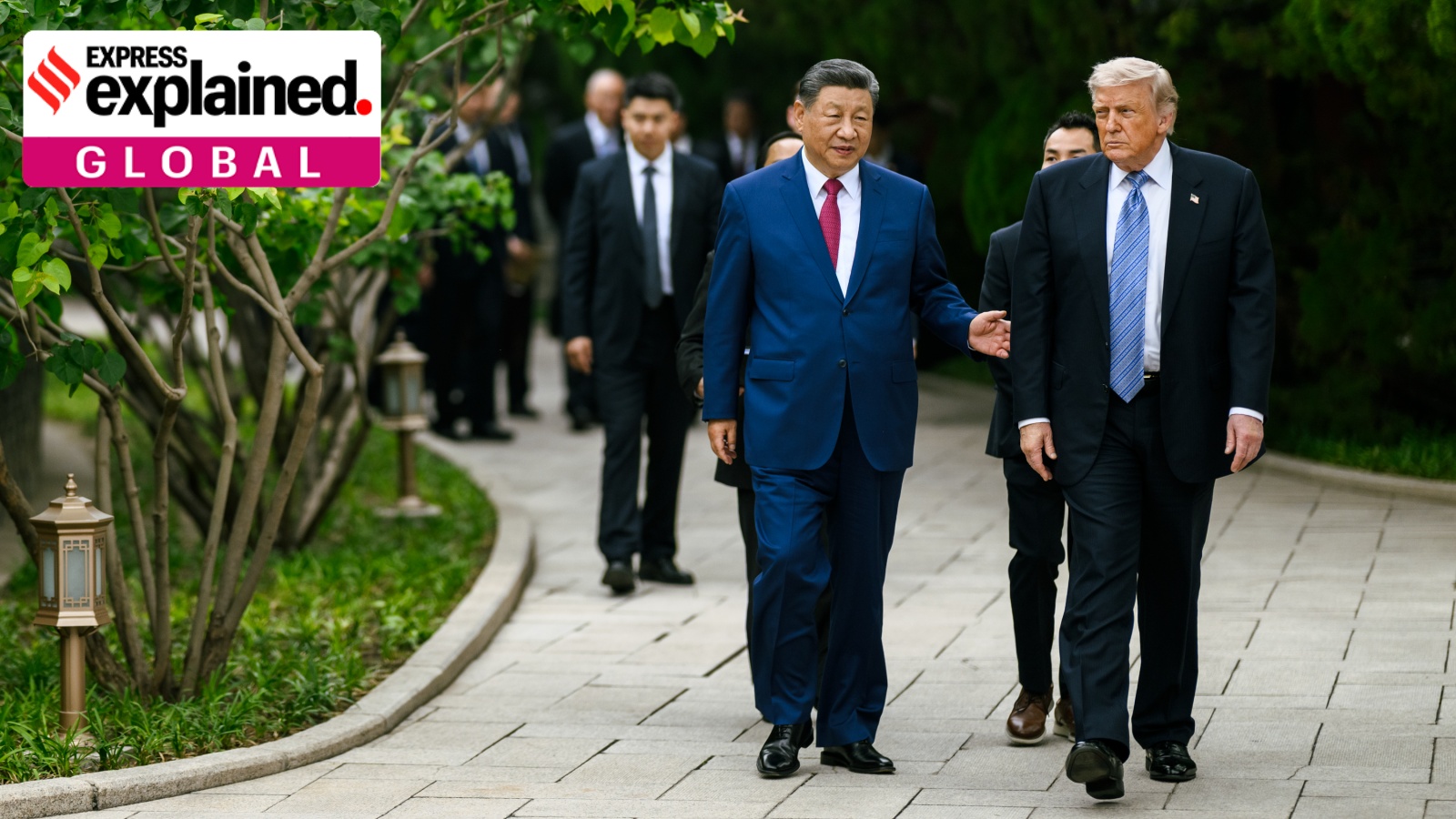
In February, BYD, Baidu and Alibaba were briefly added to the list before being removed. Speculation at the time linked the removal to US President Donald Trump’s official visit to Beijing in May. Chinese President Xi Jinping is now expected to travel to the US in September.
Though the listing does not formally impose sanctions, under a recent US law, the US Defense Department will be prohibited from contracting directly with companies on the list and from buying their products or services via third parties beginning in 2027, according to Reuters.
Earlier this month, US chipmaker Nvidia, which has frequently criticised the US government’s restrictions on its sales to China, said it was planning to work with Unitree.
Story continues below this ad
The US House Select Committee on the CCP called the development “a warning” to the American people, even calling for companies on the list traded publicly on US stock exchanges to be delisted.
Larger competition, Beijing’s unique model
For some in the US, this is a tit-for-tat move against China, which has often restricted American companies and technology from operating in the country. Most recently, China revoked a deal signed between Meta and an AI company with Chinese origins, despite the company shifting its base to Singapore.
Other Chinese restrictions, like on the supply of rare earths essential for manufacturing in defence, automobile and other sectors, have also been pointed to.
Then there is the fact that China and the CCP are deeply intertwined with private entities under its unique state model. A 2023 report from the Hoover Institute and Asia Society (The CCP Absorbs China’s Private Sector) noted: “Xi has launched a massive structural undertaking to restore the party’s political authority across China’s economic landscape.”
Story continues below this ad
This can, at times, include actions such as crackdowns and scuttling certain companies, including Alibaba, in recent years. The report said: “Xi has taken the message of party control directly to China’s private companies. He has explicitly tied their future success to their demonstrations of ‘patriotism’ — a term the party uses interchangeably with ‘party loyalty’.”
The report quoted Xi from a July 2020 speech to entrepreneurs, saying: “…I hope everyone will improve their patriotism. Enterprise knows no borders, and entrepreneurs have a motherland. Excellent entrepreneurs must have a lofty sense of mission and a strong sense of responsibility for the country and the Chinese nation.”
In turn, under the Trump administration, the US has also somewhat uncharacteristically taken steps to bring private companies under some government control. Among the most prominent examples is the government’s acquisition of a 10% stake in Intel, which manufactures semiconductors crucial for the AI sector.
Just this week, Trump said he would meet executives at top AI firms and discuss them “giving back” to the public, in reference to acquiring a public stake. National security, larger competition, and China’s way of doing things can be cited as reasons for such moves, but they would signal a changing manner of doing things. An era of greater domestic controls would also, undoubtedly, add to the complexities for countries like India, which seek to manage ties with both nations.
View original source — Indian Express ↗
Related stories

Wired
TechnologyJun 13, 2026 · 1 min
Meet the New Dyson Vacuums: V16 Piston Animal, V10 Konical, V8 Cyclone (2026)
Wired

Indian Express
TechnologyJun 13, 2026 · 1 min
5 brain-boosting habits for people in their 30s
Indian Express

Antara News
TechnologyJun 13, 2026 · 1 min
Indonesia taps Brazil for semiconductor, aerospace expertise
Antara News

Indian Express
TechnologyJun 13, 2026 · 1 min
Third IAF AN-32 crash in 10 years: All about the Soviet-origin military transport aircraft
Indian Express