VnExpress
VnExpress··3 min read
Two of the world's top study destinations are losing faith in university degrees
Public faith in a university degree has hit a record low in England, months after a similar slump in the U.S., as graduates in two of the world's top study destinations face a weak job market and rising debt.
The warning came on June 2, when the National Center for Social Research published its annual British Social Attitudes survey. Among people in England, a record 34% now agree that a university education is not worth the time and money it takes, the highest level since the question was first asked in 2005, when just 14% felt that way. As Times Higher Education noted in its reporting, it was the first time the figure had ever climbed above 20%.
The share who reject that view has fallen from 46% in 2018 to 22%, so the doubters now outnumber the believers for the first time on record. Only 36% still think graduates end up a lot better off financially, also a record low, and 77% say a degree no longer offers good value for money, up from 51% in 2014.
Alex Scholes, a research director at NatCen who leads the survey, said a difficult job market, a shrinking wage advantage and rising debt had converged to shift opinion, adding that arguments over student loan fairness and the impact of AI on jobs "have filtered through to people's views about the value of a degree."
University leaders have been making the same point. Professor Shitij Kapur, vice-chancellor of King's College London, told the Guardian earlier this year that a degree had become "like having a visa" rather than the guaranteed passport to social mobility it once was, blaming a stalled economy, an oversupply of graduates and the spread of AI for the squeeze on graduate jobs.
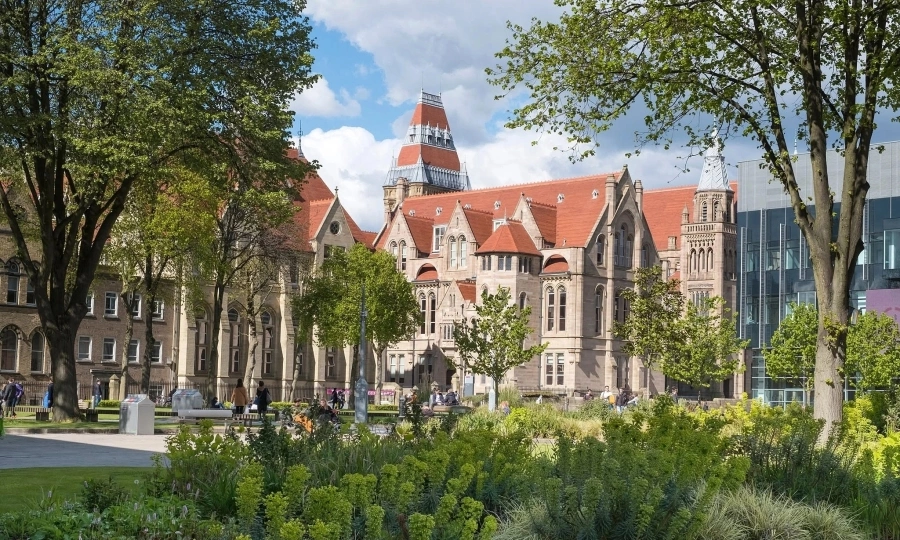
A building on the University of Manchester campus in England. Photo courtesy of the University of Manchester
The U.S. had reached the same place. An NBC News poll of registered voters in late October found 63% saying a four-year degree is not worth the cost, against just 33% who say it is. As recently as 2017, NBC found Americans split almost evenly, 49% to 47%. The pollsters called the speed of the shift remarkable, noting confidence fell across every group, including graduates themselves.
The labor-market numbers behind the mood are hard to argue with.
In the first quarter of 2026, 729,000 people aged 16 to 24 were unemployed across the U.K., 110,000 more than a year earlier, with the youth unemployment rate rising to 16.2% from 14.2%, according to House of Commons Library figures published May 19. The BBC has reported separately that more than 700,000 graduates of all ages are out of work and claiming benefits.
In the U.S., the unemployment rate for recent college graduates sat near 5.7% early this year, above the national rate, the Federal Reserve Bank of New York reported, with more than 40% of those who found work underemployed in jobs that never required a degree.
The financial premium that long justified the cost is eroding too. The extra earnings young graduates command over non-graduates in the U.K. fell from around 35% to around 24% between 2007 and 2024, according to the National Institute of Economic and Social Research, which ties the decline largely to a flood of graduates that lets employers be choosier and holds pay down.
Debt sharpens the calculation. Students in England now pay up to £9,535 (US$12,800) a year in tuition, and the government has frozen the salary threshold at which graduates start repaying their loans rather than lifting it with inflation, a move the BBC reported the Institute for Fiscal Studies has characterized as a stealth tax rise on graduates.
Analysis by the consultancy London Economics found the cumulative changes since 2022 will cost male graduates roughly £13,400 ($18,000) and female graduates about £16,900 ($22,600) more over their lifetimes. Americans, meanwhile, carry about $1.81 trillion in student debt.
Scholes said universities, as engines of social mobility and economic growth, are already under severe financial strain. If public confidence keeps sliding, he cautioned, their position only gets worse.
View original source — VnExpress ↗
Related stories

The Punch
PoliticsJun 13, 2026 · 1 min
Nigerian inmates in Ethiopia celebrate prisoner transfer deal, thank Tinubu
The Punch

ESPN
SportsJun 13, 2026 · 1 min
Hurdles remain, but UFL upbeat in 2026: 'Didn't th...
ESPN

ESPN
SportsJun 13, 2026 · 1 min
How Giants WRs stack up with Nabers, Beckham & Co....
ESPN

ESPN
SportsJun 13, 2026 · 1 min
World Cup Daily LIVE: Brazil fans take over NYC ah...
ESPN