Times of Israel
Iran said to have mined entrance to bombed nuclear site to deter raid on enriched uranium
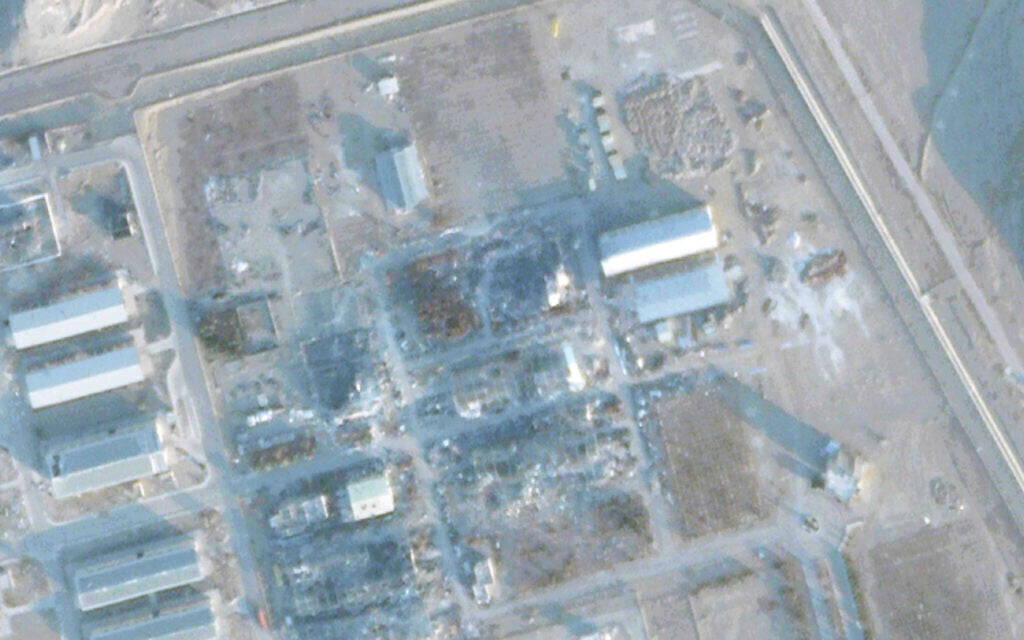
Iran has, in recent weeks, deliberately collapsed tunnels and mined entrances to its bombed Isfahan nuclear complex in a bid to stop the US from launching a raid to retrieve the Islamic Republic’s store of highly enriched uranium that is believed to be buried at the site, CNN reported Saturday.
The report, citing five sources familiar with US intelligence, said that it would now be far more difficult and dangerous for anyone, including the Iranians, to retrieve the uranium than it was at the start of the war, when US President Donald Trump mulled a ground operation to seize the nuclear stockpile.
The fate of the enriched stockpile is one of the key issues in an emerging potential deal between Iran and the US to end the war.
A former senior nuclear official told CNN that the Iranian move also raised the risk that Tehran could claim it was unable to retrieve some of the material.
If negotiators “require that Iran bring the entire stockpile to a central location for verification and ultimately to remove or downblend the material,” that would place the onus on Tehran to access and “provide the full inventory” of enriched uranium, Scott Roecker, who headed the National Nuclear Security Administration’s Office of Nuclear Material Removal from 2017 to 2021, told CNN.
Get The Times of Israel's Daily Edition
by email and never miss our top stories
By signing up, you agree to the terms
But, “in this scenario, I would worry that Iran would claim that some portion of the HEU was irretrievable,” Roecker said. “We wouldn’t have full confidence that Iran couldn’t retain access to it at some point in the future.”
A US official said Friday that the emerging memorandum of understanding with Iran “leads to” Washington getting Tehran’s stockpile of highly enriched uranium.
“We provide in the agreement that this material would be destroyed on site, and then taken out of the country,” he said.
Iran has repeatedly denied seeking nuclear weapons, but has enriched and stockpiled uranium to near weapons-grade levels while openly seeking to destroy Israel.
The highly enriched uranium is believed to be stored in the tunnel complex at the Isfahan site.
Last month, a senior Israeli military official said if the uranium wasn’t removed, the war could be considered “one big failure.”
Israel and the US launched their campaign against Iran on February 28 in a bid to destabilize the regime and destroy its nuclear and ballistic missile capacities. Iran responded with missile and drone strikes across the region, and its terror proxies in Iraq, Yemen and Lebanon have also carried out attacks.
Iran blockaded the Strait of Hormuz, a vital conduit through which about a fifth of the world’s oil supplies are shipped, while charging tolls for vessels that wanted passage and attacking others that tried to pass.
The US, in response, blockaded Iranian ships and ports to prevent Tehran from shipping any oil itself. The halt in movement through the strait has rattled global economies.
The US military said early Saturday that forces had “downed” several Iranian drones targeting commercial ships in the Strait of Hormuz.
“Iran launched multiple one-way attack drones in an attempt to strike commercial ships transiting the Strait of Hormuz,” US Central Command (CENTCOM), which oversees operations in the region, posted on X.
CENTCOM insisted that the strait “remains open for transit.”
View original source — Times of Israel ↗
Related stories

Wired
TechnologyJun 13, 2026 · 1 min
Meet the New Dyson Vacuums: V16 Piston Animal, V10 Konical, V8 Cyclone (2026)
Wired

Indian Express
TechnologyJun 13, 2026 · 1 min
5 brain-boosting habits for people in their 30s
Indian Express

Antara News
TechnologyJun 13, 2026 · 1 min
Indonesia taps Brazil for semiconductor, aerospace expertise
Antara News

Indian Express
TechnologyJun 13, 2026 · 1 min
Third IAF AN-32 crash in 10 years: All about the Soviet-origin military transport aircraft
Indian Express