Indian Express
Knowledge Nugget | Why are corals being moved? Understanding coral reefs and their Importance
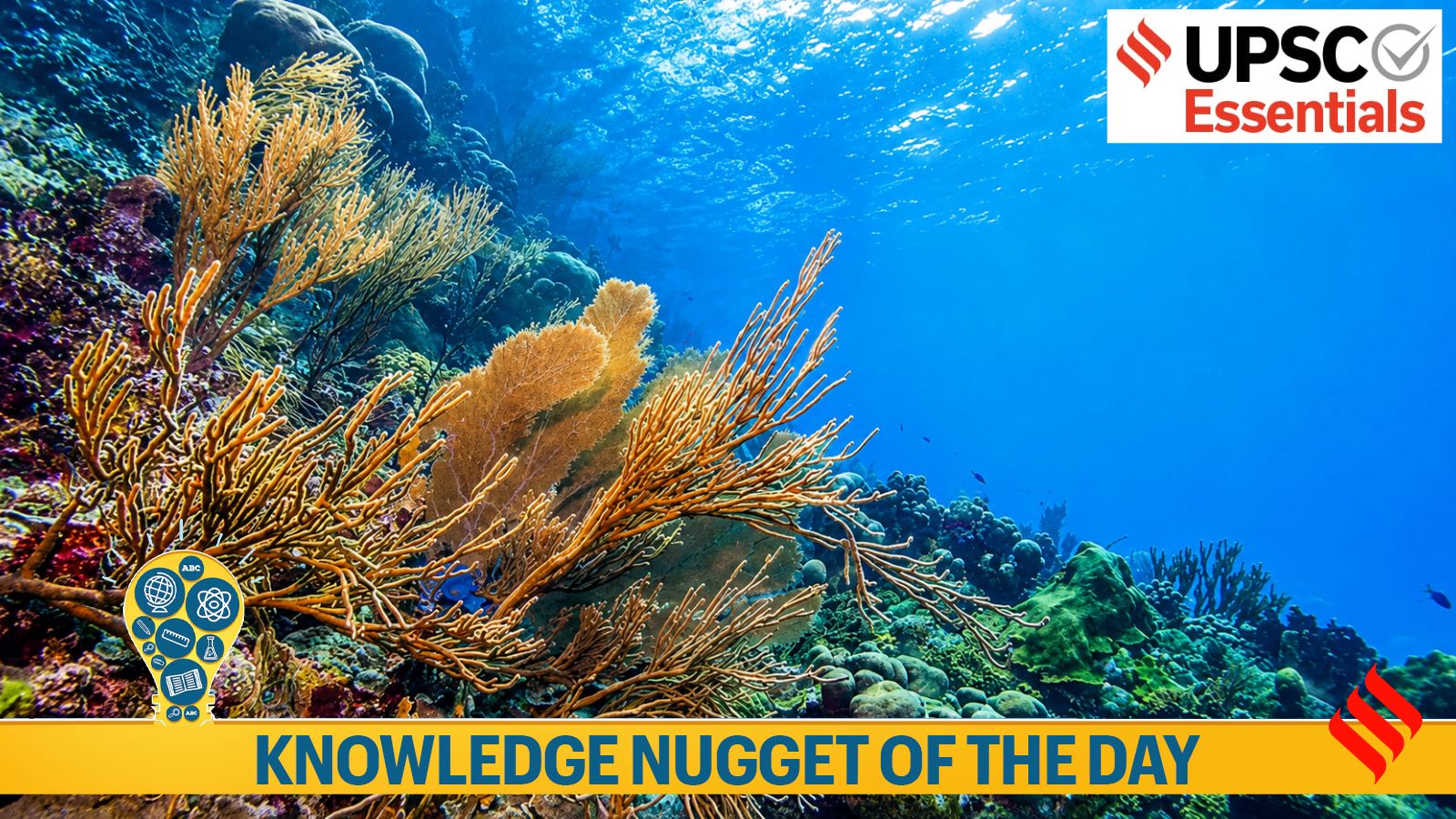
Coral reefs are referred to as the “rainforest of the sea”; their translocation is important for ecological and economic reasons. In UPSC Prelims, questions on this topic have been asked previously; therefore, understand its significance and related terms for your exam preparation
Coral colonies and giant clams will be translocated from Galathea Bay as part of environmental mitigation from the transhipment port proposed at Galathea Bay as part of the Great Nicobar Island (GNI) mega project, the Zoological Survey of India (ZSI) has said.
But what exactly is coral translocation? Why are coral reefs considered among the most valuable ecosystems on Earth? What is this GNI mega project?
5 Questions • Coral Reefs, Translocation & GNI Mega Project
Q1 of 5
Under which Schedule of the Wildlife Protection Act, 1972 are coral reefs protected in India?
Schedule III Schedule V Schedule I
In India, coral reefs receive the same level of protection as tigers and elephants — under Schedule I of the Wildlife Protection Act, 1972.
Next →
Q2 of 5
Which organisation identified four new translocation sites on the west coast of Great Nicobar Island for coral colonies and Giant Clams?
Wildlife Institute of India (WII) Zoological Survey of India (ZSI) National Green Tribunal (NGT)
ZSI identified four new translocation sites on the west coast of Great Nicobar Islands and will undertake the translocation of coral colonies and Giant Clams prior to commencement of project works, as per Environmental Clearance conditions.
Next →
Q3 of 5
What are the microscopic algae living inside coral cells — responsible for corals' colourful appearance — called?
Phytoplankton Cyanobacteria Zooxanthellae
Zooxanthellae are microscopic algae that live inside coral cells. They perform photosynthesis, bringing vital food and nutrients to corals, and are responsible for their characteristic colours.
Next →
Q4 of 5
The Great Nicobar Serpent Eagle is listed as Endangered on the IUCN Red List and comprises fewer than how many mature individuals?
500 750 250
The Great Nicobar Serpent Eagle (Spilornis klossi) is the world's smallest eagle. It is listed as Endangered on the IUCN Red List and comprises fewer than 250 mature individuals.
Next →
Q5 of 5
Galathea Bay is globally significant as a nesting site for which species?
Olive Ridley Sea Turtle Leatherback Sea Turtle Green Sea Turtle
Galathea Bay is one of the most crucial nesting sites globally for the Leatherback Sea Turtle (Dermochelys coriacea), listed as Vulnerable on the IUCN Red List and under Appendix I of CITES.
See Results →
/ 5
correct answers
Share your score
Key takeaways:
1. ZSI informed this development to the committee overseeing the implementation of biodiversity-related issues during the fourth meeting in November last year. The minutes of the meeting were made public by the Andaman and Nicobar Island Integrated Development Corporation Ltd (ANIIDCO) only on June 10.
2. ZSI has identified “four new translocation sites on the west coast of Great Nicobar Islands and undertake the translocation of coral colonies and Giant Clams from the project impact area as per EC (Environmental Clearance) and CRZ (Coastal Regulation Zone) clearance conditions prior to the commencement of project works”.
On-map location of Galathea Bay (File photo)
3. In compliance with the condition for granting Environmental Clearance, an environmental management plan is implemented. In this regard, three independent Monitoring Committees are formed. These are:
(a) Committee to oversee biodiversity-related matters.
(b) Committee to oversee pollution-related matters.
(c) Committee to oversee welfare and issues related to Shompen and Nicobarese.
Story continues below this ad
4. The biodiversity-related committee is tasked with overseeing wildlife conservation plans and actions to mitigate the project’s impact on the endemic Nicobar Megapode, leatherback marine turtles, saltwater crocodiles, Nicobar Macaque, Robber Crab, coral translocation, and other birds found only on the island.
Species
Conservation Status
Nicobar Megapode (Megapodius nicobariensis)
Endemic to Nicobar Island
Commonly known as the “thermometer bird”
IUCN Red List: Vulnerable
Leatherback turtles (Dermochelys coriacea)
IUCN Red List: Vulnerable
Appendix I of CITES
Galathea Bay is one of the most crucial nesting sites globally for the leatherback sea turtle.
Great Nicobar Serpent Eagle (Spilornis klossi)
World’s smallest eagle
Comprising fewer than 250 mature individual
Story continues below this ad
IUCN Red List: Endangered
Nicobar Long-tailed Macaque
IUCN Red List: Vulnerable
Appendix II of CITES.
Schedule I of Wildlife (Protection) Act, 1972
Nicobar Parakeet (Psittacula caniceps)
Endemic to the Nicobar
IUCN Red List: Near Threatened
Nicobar Scops-owl (Otus alius)
CITES Appendix II
IUCN Red List: Near Threatened
(Source: IUCN Red List, ZSI)
Story continues below this ad
Before we move to understand coral translocation, let’s understand what coral reefs are.
5. Corals are animals from the phylum Cnidaria. They comprise hundreds to thousands of living organisms called polyps, each only a few millimeters in diameter. Each polyp has stinging tentacles to capture food such as plankton and small fish. It lives in groups of hundreds to thousands of genetically identical polyps known as a ‘colony’, which is recognised as coral.
6. Corals are characterised as either hard or soft coral. The architects of coral reefs are hard corals, which form complex three-dimensional structures over thousands of years.
7. At the coral base is a hard, protective limestone skeleton called a calicle, which forms the structure of coral reefs. Reefs begin when a polyp attaches itself to a rock on the seafloor, then divides, or buds, into thousands of clones. The polyp calicles connect to one another, creating a colony that acts as a single organism.
Story continues below this ad
8. The reason for the colorful appearance of corals is the microscopic algae that live inside coral cells, called zooxanthellae. These algae perform photosynthesis, bringing vital food and nutrients to the corals.
What is the significance of coral reefs?
Protection from big storms and floods. Coral reefs act like low-crested breakwaters and absorb 97% of wave energy.
Underwater cities that support marine life. A single reef can support thousands of different marine species.
Act as ‘wave breaks’ between the sea and the coastline and minimise the impact of sea erosion.
Produce commercial goods and services worth around $375 billion every year.
New ingredient source for some medicines to be explored by scientists. Eleutherobin, that is believed to slow cancer cell growth is found in a common species of soft coral
Referred to as “rainforests of the sea”, existed on the Earth for nearly 450 million years. Australia’s Great Barrier Reef is the largest in the world, stretching across 2,028 kilometres.
In India, coral reefs are protected in the same way as the tiger or elephant, under Schedule I of the Wildlife Protection Act (WPA), 1972.
How are Coral reefs translocated?
1. ZSI is dedicated to monitoring coral reef translocation. For restoration purposes, it successfully moved over 16,000 corals in the Gulf of Kachchh to new locations. In a project in the Andaman Islands since 2017, ReefWatch Marine Conservation has transplanted coral fragments on to nine artificial structures totalling a 20 square metre area.
Infographics from NotebookLM
2. In a three-year-long project in Sindhudurg, corals were cultivated — fragments of corals were taken and attached to concrete frames with the help of nylon threads — and then left on ocean beds at a depth suitable for their growth.
3. Some experts are of the view that for a high survival rate, it is important to translocate corals in a place with similar environmental characteristics such as depth, current flow, amount of light, and pressure.
Story continues below this ad
BEYOND THE NUGGET: Great Nicobar Island (GNI) Mega Project
1. In February 2026, the National Green Tribunal (NGT) cleared the way for the government’s Rs 81,000-crore Great Nicobar mega infrastructure project, noting its “strategic importance” and observing that there were “adequate safeguards” in the project’s environmental clearance.
2. Great Nicobar Island covers 910 sq km and is home to India’s southernmost location, Indira Point.
3. The government’s main goal on the island is to create an economic and defence hub. This goal rests on four pillars:
An integrated township that will include defence facilities
A transshipment port
A civil and military airport
A 450-MVA gas and solar power-based plant
4. Initially driven by NITI Aayog, the project’s implementing agency is now the Andaman and Nicobar Island Integrated Development Corp Ltd (ANIIDCO).
Story continues below this ad
5. Of the cumulative area earmarked for the project, around 149 sq km will be used for the integrated township, 8.45 sq km for the new airport, 7.66 sq km for the port and .39 sq km for the power plant. The integrated township will include residential, commercial, tourist, logistics and defence facilities.
6. The transshipment port will be located on the southern tip of Great Nicobar at Galathea Bay, an ecologically important area that is home to the nesting sites of Leatherback turtles, and where the Galathea River drains into the sea.
Post Read Questions
(1) Consider the following statements: (UPSC CSE 2018)
1. Most of the world’s coral reefs are in tropical waters.
2. More than one-third of the world’s coral reefs are located in the territories of Australia, Indonesia and Philippines.
Story continues below this ad
3. Coral reefs host far more number of animal phyla than those hosted by tropical rainforests.
Which of the statements given above is/are correct?
(a) 1 and 2 only
(b) 3 only
(c) 1 and 3 only
(d) 1, 2 and 3
(2) Which of the following have coral reefs? (UPSC CSE 2014)
1. Andaman and Nicobar Islands
2. Gulf of Kachchh
3. Gulf of Mannar
4. Sunderbans
Select the correct answer using the code given below:
(a) 1, 2 and 3 only
(b) 2 and 4 only
(c) 1 and 3 only
(d) 1, 2, 3 and 4
(Note: Coral reefs require pristine, clear sunlight, high salinity to grow. However, at Sunderbans influx of river sediments create muddy and low salinity conditions.)
Answer Key
(d) 2. (a)
(Sources: Coral reefs damaged: What’s the big deal?, How corals off Mumbai’s coast will be moved, As NGT clears Great Nicobar project, a look at its strategic importance and ecological fallout, 4 sites on Nicobar west coast identified for coral translocation, says Zoological Survey of India)
Subscribe to our UPSC newsletter. Stay updated with the latest UPSC articles by joining our Telegram channel – IndianExpress UPSC Hub, and follow us on Instagram and X.
🚨 Click Here to read the UPSC Essentials magazine for May 2026. Share your views and suggestions in the comment box or at [email protected]🚨
View original source — Indian Express ↗
Related stories

Antara News
TechnologyJun 13, 2026 · 1 min
Indonesia taps Brazil for semiconductor, aerospace expertise
Antara News
Indian Express
TechnologyJun 13, 2026 · 1 min
Third IAF AN-32 crash in 10 years: All about the Soviet-origin military transport aircraft
Indian Express

Times of India
TechnologyJun 13, 2026 · 1 min
'Baseless': Iran lashes out after US blames Tehran of attacking ships with Indians onboard
Times of India

The Guardian
TechnologyJun 13, 2026 · 1 min
UK sets out AI infrastructure push at London Tech Week – how does it stack up?
The Guardian