Indian Express
Indian Express··4 min read
Hidden behind FC Road’s bustle, this Pune coffee shop has served connoisseurs for decades
On FC Road, where every shop vies for attention, Kumaradhara Traders has remained tucked away behind other establishments for more than three decades. Coffee connoisseurs arriving at Goodluck Chowk turn into a narrow lane beside a restaurant that claims to serve Pune’s best biryani.
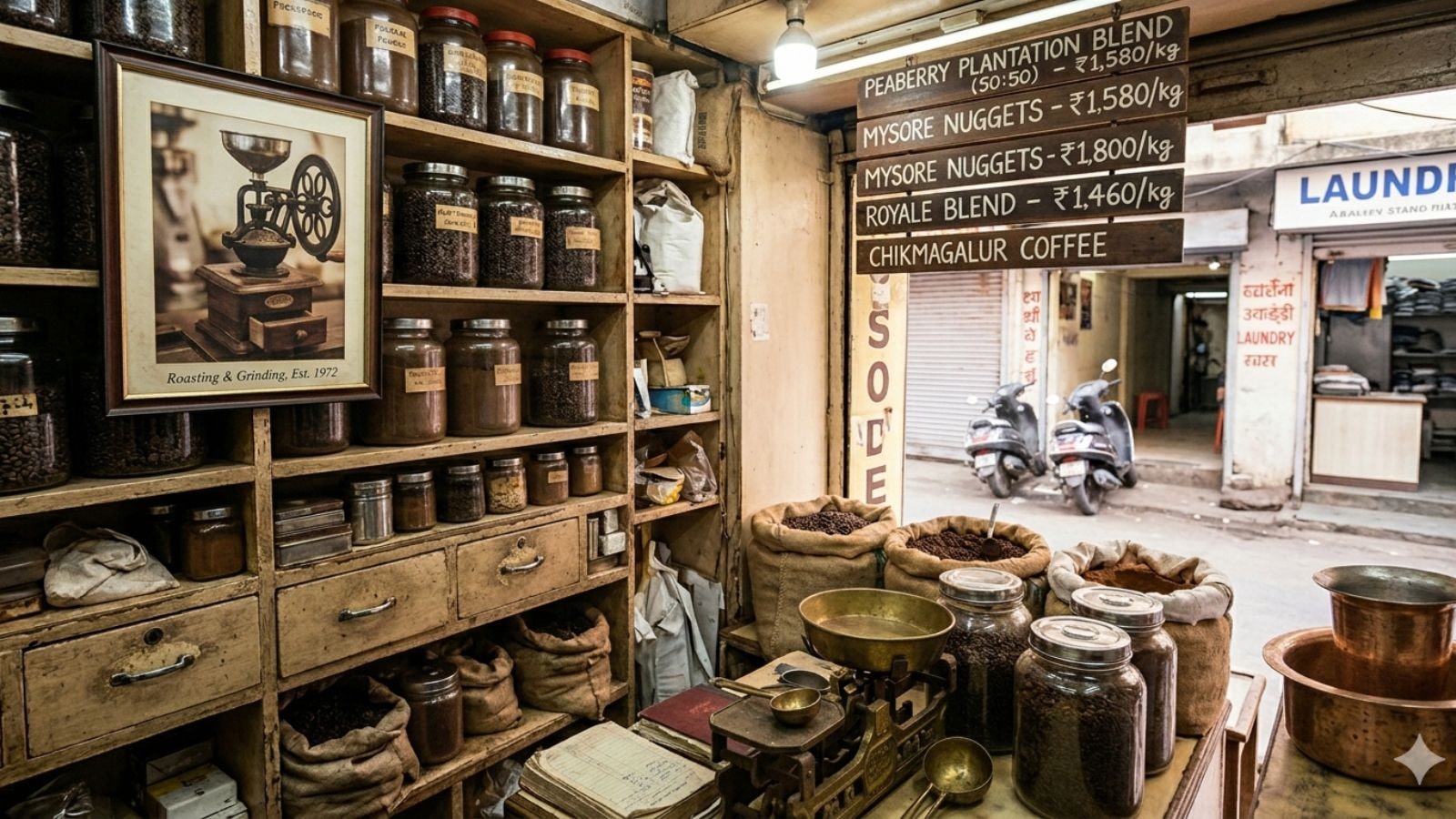
They walk past a two-wheeler parking area, ignore the backs of shops and the spicy aromas wafting from nearby eateries, and finally slow down before a laundry. Next door is their destination — a 12×12-ft outlet that welcomes them with the smell of freshly ground coffee and the rustle of beans dropping into weighing scales.
“Long before the Garware Bridge was built, this shop came up on the other side of FC Road. It was 1972, and he was the person who started this adventure,” says Ajit N Raichur, pointing to a framed photograph of the founder.
The photograph is of NR Katti, who retired from Burma Shell Oil Company at the age of 50.
“He wanted to keep himself physically active, so he explored different lines of business, including restaurants and grocery shops. Coffee was one area where there were hardly five or six businesses in the whole of Pune. Only South Indians used to drink coffee at that time,” says Raichur.
The shop sold only five varieties of coffee for its first 47 years. That changed when Raichur’s son joined the business and expanded the range to 27 varieties.
The store carries the nostalgia of an old photograph. Drawers and shelves are crammed with coffee beans and powders. A board lists different varieties, including Arabica coffees such as Peaberry, described as offering “good flavour and light decoction”. Robusta is available in premium grades sourced from a single estate and is known for its “very good aroma and very light decoction”.
Story continues below this ad
Mysore Nuggets is the only grade noted for both aroma and strength, while Thogarihankal HSD is described as having the “best aroma”.
Raichur sits in front of a computer but admits he “belongs to the old school of thought”. He joined the shop as its first salesman at the age of 20, earning a salary of Rs 120 per month.
The best-selling Peaberry coffee cost Rs 13.50 per kg in 1972. Today, it sells for Rs 1,600 per kg.
Prices are prominently displayed on boards around the shop. A Peaberry-Plantation (50:50) blend costs Rs 1,580 per kg, while the Royale Blend is priced at Rs 1,460 per kg. All the coffee comes from Chikmagalur in Karnataka, popularly known as the ‘Coffee Land of India’.
“There was another variety of coffee from Araku Valley in Andhra Pradesh. A gentleman who had spent many years in the US thought of bringing together local coffee growers from Araku who produced excellent coffee but lacked marketing expertise. It took him about five years to organise and train them. That coffee sold for Rs 6,500 per kg. Buyers appreciate the flavour,” says Raichur.
Story continues below this ad
Among the more distinctive offerings is a variety called Kusum, known for its floral notes of rose and lavender.
Raichur recognises most of his customers, including drivers sent by industrialists to pick up several kilograms of coffee at a time. If you drink coffee at a Udupi restaurant in Pune, chances are it came from Kumaradhara Traders.
The shop supplies coffee to 105 Udupi restaurants across the city. Raichur says landmark eateries Vaishali and Roopali are among its biggest customers.
“They use the Peaberry Plantation Blend. It offers a fine taste,” he says.
Story continues below this ad
Thanks to his son, who has undergone extensive training in coffee, several new cafes have also begun sourcing their beans from the shop.
“At the Sawai Gandharva Festival, we have had a stall for many years. Our Sawai Blend sells out during the five days of the festival,” says Raichur.
Another source of pride is the in-house Katti Blend, named after the founder. Its ingredients remain a closely guarded trade secret.
View from Brazil
A year and a half ago, coffee crops around the world suffered because of El Niño, a natural climate phenomenon characterised by unusually warm sea surface temperatures in the central and eastern tropical Pacific Ocean.
Story continues below this ad
India accounts for about 4.5 per cent of the global coffee market, while Brazil contributes nearly 45 per cent. When Brazil and Vietnam, which accounts for around 18 per cent of global supply, experienced poor harvests, demand for Indian coffee exports surged.
“This resulted in a shortage here and prices rose,” says Raichur.
While the United Nations’ weather agency has warned that a moderate to strong El Niño could develop in the coming months, Raichur says current forecasts point to a record coffee yield in Brazil.
For coffee lovers, that is certainly something to raise a cup to.
View original source — Indian Express ↗
Related stories

The Punch
PoliticsJun 13, 2026 · 1 min
Nigerian inmates in Ethiopia celebrate prisoner transfer deal, thank Tinubu
The Punch

ESPN
SportsJun 13, 2026 · 1 min
Balogun makes this USMNT side better, including it...
ESPN

ESPN
SportsJun 13, 2026 · 1 min
What's gone wrong for the Cubs -- and if they can ...
ESPN

ESPN
SportsJun 13, 2026 · 1 min
How 34 generations of ancient warrior training sha...
ESPN