Indian Express
Indian Express··5 min read
50 tonnes in, 1 tonne out: Bengaluru startup turns city garbage into green energy amid LPG crisis
At the Harohalli Industrial Estate, around 30 km from Bengaluru, trucks in large numbers can be seen moving out of a waste-to-green-energy facility. They are out to deliver biogas cylinders to dozens of restaurants around Bengaluru, including Konark Kanteerava, Konark Residency, RR Cafe, Little Food and SLV.
Sustainable Impacts, a joint venture between a start-up firm Carbon Masters, and Hasiru Dala Innovations, an NGO involved in city waste handling, converts 50 tonnes of city waste to one tonne of biogas every day. Other similar waste-to-biogas ventures of Carbon Masters–being executed in collaboration with different partners around the city–have found a growing client base amid a commercial LPG crisis that has affected hotels and restaurants in Bengaluru in the last two months.
Since March 2026, the disruptions to LPG import routes due to the West Asia crisis have led to a shortage of commercial cooking fuel across Karnataka. The state government has capped restaurant supply at 1,000 commercial cylinders daily for a city with nearly 25,000 eating establishments. Domestic households also face a mandatory 25-day gap between refills.
Every tonne of waste that arrives at Harohalli does not fill a landfill nor will it release uncontrolled methane, a harmful greenhouse gas.
A journey of discovery and realisation
Som Narayan, a law graduate and a master’s degree holder in carbon management, economics and geoscience from the University of Edinburgh, who is the co-founder of Carbon Masters, started the venture with a fundamental question: ‘Can we really reduce emissions through alternatives?’
Narayan, along with co-founder Kevin (Houston), realised that waste ending up in landfills is methane, and they had an afterthought: “Can we capture that and use it to replace other fossil fuels?”
Story continues below this ad
“You are not only solving one problem by capturing methane. You are also replacing another fossil fuel through renewable energy. So it’s been a journey of discovery and realisation,” said Narayan.
Narayan stated that the LPG crisis is a warning that must be heeded. “We need to fix this once and for all. Over the next five to ten years, we can really create local, decentralised energy that solves multiple problems,” he said.
How the facility converts waste to CBG
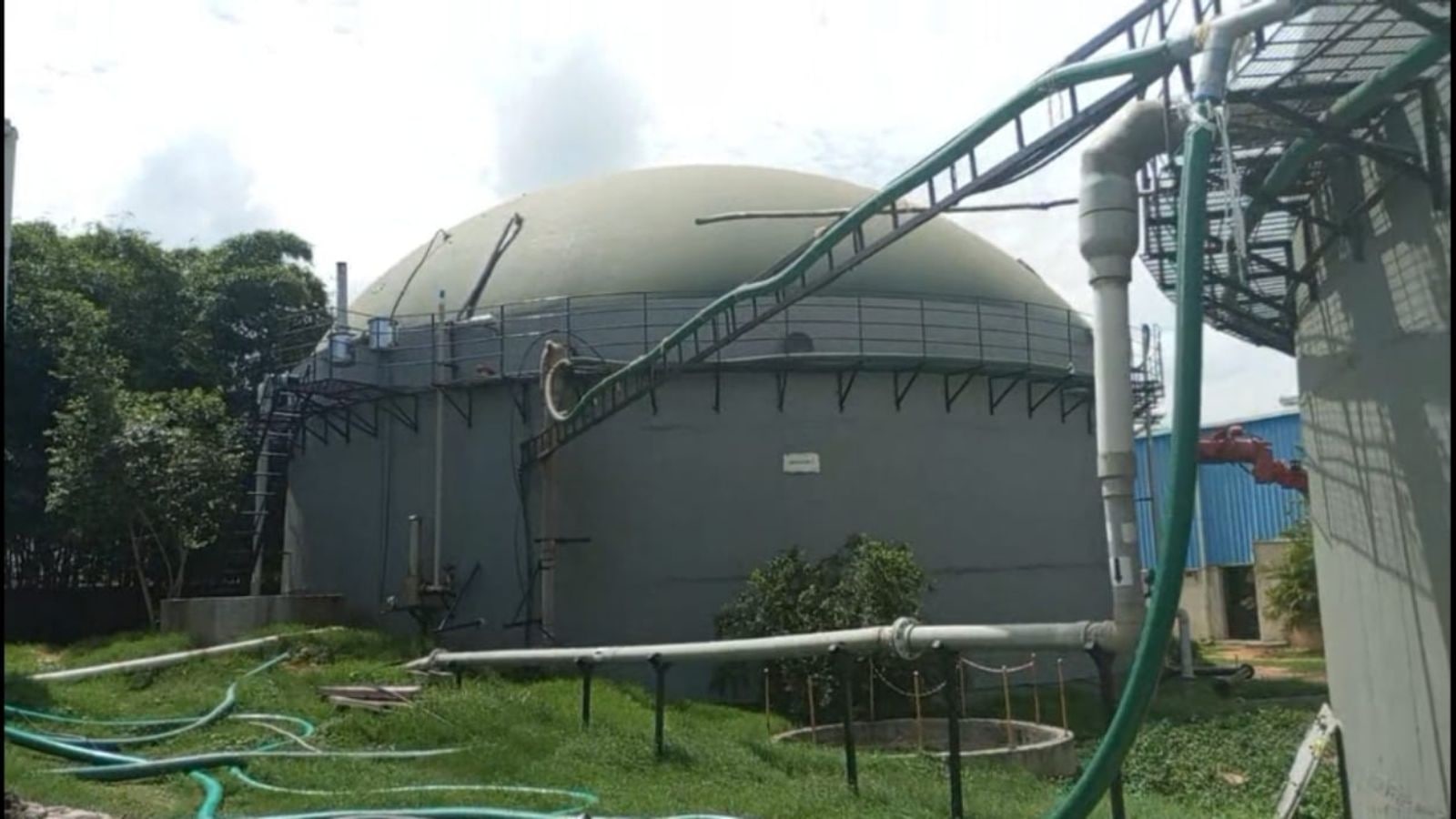
At the Harohalli joint venture facility of Carbon Masters, G E Muralidhara, the head of plant operations, explained the process involved in generating biogas from city waste. “Today 54 tonnes of municipal waste has arrived. The trucks tip their load onto a concrete receiving floor. The waste moves onto a slow-moving belt conveyor. Workers in masks and gloves manually pick out contaminants. Anything not organic cannot go into the digester. The slurry flows into a pre-digester, where pH levels are balanced and heavy sediment like eggshells and seeds settles out,” Muralidhara said. “The retention time is 30 days but because we feed fresh slurry in every day, gas is produced continuously,” he explained. The raw biogas is roughly 60 per cent methane, 30 per cent carbon dioxide, and some hydrogen sulphide. It is piped to purification units, where impurities are removed.
What comes out is 96% pure methane, which is compressed and stored as Compressed Biogas (CBG).
Story continues below this ad
Inside the Harohalli facility, slurry flows into a pre-digester, where pH levels are balanced and heavy sediment like eggshells and seeds settles out. Express/Photo credit: Mark Philip Jayan
CBG cylinders sold for Rs 120 to Rs 130 per kg
The plant’s daily output runs between 900 and 1,000 kg. The conversion ratio is fixed: 50 tonnes of waste yields one tonne of fuel. “The gas is sold for Rs 120 to Rs 130 per kg in cylinders, and Rs 90 per kg through the pipeline,” he said.
In April, the plant’s CBG was pumped directly into the GAIL (Gas Authority of India Ltd.) pipeline network for the first time. The company has a clearance for GAIL pipeline injection from the Harohalli facility.
“Around 700 kg per day now flows through that pipeline. Another 200 to 300 kg goes into cascades (for cylinders),” the plant head said.
Story continues below this ad
A commercial LPG cylinder is currently priced at around Rs 3,200. The equivalent volume of Carbonlites CBG from the start-up’s Harohalli biogas plant costs approximately Rs 2,100, roughly Rs 900-1100 less per cylinder- equivalent, according to Narayan.
Higher calorific value, more heat
Muralidhara said CBG is highly preferred by restaurants because it aligns with their environmental outlook. “It has a higher calorific value so it generates more heat and cooks the food faster… It is not anymore about just being environmentally friendly or saving costs; it can cost you the whole business itself. Several restaurants had to shut down. The ones we were supplying were able to keep their kitchens going because we produce locally and source the feedstock locally,” Som Narayan said.
Organic residue converted to fertilizer
The organic residue left after gas extraction is processed into fertilizer and distributed to farmers under the central government’s Market Development Assistance scheme, which provides Rs 1,500 per metric tonne. “The farmers get it free for now,” Muralidhara said.
Expansion plans to process 200 tonnes of waste
Bengaluru generates 3,000 tonnes of wet waste daily. Sustainable Impacts currently processes 50 tonnes of them. “We will be expanding to process 200 tonnes soon,” said Muralidhara. The Harohalli facility cost Rs 20 crore to build.
Story continues below this ad
An upcoming Kannahalli plant — a collaboration between the Bengaluru civic authorities and Carbon Masters — will process 900 tonnes daily at Rs 45 to Rs 48 crore. Carbon Masters intends to build six such plants, requiring roughly ₹300 crore in total.
Authorised waste destination for south Bengaluru
The Bengaluru Solid Waste Management Limited, which is responsible for waste management in the city, has empanelled Sustainable Impacts as the authorised waste destination for the whole of south Bengaluru, guaranteeing feedstock from bulk generators across that half of the city, according to Narayan.
However, even at full build-out, the plants will handle less than 40 per cent of the city’s wet waste.
Thrust on multiple green energy sources
Narayan clarifies that biogas is not the whole answer. “You can’t rely on one silver bullet,” he said. “You need multiple green energy sources knocking off as much fossil fuel as you can, then generate everything locally.” The challenge is the absence of a sustained government price signal, says the start-up founder.
Story continues below this ad
“When solar power first came in, pricing was Rs 17 to Rs 19 per unit. Today it is Rs 3 to Rs 4. That happened because the government held a price guarantee long enough for investment to flow. Biogas has had no equivalent commitment. There is still a lack of long-term clarity — policy with a floor price is far away,” he said.
Germany has 9,000 biogas plants. India’s national target is 5,000. “For India’s size, we should have much more; every city, every rural area with its own decentralised gas and fertiliser production,” Narayan said.
(Mark Philip Jayan is an intern with The Indian Express)
View original source — Indian Express ↗
Related stories

The Punch
NewsJun 13, 2026 · 1 min
Bandits kill 17 farmers, injure others in Zamfara community
The Punch
The Punch
NewsJun 13, 2026 · 1 min
DSS intercepts arms cache in Zamfara, nabs courier
The Punch
The Punch
NewsJun 13, 2026 · 1 min
Kebbi begins plan for new police mobile force base
The Punch
The Punch
NewsJun 13, 2026 · 1 min
Two Kogi varsity students arrested for killing 300-level student
The Punch