VnExpress
VnExpress··5 min read
Vietnamese student with severe vision loss admitted to four Ivy League schools, Stanford and Johns Hopkins
A Vietnamese woman who underwent seven surgeries from infancy, ultimately losing complete sight in her right eye, has been admitted to a series of the world's most prestigious postgraduate programs.
Dong Thi Hai Yen, 25, received admission offers for a master's program in public health at Harvard University and a community health research program at Stanford University School of Medicine in late February.
These acceptances followed earlier offers, complete with financial aid, from Ivy League institutions Columbia, Yale, and Brown, as well as Johns Hopkins University, which is globally renowned for its medical education. Columbia offered the largest financial package, providing US$60,000 for its mental health sciences program.
"I want to become a university lecturer and contribute to building a more equitable society, where people with disabilities receive both physical and mental support through social welfare," Yen said.
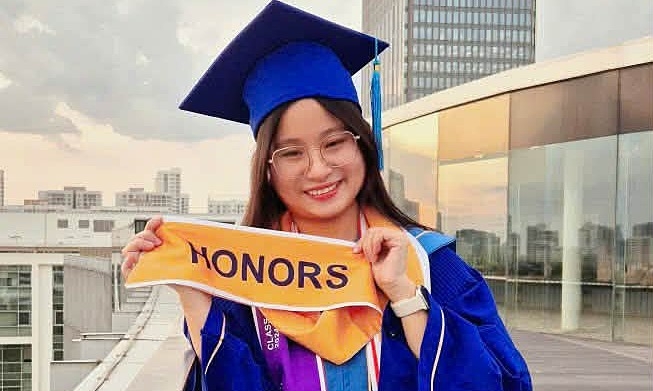
A 2024 graduate of Fulbright University Vietnam, Yen earned her degree with distinction, majoring in Psychology and Vietnamese Studies with a 3.76 GPA. She is the first person in her family to graduate from university.
Having previously served as a research intern at the Harvard T.H. Chan School of Public Health, she is currently collaborating with Professor Emily Brinck at the University of Wisconsin-Madison. Their research examines mental health and employment conditions among people with disabilities in Vietnam.
Dong Thi Hai Yen on her graduation day at Fulbright University Vietnam. Photo courtersy of Yen
A difficult start
Born in a rural area of Lang Giang District in the former Bac Giang Province (now merged with Bac Ninh), Yen suffered from a hereditary eye condition from birth. She underwent her first surgery at just 20 days old and has endured seven operations since.
Today, her left eye can only perceive blurred images within a range of about one meter, while her right eye is completely blind.
Challenges began in the first grade, when her teacher realized Yen could not see the blackboard, she had to rely on classmates to copy lessons. Her family eventually transferred her to a boarding school for students with disabilities.
She struggled academically during her first two years there, maintaining only average grades. Hoping to provide her with better opportunities, her father followed the advice of a relative in the provincial blind association and sent her to a shelter for the visually impaired in Ho Chi Minh City.
At the shelter, nuns provided a year of individual tutoring to help Yen transition into mainstream education by the third grade. Instead of standard textbooks, she studied using Braille, with some subjects requiring as many as nine volumes to cover the material of a standard two-volume set.
"Another obstacle was the way other children looked at me," Yen recalled. "I was teased so much that at one point I wanted to quit school. But I kept going because I was afraid that if I stopped studying, I would have to depend on others for the rest of my life."
Academic and athletic milestones
Fueled by determination, Yen excelled both in and out of the classroom. She became an accomplished athlete, winning 53 domestic and international medals. Her achievements include a gold medal in the women’s 1,500-meter race at the 2017 Asian Youth Para Games in Dubai.
After high school, she initially enrolled in the social work program at the University of Social Sciences and Humanities in Ho Chi Minh City, utilizing a computer equipped with screen-reading software.
Seeking an international academic environment, she eventually set her sights on Fulbright University Vietnam. She failed the entrance requirements twice due to weak English skills. However, after intensive language study in 2020, she earned a scholarship, becoming one of only two visually impaired students in the university's history.
Yen knew from the start she wanted to pursue psychology, aiming to become a counselor shaped by her own experiences in inclusive classrooms. But the transition to Fulbright's liberal arts environment, which demanded active discussion and critical thinking, was a severe culture shock.
"In my first semester, I felt like I was drowning," she said. "Sometimes I could only understand about 10% of what professors were saying, while everyone around me spoke English fluently."
She nearly failed a course, receiving a D grade. Seeking help from the university's academic support centers, she gradually adapted and caught up. By the end of her second year, she had nearly completed her psychology curriculum and added a second major in Vietnamese Studies to deepen her understanding of the country's culture and history.
Research and advocacy
Her interest in research blossomed during a psychology class taught by Professor Matthew McDonald. The two built a close academic relationship after Yen asked for his help in adapting course materials into more accessible formats. Encouraged by McDonald, she began seriously considering a future in academia.
Her graduation thesis, "Visual Impairment and the Experience of Stigma in Vietnam: A Narrative Psychological Inquiry," sparked a deep passion for research, a field she found highly meaningful and physically accessible without requiring extensive travel.
Outside of academia, Yen co-founded M-Y Blind Spa and Therapeutic Massage in 2021 to create stable, respectful employment for visually impaired individuals. She also joined The VIP Companion (VIC), a nonprofit social project that trains visually impaired people in practical skills, such as using artificial intelligence tools and writing résumés.
"I hope society will adopt a more open and equitable view of the potential of people with disabilities," she said, noting that with AI support, visually impaired people are fully capable of contributing to society just like anyone else.
These initiatives earned her a spot in the 2024 Young Southeast Asian Leaders Initiative (YSEALI) program in the U.S. and a speaking role at last year's Southeast Asian Disability Forum in Malaysia.
Professor McDonald described Yen as a leader who has made meaningful contributions to her community. "Yen also possesses intellectual curiosity, social vision, and deep enthusiasm for research and public policy practice," he said.
Yen attributes much of her success to the support of her family, teachers, and alumni from Oxford and Cambridge, who advised her on disability-related projects and her university applications.
"If students see that I cannot see but can still study and succeed, maybe I can inspire them to overcome their own difficulties," Yen said.
View original source — VnExpress ↗
Related stories

The Punch
NewsJun 13, 2026 · 1 min
Bandits kill 17 farmers, injure others in Zamfara community
The Punch
The Punch
NewsJun 13, 2026 · 1 min
DSS intercepts arms cache in Zamfara, nabs courier
The Punch
The Punch
NewsJun 13, 2026 · 1 min
Kebbi begins plan for new police mobile force base
The Punch
The Punch
NewsJun 13, 2026 · 1 min
Two Kogi varsity students arrested for killing 300-level student
The Punch