Indian Express
The worries in India’s push beyond E20 fuel — and the lessons it can take from Brazil
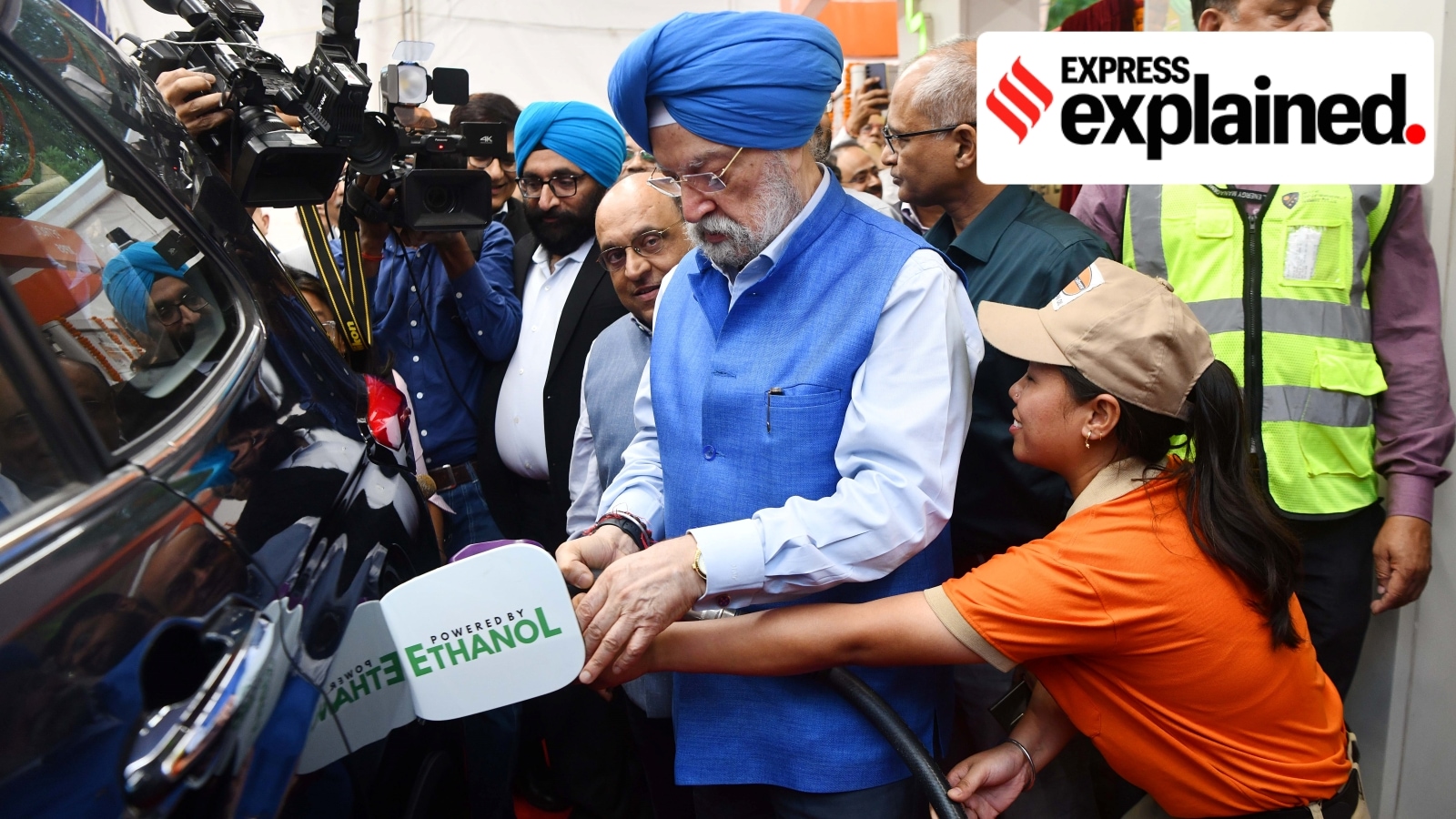
The Union government Wednesday exempted higher ethanol-petrol blends (22%-30% ethanol) from central excise duty, putting their tax treatment on a par with the 20% ethanol blend (E20) that’s currently the standard at pumps.
Both measures signal the government’s intent to prepare the country’s vehicular and fuel ecosystems for the next stage of ethanol adoption. But they also have differing implications.
The first measure — the transition from E20 fuel to higher blends — is aimed at most petrol cars.
The second move — the draft amendment to recognise E85 and higher fuel — targets an entirely new category called flex fuel vehicles. Such vehicles are designed to operate on varying blends of petrol and ethanol but are still some way away from being widely introduced to the Indian market.
For now, it is the first proposal that has caused concern among carmakers and motorists — especially considering their experience with the initial transition to the E20 ethanol blend from E10. Here’s a look at the many problems with shifting to higher ethanol blends.
The problems for consumers…
Last year, India achieved 20% ethanol blending in petrol, five years before target.
Story continues below this ad
E20 fuel, denoting 80 parts petrol to 20 parts of ethanol, is now the standard petrol variant nationwide.
For people with E10 certified vehicles or older ones, the transition to E20 came in just three years, with little warning of the pitfalls. The experience left motorists, especially those owning older cars and two-wheelers, feeling shortchanged.
There are multiple problems with using a higher ethanol blend in petrol for engines not designed for these blends.
Story continues below this ad
Engine damage: Ethanol has a higher content of water, which is corrosive. So, E20 or higher ethanol blends could damage the parts of the internal combustion engine. This is especially true for older engines and the ones used on two-wheelers, where high-grade aluminum or steel casts are not used for the engine block.
Mileage: Many customers had flagged a drop in mileage after the E10 to E20 shift. The drop could be between 5-12%, depending on when the car was manufactured. The Petroleum Ministry, however, has said that the drop in mileage would be “marginal”.
The only option: Vehicle owners in India currently do not have an option to choose different fuels at the petrol pump, unlike their counterparts in Brazil — a country that has successfully and structurally integrated ethanol with its automobile ecosystem. Brazilian law, unlike India, also provides for a discount for higher ethanol blends.
Ignition issue: Regular ICE cars running on higher ethanol blends are hard to start on winter mornings because ethanol burns at a higher temperature than petrol.
Exponentially worse performance: While a fuel with 10% ethanol (E10) makes little difference to a car’s performance, anything above that level is said to cause problems in engines that aren’t specifically built for it. And this performance worsens exponentially as the blending levels increase. The impact could be higher in the transition from E20 to E25 than from E10 to E20. E25 is what the government is now targeting as the base fuel, up from the current E20.
The Petroleum Ministry has said that these concerns around higher ethanol blends are not backed by “scientific evidence”.
A senior technical expert at a major automaker acknowledged that there are no conclusive studies on the long-term impact of blended fuel on non-compliant vehicles. But the expert also told The Indian Express that it could definitely have an impact on the engine’s life, its various rubber parts, valves and piston heads, among others.
“In case of this new transition too, the consumer will likely end up bearing the brunt of any drop in fuel efficiency. For older vehicles, there is the added question over vehicle damage due to the high ethanol mix. That too is left to the consumer,” a representative of an auto manufacturing association said.
…and for automakers
The E25 transition will require additional engineering and validation work around engine calibration, fuel-system durability, corrosion resistance and material compatibility. All this, just months after the E20 transition.
Story continues below this ad
Vehicle costs will increase and likely fall on the consumer.
Ethanol supply to OMCs.
Carmakers have flagged concerns over this rapid transition. They have called for greater policy clarity and alignment across fuel infrastructure, dispensing systems and nationwide fuel consistency before higher ethanol blends can be rolled out at scale.
Beyond that, in private, they’re willing to talk about some anomalies in this E20 to E25 transition.
“Some of the concerns have been conveyed, especially through (auto) industry representatives. Indications are that the transition towards a base fuel having a higher blend of ethanol (above E20) is likely to happen, alongside the progressive rollout of the E85-E100 fuels,” a senior auto industry executive told The Indian Express.
Story continues below this ad
Oil marketing companies such as Indian Oil and Bharat Petroleum, too, will face challenges. A government source involved in the process indicated that OMCs have made it clear that they can only offer two ethanol blends at any given point.
Why is the government pushing for blends beyond E20?
The government is looking to progressively increase ethanol blending in petrol from the current E20 level to E25, before transitioning towards flex-fuel vehicles and E85-E100 fuels.
This is an integral part of India’s strategy to reduce its dependence on imported fossil fuels — especially after the experience with the West Asia conflict that drove up prices.
India currently imports nearly 88.5% of its crude oil requirement, making the economy and energy security vulnerable to geopolitical disruptions.
Story continues below this ad
There’s a political angle too: the agricultural lobby, especially from Maharashtra and Uttar Pradesh, is pushing hard for ethanol blends to be hiked since farmers such as those growing sugarcane are sitting on significant overcapacity.
The government maintains that the rollout of higher ethanol-petrol blends will only be done after proper testing and consultations. The Bureau of Indian Standards (BIS), on May 19, also notified fuel standards for these higher ethanol blends.
According to a source in the government, the move towards blends higher than E20 is “not being pushed through in a hurry and there will be enough time given for vehicles and oil companies to gear up for this transition”. “Too much should not be read into (Wednesday’s) notification” on the excise duty exemption, said this source.
So how will this transition to higher blends work?
Story continues below this ad
In the medium term, consumers may have two categories of fuel available at petrol pumps. One would be the standard fuel — E20 today, and potentially E25 if the government pushes ahead with its plans. The other would be high-ethanol fuels such as E85 or E100.
The high blend would likely be priced lower. A consumer with a flex fuel vehicle can also consider the pricing before deciding which one to use.
Automakers say the move to E25 would require fresh tests on existing vehicles to evaluate compatibility with the higher ethanol blend.
Story continues below this ad
For new vehicles, manufacturers would have to recalibrate engines and undergo fresh emissions certification and homologation, since current models have been tested and approved using E20 fuel. Homologation, the process of certifying a vehicle’s roadworthiness, would need to be repeated for E25, just as it was done when E20 was introduced.
Ultimately, however, they will likely make a shift to flex fuel vehicles — a project that is still a work in progress, and delayed on multiple counts.
The lesson from Brazil
Brazil’s decades-long experience with ethanol-blended fuels may offer a template for how India could move forward.
The South American country has widely adopted flex fuel vehicles, driven by government mandates, price incentives for consumers, clear guidance for automakers and robust public awareness campaigns.
An ethanol fuel pump in Brazil. Wikimedia Commons
The question is whether India can replicate some of these strategies to improve acceptance of E20 and higher ethanol blends.
Brazil’s ethanol programme, which kicked-off in the 1970s, was in response to the uncertainties of the oil market. Over the next five decades, it worked to create a viable alternative to petrol by using more sugarcane-based fuels in the mix.
At nearly every petrol pump in Brazil now, people have an option to either choose between blended petrol, which typically includes 27-32% ethanol, and E100, which is pure hydrous ethanol.
Alongside that, Brazil also got carmakers to usher in flex fuel cars.
The flex fuel cars were a big hit with Brazilian consumers, largely because government price support made the blended fuel cheaper than petrol at the pump.
When Brazilians drive to a fuel pump to tank up, they get a choice of fuel mixes at different price points. In India, that is far from the case.
Ethanol also improves acceleration, an advantage in a country where Formula One racing is a national obsession. By the late 1980s, nine out of every 10 new cars sold in Brazil were capable of running on ethanol alone.
Brazil implemented its policy in a phased manner to ensure that people who had bought vehicles earlier did not feel disadvantaged.
View original source — Indian Express ↗
Related stories

TechRadar
TechnologyJun 13, 2026 · 1 min
How to watch Qatar vs Switzerland: Free Streams & TV Channels online from anywhere for FIFA World Cup 2026
TechRadar

TechCrunch
TechnologyJun 13, 2026 · 1 min
This thin under-pillow speaker helped me fall asleep without earbuds
TechCrunch

The Verge
TechnologyJun 13, 2026 · 1 min
Bose’s latest QuietComfort Ultra are $70 off, marking a new low price
The Verge

Engadget
TechnologyJun 13, 2026 · 1 min
Why your cardiologist might tell you to skip AirPods
Engadget