Indian Express
Indian Express··4 min read
Mumbai-Ahmedabad bullet train project: Why Tunnel Hoods are being installed in mountain tunnels
3 min readJun 13, 2026 07:37 PM IST
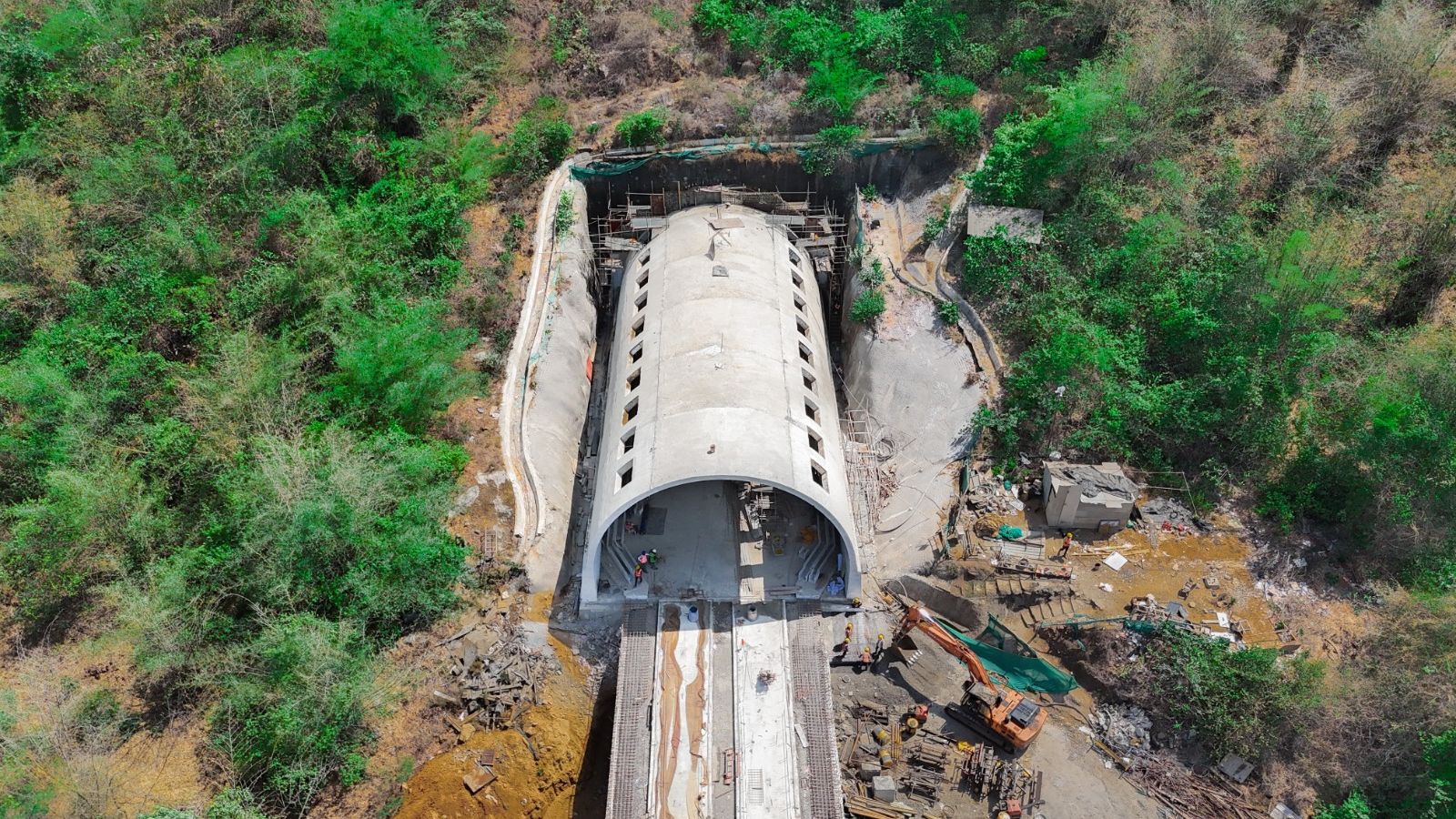
Mumbai-Ahmedabad bullet train project gets India's first Tunnel Hood technology (Image: NHSRCL)
Mumbai-Ahmedabad bullet train project latest update: The National High-Speed Rail Corporation Limited (NHSRCL) is working in full swing on the country’s first bullet train corridor, which will connect Mumbai and Ahmedabad. The 508-km-long High-Speed Rail (HSR) corridor passes through Maharashtra, Gujarat and Dadra & Nagar Haveli.
As part of the Mumbai-Ahmedabad HSR Project, the NHSRCL is now installing ‘tunnel hoods’ at the portals of mountain tunnels. “This is the first time such tunnel hood technology has been designed and implemented for railway tunnels in Bharat.
The Mumbai–Ahmedabad Bullet Train corridor traverses challenging terrain and includes seven mountain tunnels in Maharashtra, and one mountain tunnel in Gujarat. Tunnel hoods are being provided at both ends of these mountain tunnels. ” it said.
First time in India: Mumbai-Ahmedabad bullet train gets Tunnel Hood technology (Image: NHSRCL)
What Is Tunnel Hood technology?
As tunnel hood technology is being introduced in India for the first time, it is quite interesting to know about what these structures are and how it works. According to NHSRCL, the tunnel hoods are designed to mitigate the tunnel boom effect caused by pressure waves generated by high-speed trains. It is an advanced engineering solution adopted to ensure smoother train operations and enhanced passenger comfort.
🚇 Tunnel-wise Hood & Window Data 8 Tunnels
Sr.
Mountain Tunnel
Tunnel Length
Hood Length
Windows
1
MT-8Valsad
350 m
31 m each side
20 each end
2
MT-7Palghar
417 m
32 m each side
20 each end
3
MT-6Palghar
454 m
32 m each side
20 each end
4
MT-5Palghar
1.5 km
40 m each side
24 each end
5–6
MT-4 + MT-3Palghar LONGEST COMBINED
2.66 km
45 m each side
26 each end
7
MT-2Palghar SHORTEST
228 m
30 m each side
20 each end
8
MT-1Palghar
820 m
35 m each side
22 each end
7 of 8 tunnels are located in Palghar district. MT-8 is the only tunnel in Valsad. Longer tunnels have wider hoods and more windows.
Why does the Mumbai-Ahmedabad bullet train need tunnel hood technology?
NHSRCL said that when a high-speed train enters a tunnel, it pushes a large volume of air ahead of it, similar to a piston moving inside a cylinder. “This sudden compression of air generates pressure waves that travel through the tunnel. If not properly managed, these pressure waves can create booming noise, when train exists the tunnel,” it noted.
Thus, the tunnel hoods act as a transition zone between the open environment and the confined tunnel space. By allowing air to enter and exit more gradually, they help control pressure changes and improve the overall aerodynamic performance of the system.
The tunnel hoods on the Bullet Train corridor are designed to:
Story continues below this ad
Minimise tunnel boom and noise generated by high-speed train movement while exiting
Lower disturbance to surrounding communities.
Support safe and efficient operation of trains travelling at very high speeds.
🌬️ Part 1: Special Pressure-Relief Openings
One of the distinctive features of these tunnel hoods is carefully designed pressure-relief vents or windows built into the structure.
Train enters tunnel
→
Air compresses rapidly
→
Vents release pressure
→
Smoother airflow
1
Windows allow compressed air to escape gradually into the atmosphere as a train enters the tunnel
2
Reduces the intensity of pressure waves that build up ahead of a moving train
3
Minimises tunnel boom — the loud sonic effect heard when trains exit tunnels at speed
4
Helps maintain smoother airflow throughout the tunnel length
🌍 Part 2: Bringing Global Technology to Bharat
✓
Tunnel hoods are a standard feature on high-speed rail systems across the world
✓
Widely used in countries operating bullet trains at speeds exceeding 300 kmph
✓
India is now adopting this proven global technology for its next-generation rail infrastructure
⚡ Bullet train benchmark speed: 300+ kmph
“In simple terms, the tunnel hood helps the train and the air adjust to each other gradually rather than abruptly, making high-speed rail travel quieter, smoother and more comfortable,” the NHSRCL said.
What happens when a bullet train enters a tunnel? (Image: NHSRCL/enhanced with AI)
Anish Mondal is a journalist with over nine years of experience covering the railways and roadways. Currently a member of the Indianexpress.com editorial team, Anish specializes in high-impact sectors.
Professional Journey
Anish began his career at the public broadcaster Rajya Sabha Television (now Sansad TV), where he developed a foundational understanding of legislative processes and national governance. In 2018, he transitioned to digital financial journalism at FinancialExpress.com, spending nearly six years refining his expertise in market trends and corporate reporting. Before joining The Indian Express in 2025, he served as a key contributor at ETNowNews.com.
Education & Expertise
Anish’s reporting is backed by a rigorous academic background in communication and the humanities:
Master of Journalism and Mass Communication (MJMC) – Apeejay Stya University
Post Graduate Diploma in Journalism and Production (PGTVRJP) – Apeejay Institute of Mass Communication
Bachelor of Arts (English Honours) – University of Calcutta
Areas of Coverage
Connectivity: Detailed reporting on the expansion of Indian Railways and National Highway networks. ... Read More
Tags:
Ahmedabad-Mumbai bullet train
Bullet train
bullet train India
Bullet Train project
Bullet trains
Indian Railways
Indian Railways news
Ministry of Railways
View original source — Indian Express ↗
Related stories

The Punch
NewsJun 13, 2026 · 1 min
Anambra arrests pastor over child trafficking, underage marriage, wife-snatching claims
The Punch
The Punch
NewsJun 13, 2026 · 1 min
Anambra demolishes collapsed building, warns builders over safety violations
The Punch
The Punch
NewsJun 13, 2026 · 1 min
Insecurity: Ogun on high alert, deploys technology to tackle threats
The Punch

ESPN
SportsJun 13, 2026 · 1 min
Russell edges out Hamilton for pole; Antonelli thi...
ESPN