CNA
'Every chance of making history': Japan tipped to shine at 2026 World Cup
Sport
With a squad of players who are nearly all playing in Europe, observers tell CNA's Matthew Mohan that hopes are high for the Samurai Blue at this year's World Cup despite the injuries.
New: You can now listen to articles.
This audio is generated by an AI tool.
14 Jun 2026 06:00AM
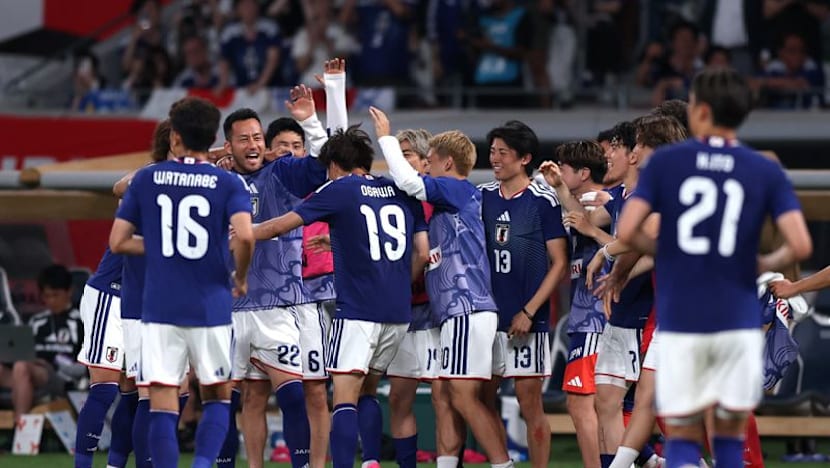
ARLINGTON, Texas: Japan have never progressed past the round of 16 at the World Cup, but this could be the year that history is made, observers told CNA.
The Samurai Blue have been tipped to do well in this year's tournament, despite injuries to key players.
Japan are grouped with the Netherlands, Sweden and Tunisia. They kick off their World Cup campaign against the Netherlands on June 14 at the AT&T Stadium in Arlington, Texas.
“I feel very optimistic about Japan's chances. This is one of the most talented and experienced squads Japan have ever had,” Albirex Niigata Singapore technical director Keiji Shigetomi said.
“The players are competing at a high level in Europe and have gained valuable experience against top opposition. If they can perform consistently, they have every chance of making history.”
Only three of Japan’s 26-man World Cup squad are playing in the domestic J1 League, with the rest plying their trade in Europe.
“They are not scared now. Two, three World Cups ago, they didn’t have this Europe (experience),” said Lion City Sailors midfielder Kyoga Nakamura, a naturalised Singaporean who featured for Japan at the 2013 FIFA Under-17 World Cup.
“This Japan team is a very strong team, I think they can compete with the best countries,” added BG Tampines Rovers defender Shuya Yamashita. “I’m quite confident they will go far.”
The Samurai Blue have impressed in the last 12 months, notching high-profile victories over Brazil and England in friendlies.
Japan are now unbeaten in seven games, with their last loss coming in a friendly against the US in September last year, when head coach Hajime Moriyasu heavily rotated the team.
Mr Dan Orlowitz, a journalist who has covered Japanese football for over a decade, said: "Japan's talent pool has never been this deep.
"You have a squad that's almost entirely players who are based in Europe, not just in Europe, but playing for top European clubs in the Champions League, in the Europa League, winning the Conference League.
“Expectations are high, everyone wants to believe that this is the year.”
And nobody is setting the tone more clearly than Moriyasu.
“Of course, the players were happy when we beat Brazil and England, two teams we had never beaten before,” he said after Japan’s 1-0 victory over Iceland in May.
“But I sensed an atmosphere where the players quickly shifted their focus to a bigger goal ahead.”
MORE DEPTH AND MATURITY
The mood was markedly different four years ago when some were calling for Moriyasu’s dismissal even before the tournament began.
Drawn with Spain and Germany in what some considered to be the most difficult group in the tournament, Japan overcame the odds.
They shocked four-time world champions Germany in their opener. A loss to Costa Rica then appeared to have dashed their hopes of progression, but Moriyasu’s team beat Spain 2-1 to top the group.
“You look at what he did at half-time against Germany and Spain, what he did at half-time against Brazil, he understands that you have to have a plan B. Not every national team coach has had that,” said Mr Orlowitz.
But there was heartbreak in the next round as Croatia eliminated the Asian giants on penalties after a 1-1 draw.
“Moriyasu deserves criticism for this – that they had not planned for penalties. Once they got there, they were just lost,” said Mr Orlowitz. “I think that he’s not going to make that same mistake twice.”
Apart from the lessons from Qatar, Mr Shigetomi believes this team is stronger.
“I think this team has more depth and maturity than the squad from the last World Cup,” he said. “They also have a better balance between experience and youth.”
LOSS OF CAPTAIN "CONCERNING"
However, preparations for the World Cup have not been all smooth sailing for Japan.
According to Japanese media, the team had to change their training pitches twice in Mexico due to poor condition of the fields.
Prior to the team’s departure, it was announced that the mercurial Brighton midfielder Kaoru Mitoma would miss the World Cup due to injury, with Monaco attacker Takumi Minamino also ruled out.
“If one of them is missing, we wouldn't stress it. Without them missing, I think we're stressing it a little,” said Mr Orlowitz.
“I’m not going to say, ‘we’re fine without Mitoma’. This isn’t as good a team as it would be with Mitoma.”
Describing Mitoma as “one of the best players in Japan”, Nakamura admitted that his absence is a blow. However, he added that there are replacements waiting.
After all, this is a team which has firepower in the form of Real Sociedad’s star man, Takefusa Kubo, Celtic’s Daizen Maeda, and Eredivisie top scorer Ayase Ueda.
“It's a team that doesn't rely on a saviour – there's no Messi, there's no Ronaldo, there's no Neymar. I think Japan kind of works best when they work as a team,” said Mr Orlowitz.
Mr Shigetomi added: "Japan's strengths are its organisation, discipline, technical quality and team spirit. The players understand their roles and work hard for each other."
In a further blow, it was announced just days before the Netherlands game that captain Wataru Endo would miss the tournament due to injury, with the 33-year-old retiring from international duty.
Borussia Monchengladbach striker Shuto Machino was called up as a replacement, with Ko Itakura named captain.
"It’s concerning in that it’s never great news for a team to need to change its captain three days before the opener. But better to do it when you can still bring in new players," said Mr Orlowitz.
"The key question is depth at central midfield; Moriyasu believes he has enough cover from defenders who have had experience in the position and that his real problem was depth at shadow striker, and that Machino could actually solve both."
Nakamura said the loss of Endo creates a difficult situation for Japan.
"Given the range of factors involved and the nature of that squad, I think it would be a problem if any player were to leave," he added.
"That said, it's not as simple as just replacing him with another player in the same position.
"This tournament is a long one. While on-pitch performance is obviously important, contributions off the pitch are just as vital."
Getting through the group stage is the “bare minimum” that is expected of the team, said Mr Orlowitz.
“The round of 32 is the landmine, and if they go beyond that, the sky is the limit,” he added.
A stern challenge could await Japan should they progress from their group, as they may face five-time champions Brazil, or Morocco, who reached the semi-finals at the last edition.
“The key is not just qualifying from the group but arriving in the knockout rounds with confidence and momentum,” said Mr Shigetomi.
“Reaching the quarter-finals should be a realistic target. Once you get to that stage, anything can happen in a knockout tournament.”
Source: CNA/mt(mi)
Related stories

The Punch
SportsJun 13, 2026 · 1 min
Japan coach apologises after ending Liverpool’s Endo’s World Cup hopes
The Punch

ESPN
SportsJun 13, 2026 · 1 min
Follow live: Ancelotti's Brazil take on Morocco
ESPN
CNA
SportsJun 13, 2026 · 1 min
Belgium's De Bruyne says fourth World Cup is one he can enjoy
CNA

ESPN
SportsJun 13, 2026 · 1 min
Follow live: Yoshinobu Yamamoto working on perfect...
ESPN