CNA
‘This person loves you but doesn’t exist’: Inside China’s romance role-playing boom
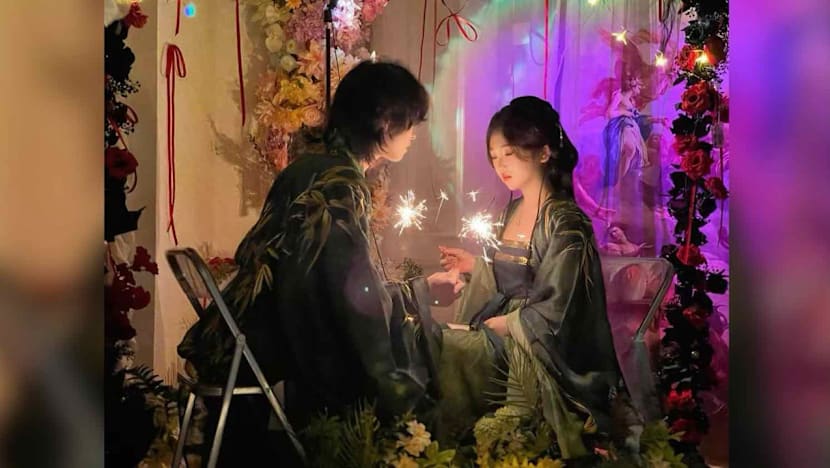
SHANGHAI: “My shepherd,” said the man, striking a match in the dark. “Do you see me now?”
The 26-year-old performer, who only wants to be known as Xiaobai, is playing Qiang Qingci - a fictional psychiatrist who erased himself from the memory of the woman he loved to keep her safe.
The woman across from him is not really Cheng Yuhuai, the war correspondent he loves in the story.
She is a paying customer.
And she is crying too hard to answer.
“I see you,” she finally says.
The lovelorn scene is part of a romance role-playing game in China known as lianpei or “love companion”, a genre which has surged in popularity especially among young Chinese women.
Adapted from traditional murder mystery games, players pay to act out scripted storylines with professional performers - taking on roles like childhood sweethearts, devoted partners or tragic lovers.
They often run for hours and can cost hundreds of yuan. Customers are mostly young women, players and performers said. At one Changzhou venue, they account for about 80 per cent of participants, a staff member told CNA.
Their rise offers what many young players describe as a form of escape and emotional release - a chance to experience emotional intimacy for a few hours without real life obligations.
Yet the popularity of scripted romance has also raised questions about where the boundaries of manufactured intimacy lie - and what happens when they begin to blur.
“You spend this money and within this (period) there's an (actor) unconditionally loving you, devotedly serving you and you alone,” said Chi Peiyao, a 20-year-old from the eastern city of Qingdao who first began playing parlour mystery games in 2018.
Back then, the games were largely something people played with friends, said Chi, who later started her own role-playing game business.
But demand shifted, she said, and mystery writers and venue operators increasingly turned to romance-focused stories.
“It's because players want it,” Chi said. “If these (romance) scripts disappeared, nobody would be even playing role-playing games right now.”
THE ECONOMICS OF FANTASY
The genre has also found huge popularity on apps like Xiaohongshu and Douyin, where the clips do the recruiting. They offer glimpses of what a session entails: an embrace from behind, a caress of the face, the “princess carry”, a lollipop passed mouth to mouth, and the lean-in before a near-kiss - all part of a trade built on manufactured affection.
Beyond the viral clips is a rapidly expanding industry.
Sessions typically involve around six players and are run by two or more performers, staged in themed rooms fitted with costumes, stage lighting and sound systems. At the higher end, some are held in professional theatre-style spaces.
Business-registry data from Qichacha shows about 178,700 jubensha-related companies registered in China as of early June. Registrations have risen for a decade, with a record 73,300 new companies in 2025.
In a survey conducted by financial news outlet Yicai, 54 per cent of around 1,000 respondents said they would be willing to try a love-companion game, while 70 per cent said the format could provide genuine emotional value.
Respondents cited loneliness, a desire to feel loved and a reluctance to pursue real-world relationships among reasons for their interest.
The emotional investment can also translate into financial spending.
In Shanghai, taking part in a romance script can cost anywhere between 300 yuan (around US$44) and 600 yuan.
There is also a “subsidy” feature, in which a player who wants a particular companion pays part or all of the game fees for other players at the table to ensure a session goes ahead.
That can push the cost of a session above 1,000 yuan, Chi said.
Extras such as costumes, styling and photography packages can add to the bill.
In some romance theatres, professional performers also interact directly with players and encourage tipping.
Chi said she knew of one woman who spent more than 200,000 yuan a month at such a venue.
“It's a bottomless pit,” she said.
For performers at the centre of these fantasies, earnings can vary dramatically.
A performer in a first-tier city like Shanghai can make around 10,000 yuan a month, according to Xiaobai, who has been in the industry for nearly five years.
Those in minor roles may earn around 100 yuan a day, while lead actors and sought-after performers make several times more.
In smaller cities, monthly earnings are typically much lower, closer to 6,000 yuan, he said.
The labour-intensive nature of scripted romance games also increases costs for venue operators.
Scripted “love companion” games require more performers and staff than conventional games, said Yanyan, 23, who asked to be identified by a nickname. She works at a scripted romance venue in Changzhou and occasionally participates in sessions herself.
“THIS PERSON LOVES YOU BUT DOESN’T EXIST”
If the feelings feel real, what happens when the game ends?
For many players, the appeal lies not in the performer but in the character.
“I think emotional scripts are fundamentally about loving a fictional character - characters entirely created by an author,” said Chi from Qingdao.
“This person loves you - but doesn't exist."
But that distinction can also be difficult to maintain.
She once dated a performer she had been paired with in a game. The relationship did not last.
“I fell for him because (he was my) lover in the script,” she said. "But the real person behind the role isn't like that."
The experience also changed how she viewed real-life relationships.
“My lovers in the scripts are all very perfect - devoted, handsome, rich, and they love me,” she said.
“So in reality it actually raises my expectations.”
Still, she is careful not to measure real partners against fictional ones.
“I wouldn't take things from emotional scripts and constrain him with them,” she said. “Those are all fake things created by an author.”
The burden of separating fantasy from reality also falls on performers.
Xiaobai said he regularly reminds players that devoted lovers they meet in games are just characters, not actual people.
“The character must absolutely not be mapped onto the performer,” he said.
Even so, he sees his work as providing something meaningful.
“I feel like I'm a dream-maker,” he said.
“They (players) experience a lifetime in the script, and I'll take them through it.”
Many players, Xiaobai said, arrive with nowhere else to put their feelings - no chance "to let themselves cry hard, or laugh well once" - and leave feeling relieved.
That, he believes, is the real purpose of the work.
THE LIMITS OF MANUFACTURED INTIMACY
Where the performance is supposed to stop is a line the industry does not always agree on.
While physical contact is permitted, at shops that follow the rules it is limited and agreed in advance.
It can range from holding hands and linking arms to resting a head on the shoulder or sharing a hug - the upper limit at shops like the one Chi ran.
"At most, actors would hold a hand or give a hug," she said. "Even kissing a hand wasn't allowed."
A real kiss, Xiaobai said, "inherently goes beyond the scope this industry should have", and if a player pushes for it, the shop will step in and end the session.
The greatest risk lies in the "small dark room", a private one-on-one scene between a player and a performer.
"A lot of shops don't install cameras," Chi said, "so very over-the-top behaviour could occur."
The harm runs both ways.
Xiaobai has been harassed by a player himself - daily messages and stalking, he said, until the shop banned her.
"It actually affected me quite a bit."
“Because of too much stress, for a while I had mild depression.”
Chi knew of a female player who pursued one male performer with intimate photos and money, then threatened to expose their exchanges when he tried to end things.
Still, those inside the trade say the worst cases are not the common ones. Chi remembers a shop that protected her from a pushy male player in her own session, keeping the two apart and walking her to her car.
Most shops now hang a notice by the door, reminding customers not to confuse the character with the performer.
The pressure to push further is commercial, not scripted.
Publishers, Chi said, "will absolutely not write explicit physical contact into the script".
It is shops and performers who add it afterwards - a player on a performer's lap, a lollipop passed mouth-to-mouth - and then film and post the scenes online.
Those clips, Chi added, are what convince outsiders that the industry is sleazy.
Videos of lingering embraces and intimate role-play regularly attract millions of views online, prompting some critics to dismiss love companionship games as little more than paid companionship.
That is the accusation players most want to refute: that what they are really buying is sex.
When one of Chi's videos on Douyin surpassed five million views, she said, the comments were filled with comparisons to male escorts.
The reaction reflects a double standard, said Mu Zheng, an associate professor of sociology at the National University of Singapore (NUS).
China, like many Asian societies, "still tends to be very gendered", she said.
Men have long paid for female companionship and intimacy, she said; women paying for the male equivalent is what is new - "but it definitely is something emerging".
That a woman would openly pay for romance is, in this still-conservative frame, a transgression, Mu added.
She also sees the popularity of romance scripts as part of a broader shift in how some young people think about intimacy.
In the past, love tended to come as a package - emotional closeness, trust, companionship and the responsibilities of building a shared life, many of which still fall disproportionately on women in China, she said.
Today, some women still want emotional connection but not necessarily the obligations that come with a conventional relationship.
And against the uncertainty of real-world dating, a few carefully scripted hours can feel like a simpler and more predictable way of getting what they want.
Players who have worked in the industry themselves tend to see the fantasy for what it is.
Yanyan from Changzhou said that she knows the performer across from her is delivering the same lines to countless others.
“I do get hooked but I’ll hold back,” she said.
“The performance doesn't fool me,” said Xiaokui, 29, who only wants to be known by her nickname.
She started playing about a year ago after previously working at an immersive role-play venue.
“When I worked in that field, I'd say the same things to players,” she added.
Mu does not view such attachments as inherently healthy or unhealthy, adding that most do not develop into meaningful real-world relationships.
But that does not make the emotions experienced during a game any less real, she said.
"If someone leaves with moments of meaningful connection, that experience was real to them," Mu said.
The risk is when occasional escapism becomes a substitute for real intimacy, she added.
“Players get to enjoy the positive side of a relationship without really bearing the uncertainty,” she said.
“That's what makes it addictive.”
Chi does not dispute that the relationship being sold is artificial.
“This kind of relationship is fake to begin with. You spend money just to experience it,” she said.
Then the game ends, the lights come on and everyone goes home.
“And that's enough.”
Source: CNA/xy(ht)
Related stories

The Punch
BusinessJun 14, 2026 · 1 min
Nigerians shifting from home ownership to rentals – Chairman, Exclusive Estates
The Punch

The Guardian
BusinessJun 13, 2026 · 1 min
Bran flakes could be classed as junk food under new guidelines to promote healthy eating
The Guardian

The Guardian
BusinessJun 13, 2026 · 1 min
UK and Japan set to agree investment deal worth £18bn
The Guardian
The Guardian
BusinessJun 13, 2026 · 1 min
One Stop shop worker sacked after trying to tackle suspected shoplifter
The Guardian