CNA
CNA··7 min read
How a restored Singapore shophouse became a home for art, Danish design and family memories
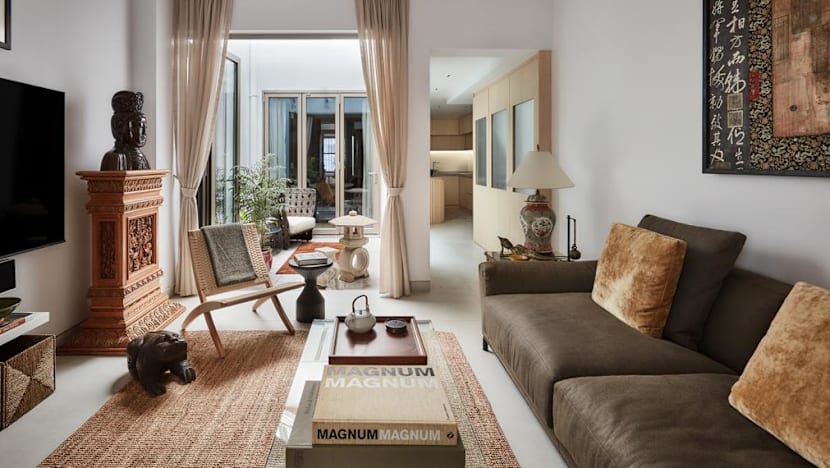
Lena Koh was born in Singapore, but life has taken her across the world. “I have lived in seven cities,” said Koh, who opened the stained glass-panelled pintu pagar of her Mount Sophia shophouse one morning. The home bears traces of those globetrotting influences, from her curated art collection and Chinese artefacts to her Danish furniture and lighting pieces – all reflecting her eye for proportion, colour and composition.
Earlier in her career, Koh worked in public relations, advertising, events and business development around the region. She spent much of the past few decades in Beijing, where she raised her children while pursuing various creative projects.
“My interest in art started in 2013 as a point of connection with my three children, who are in the arts field,” said Koh, who later attended a docent-training programme with Singapore Art Museum in 2014 and became a guide for contemporary art. She also visits biennales around the world with friends “to expand our horizon”.
She is a docent with Friends of the Museums Singapore and guides tours on the Bukit Pasoh Chinatown Trail, the Kampong Glam Trail and at the Malay Heritage Centre. “Guiding art has enriched my life by forcing me to think critically and offering different perspectives of the world. Art is the catalyst for interesting conversations,” said Koh, whose influences range from traditional practices to art shaped by technology.
Her house has become a canvas for this passion. Koh first became enamoured with shophouses in 1991, after visiting a gallery cafe in a shophouse along Heeren Street in Melaka. “I was particularly drawn to the skylight, which created a restful space with both light and air,” she recalled. She was also taken by the 19th-century architectural details, including shuttered windows, an ornate balcony and high ceilings.
It took Koh three years to find a shophouse in Singapore that suited her feng shui requirements. “The elemental positioning had to match our astrological horoscope to provide good health and stability,” she explained. She worked with Envelope Architects to restore the original shophouse at the front and build a new three-storey extension at the rear. A staircase links the two, washed with light from a steel-framed glass window beside the courtyard.
The house is featured in the newly released book Shophouses of Singapore: Beyond the Facade, which profiles 30 Singapore shophouses that have been sensitively adapted. Koh’s home stands out not only as a piece of architectural history refreshed for modern living, but also as a setting for regional art and classic design.
Her children have all grown up and left home, although they stay with her when they visit. To accommodate family gatherings – especially when everyone returns for the holidays with their families – the first storey has separate living, dining and kitchen areas, as well as two bedrooms. Communal and private spaces, good ventilation and natural daylight were also essential to the renovation. “Our architect achieved all brilliantly. I feel like I’m in a sanctuary when I’m home,” she said.
Danish furniture and lighting pieces appear throughout the shophouse. Koh likes how they “fit form and function, are timeless and are ergonomically designed”. One example is the Superellipse dining table on the first storey, designed by Piet Hein, Bruno Mathsson and Arne Jacobsen and put into production by Fritz Hansen in 1968.
Several Series 7 chairs surround the table, their backs curved to follow the natural contours of the spine. “And imagine – that was designed in 1955!” Koh said. Around the house, PH lamps by Poul Henningsen for Louis Poulsen reflect the same sensitivity to function, with their three-shade profiles designed to reduce glare.
These design icons sit alongside art and craft pieces collected during Koh’s travels. “During my many travels, I would add items that reflect my Asian background to achieve a Scandinavian-Asian aesthetic,” said Koh. Chin Kean Kok, who runs Envelope Architects with Chow Sook Quang, observed: “The house is very eclectic, but Lena has a knack for putting pieces together harmoniously.”
The front facade was preserved according to regulatory guidelines, including the pintu pagar at the main door, wrought-iron balustrades at the second-storey windows and plaster details on the external walls. “Due to fire-safety requirements, we also changed the second-storey floorboards to concrete and fire-rated the underside of the timber beams at roof level,” Chin said, referring to the pragmatic updates made to the shophouse’s old bones.
The extension added 130 sq m to the original 230 sq m footprint. Koh placed the living, entertainment and dining areas in the original shophouse at the front, with the bedrooms, bathrooms and family spaces at the rear. Between them, Chin designed the stairwell as “a brightly lit vertical gallery and library”, bringing interest to a frequently used transition space.
In the master bathroom, Koh invited Singaporean artist Alvin Goh to paint a frangipani mural. Another frangipani painting appears in the first-storey courtyard below, alongside the image of a door. “I wanted to immortalise a beloved door of this 1905 shophouse that had to be discarded because of Singapore’s humid weather,” Koh said. At her request, Goh also added a discreet butterfly to animate the scene.
Many of Koh’s art pieces relate to her mixed cultural upbringing: She is Chinese and was raised by a Malay family. Koh is also drawn to works with conceptual, social and spiritual dimensions. One example is a trapezoid metal artwork by Melissa Tan, a recipient of the 2023 Young Artist Award from the National Arts Council. Below it is a print by Singaporean artist Thomas Yang, who used bicycle tyre tracks to evoke Beijing’s Forbidden City.
The house also displays works by Koh’s children, who were exposed to art from an early age. Her eldest son, Brandon Tay, lives in Shanghai and is a multimedia artist. His work has been commissioned for events and exhibitions including the Singapore Night Festival, Singapore International Festival of Arts and Singapore Biennale 2025, Koh said.
Her second child and elder daughter, Sophia Koh Maltesen, is head of content and product affiliation for TikTok in the US. She is also the mother of Koh’s five-month-old grandson. Koh’s youngest daughter, Sara-ling Koh Maltesen, was a visual graphic designer and art director for Apple in the US. She has since relocated to London to pursue a pre-master’s course in creative arts and design at the Royal College of Art.
One of Sara-ling’s high-school artworks, titled Contaminated Victims, tackles environmental pollution and takes pride of place in the second-storey living room. “As all my children are overseas, their art keeps them close to me,” Koh said. She added that she likes juxtaposing recognised works with personal pieces of sentimental, rather than commercial, value.
The lofty living room has pitched ceilings and is lit by three facade windows and the stairwell. Here, Koh’s eye for composition is clear: A black chandelier by Italian lighting designer Gino Sarfatti for Flos hangs above a CH006 dining table and CH24 chairs from Carl Hansen & Son, while two Outline sofas from Muuto and PK22 lounge chairs by Poul Kjaerholm for Fritz Hansen are arranged for intimate conversation.
These pieces are paired with a tapestry from Chiang Mai, a side table from Morocco and wooden trunks that followed Koh from her Beijing home. “I try to mix and match, to give my personal input,” she said of her eclectic style. The trunks hold cherished memories. “They are made of camphor so you don’t get insects inside. I put my children’s baby clothes and toys inside,” said Koh, who revisited the chests’ contents after her grandson was born.
Her artefacts are not overly ornate. “Although I’m Asian, I do like clean lines,” Koh said. One example is a timeworn door found in an antique shop in China, now hung on the living room wall. “It came with a frame but because of termites, I had to cut the frame out. I thought it was not impressive if I put it on the floor as a door. That’s why I came up with the idea to put it up on the wall,” she explained.
This textural element is flanked by monochrome works that reflect Koh’s sensitivity to colour and composition. On one side is young Malaysian artist Paul Nickson Atia’s grid-like work from his Obsession series, part of Form(s) of Prayer(s) (2019); on the other is Singaporean artist Hu Qiren’s Study of Composition with Lines from 2022, whose images made with face-mask loops evoke airplanes.
Koh’s curiosity for art continues to grow. After helping with an exhibition, she became intrigued by video art and acquired a work by Singaporean artist Dawn Ng. The screen at the side of the living room is for viewing video art, rather than television.
The room also serves as the setting for the art salons Koh organises. “When I acquire a piece, I try to hold a reception at home for my friends and friends of the artist, so the artist can elaborate on his or her practice,” she said.
One recent showcase featured Singapore/Taiwan artist Benedict Yu, who created work on site. Given Singapore’s multicultural heritage, Koh is also looking to highlight Malay and Indian artists. “My dream is to support local artists in any small way I can,” she said. Her shophouse, with its layered mix of art, design and memory, is clearly well suited to that ambition.
Source: CNA/bt
Related stories

ESPN
SportsJun 14, 2026 · 1 min
Vinícius Jr. rescues draw for Brazil against Moroc...
ESPN

SBS News
NewsJun 14, 2026 · 1 min
Australian girl killed in Pakistan after botched police shooting
SBS News

BBC
NewsJun 14, 2026 · 1 min
Nigerian author accuses hospital of stalling review into her son's death
BBC

Philippine Daily Inquirer
PoliticsJun 14, 2026 · 1 min
Trump, Macron will meet over dinner after G7 summit in France
Philippine Daily Inquirer