CNA
Hidden war, underrated food, Chinese influence: I explored Laos and found it at the crossroads
Travel
On the banks of the Mekong, from Vientiane to Luang Prabang, this writer explores Laos through family travel, local food and the country’s hidden wartime history.
New: You can now listen to articles.
This audio is generated by an AI tool.
14 Jun 2026 07:48AM
We were waiting for the grandma at the khao jee pate stall to come back on her scooter. We did not know where she went or how long she would be gone for, but when she eventually returned, she had what we needed.
In Laos, we found that food stalls also doubled as makeshift moneychangers. Because the kip could not be exchanged outside of the country, we were prepared with Thai baht in hand. Luckily, the lack of a common language didn’t stop us from negotiating a rate on the grandma’s worn calculator.
LOOKING FOR LAOS
For a quick getaway in the region, Laos was often overlooked by Singaporeans partly because airfare to Vientiane was not as competitive compared with other destinations. We really had to keep an eye for the occasional promotions.
But the pace of life was slower and there were less things to do compared to more tourism-savvy Vietnam and Thailand – ideal for my ageing parents who cannot walk as much as before, and my two young children with an early bedtime. It was also easy to book a car on affordable ride-hailing apps such as LOCA.
Besides, none of us had been to Laos before and I knew my parents would enjoy sightseeing, immersing in local culture over staying in a beach resort.
I, too, wanted to see for myself the country I had heard so much about from my ethnic-Lao French friends in France. The Lao community there was among the largest outside of Southeast Asia. It was somewhat ironic that my first encounter with Lao people took place in Paris. And it was also there where I had my first taste of Lao food – mok pa, aromatic steamed fish wrapped in a banana leaf parcel.
I came to Laos expecting to see remnants of French colonisation, but forgot that so much time has passed. All that’s left were baguette sandwiches, pastries, colonial-era architecture, and a handful of French signages at government institutions.
BETWEEN VIENTIANE AND KUNMING
Only upon seeing the row of national flags flying alongside the red hammer-sickle flags of the Lao People's Revolutionary Party at Patuxai, did I recall that Laos was one of the last five communist countries in the world, alongside China and Vietnam.
What struck me more was the Chinese presence. China is Laos’ largest trading partner and investor – that much was clear from the prevalent signage, tour groups, and use of the renminbi (or yuan) as accepted currency.
One morning at a market, we saw two middle-aged female tourists from China trying to purchase local produce.
"How much is this in renminbi? You tell me,” they asked gruffly in Mandarin, gesturing at the vendor’s calculator and repeating “renminbi” several times, expecting the vendor to understand.
Opened in December 2021, the Laos-China Railway (LCR) was the US$6 billion flagship Belt and Road Initiative project that linked Vientiane to Kunming in southwestern China. As of September 2025, the LCR has recorded over 59 million passenger trips.
These new railway stations in Laos were designed in the same style as the ones in China. With Chinese signage and announcements, Chinese staff and Chinese-speaking Lao food vendors – it almost felt like we were in China.
Prior to high-speed rail, travel time via bus or minivan between Vientiane and Luang Prabang was at least eight to nine hours. The journey now took about two hours and one could easily book train tickets seven days in advance on the LCR app without a local number.
No one batted an eyelid seeing hordes of Chinese tourists ambling in the streets or Chinese tour guides live-streaming loudly on phones, promoting their services to potential customers.
Yet, Laos is struggling to service its foreign debt, half of which is owed to China for the financing of ambitious infrastructure projects like the LCR. It's unclear whether Laos is reaping the benefits from the increased tourism as shrewd Chinese entrepreneurs have set up one-stop travel businesses catering exclusively to their compatriots.
NIGHTS BY THE MEKONG
On our first night in Vientiane, we strolled to an amusement park on the banks of the Mekong River, blasting thumping dance music no one seemed to mind.
High up on the rickety mini ferris wheel, it was surreal to see we were in the capital and also on its border. Thailand was just right across the Mekong, lights twinkling in the darkness.
The ride was exhilarating until the operator walked away midway, leaving us spinning for what felt like an eternity before he finally sauntered back.
We were also lucky enough to have dinner at Doi Ka Noi, one of the best places in Vientiane to discover the diversity of Lao food before the untimely passing of its owner-chef Ponpailin “Noi” Kaewduangdee, shuttered it permanently.
Ob gai pow Linten (Linten-style slow-braised chicken) and sup pak luam (steamed vegetables tossed with sesame seeds) were standouts, delightful in every bite. Everything we ordered received my mom’s stamp of approval.
LAOS’ HIDDEN WAR
Before coming to Laos, I did not know that the United States had waged a secret war in Laos during the Vietnam War. The Central Intelligence Agency (CIA) had recruited a proxy army of Hmong fighters and carried out brutal aerial bombardment for almost a decade to counter the spread of communism.
The Cooperative Orthotic and Prosthetic Enterprise (COPE) Visitor Centre in Vientiane offered a sobering account of life in the world’s most heavily bombed country per capita, and the organisation’s work in supporting unexploded ordnance (UXO) survivors.
With about 30 per cent of the cluster munitions failing to detonate, UXO remains one of Laos’ most pressing issues today.
Despite the decades-long clearance efforts, there are still approximately 10 times more UXO in Laos than people. Tens of thousands of people, almost half of whom are children, have been maimed or killed in Laos in accidents.
At the UXO Lao Visitor Centre in Luang Prabang, I translated exhibit descriptions for my parents. Like the COPE Visitor Centre, the space was small but sufficiently informative for both the young and old. There was also a modest selection of souvenirs made with UXO aluminium available.
SLOW DAYS IN LUANG PRABANG
In Luang Prabang, we stayed at MyBanLao Hotel, built on a former CIA secret site and coincidentally Singaporean-owned. Their poolside rooms, which opened directly into the swimming pool, were a dream for those with children hankering to swim everyday.
Leaving our parents and my children at the hotel, my sister and I skipped the touristy almsgiving ceremony in favour of a pre-dawn brisk walk to the Old French Bridge followed by a roadside breakfast of comforting khao piak khao (congee).
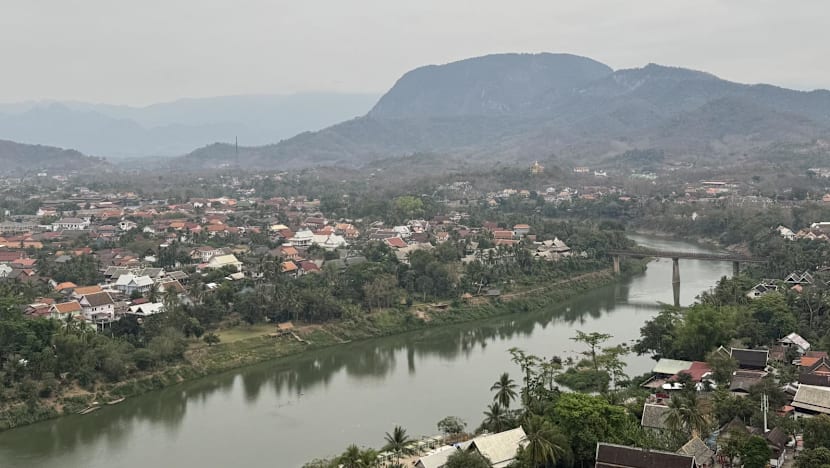
We climbed Phousi Hill twice, bringing our mother along the second time after we told her about the sweeping views at the top, of tiled rooftops amid lush greenery framed by the Mekong and the Nam Khan.
The town centre was compact and walkable but still a bit of a hike for my parents. The hotel’s free shuttle, which functioned more like a private car service to and from the town centre for most of the day, was a delightful touch we were grateful for.
“BOR PEN YANG”
We took a quick break at LuLaLao Coffee, a specialty coffee spot with locally-sourced beans roasted on-site, after visiting Wat Xiengthong, on our way to lunch at Tamarind.
While the adults ate spicy laap ped (minced duck with herbs), my children opted for khao niao (sticky rice) and sai oua (pork sausage seasoned with herbs), kneading their rice into balls “like sushi”. For once, playing with food accidentally brought them closer to the correct way of eating the dish.
Lao food seems to transcend rigid definitions by national borders. At Khaoji Pate Sihom, where we had changed money, we drank soy milk with grass jelly while chomping on khao jee pate, crunchy charcoal-grilled baguette sandwiches of pate, pork sausage, and julienned vegetables.
I feel that we do not do Lao food justice if we keep comparing it to its neighbours’ cuisines, such as Lao som tum for thum mak hoong or Lao banh mi for khao jee pate.
Just one trip in, I had already eaten a lot of delicious thum mak hoong both in the streets and in restaurants. I did not find it particularly pungent with padaek (unfiltered fermented fish sauce) and still could not tell how it differed from som tum.
I guess “bor pen yang”, as they say in Lao. It doesn’t matter. The region's history is so deeply intertwined and rooted in shared cultural ties that it is only natural for their cuisines to overlap.
Source: CNA/mm
Related stories

RNZ
EntertainmentJun 14, 2026 · 1 min
Pretending to be Trump: 'He had his hands around my neck so fast'
RNZ

Deadline
EntertainmentJun 14, 2026 · 1 min
‘Widow’s Bay’ Creator Recalls How Series Began As ‘Parks & Rec’ Episode: “Felt More Like A Spoof”
Deadline

Philippine Daily Inquirer
EntertainmentJun 14, 2026 · 1 min
Top official: Trump’s name removed from Kennedy Center facade
Philippine Daily Inquirer

The Punch
EntertainmentJun 14, 2026 · 1 min
Seek training before fame, Yemi Solade urges actors
The Punch