Indian Express
Indian Express··10 min read
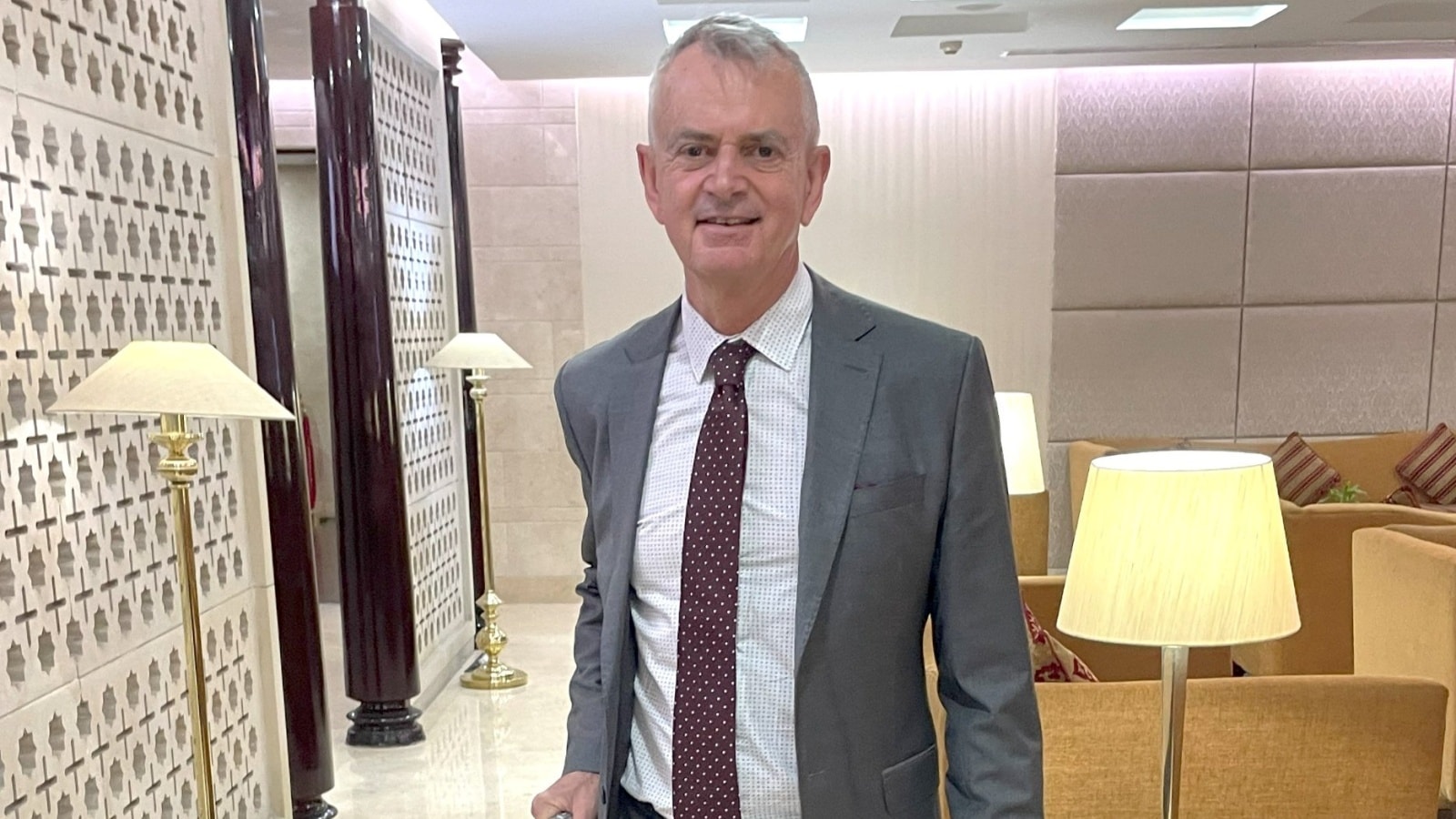
Canadian High Commissioner to India
It’s been almost a year since India and Canada hit reset and announced their new envoys after relations plummeted in 2023 over then PM Justin Trudeau’s allegation of “potential” involvement of Indian government agents in the killing of Canada-based Khalistan separatist Hardeep Singh Nijjar — a charge that India rejected as “absurd” and “motivated”.
PM Narendra Modi and his Canadian counterpart Mark Carney met at the G7 leaders’ Summit in Kananaskis in June 2025, marking the beginning of the restoration of ties. As PM Modi heads to France for the G7 leaders’ Summit next week where he is expected to hold talks with PM Carney, Canadian High Commissioner to India, Christopher Cooter, sat down for a wide-ranging interview to Shubhajit Roy, where he talked about the transformation in ties, security concerns due to Khalistan elements, cooperation in energy, defence, uranium supply, the West Asia war, and the changes he observed after returning to India where he was posted from 1997 to 2000 as a diplomat. Edited excerpts:
How did the transformation happen after PM Carney assumed office?
First, PM Carney leads a government focused on pragmatic relations with other countries. From the time he was first elected and came into office in March 2025, unexpected pressure came from the US on our economy. For 80-odd years with the US, we’ve had a very advanced relationship. And to have that challenged so directly, I think pushed the Canadian government into looking around where we can find other reliable partners.
And so a real push for diversification began in early 2025 and as the PM has said, India is the breakout country, particularly in the Indo-Pacific.
Second, a decision was taken to move the relationship forward. We had two years of trouble, tension, and he was determined to rectify that situation and move us forward in the relationship with India. India is an extremely important country for Canada and has been for decades. We’ve had our ups and downs, not only the last couple of years, but even when I was posted here in the 1990s. And I think he is committed to putting this relationship back on track. And so the two Prime Ministers met. The Prime Minister invited Prime Minister Modi to Kananaskis G7 summit back in June last year. The two saw very much eye to eye… that we both needed to go forward together. And so it was agreed at that time that the two countries would appoint their two High Commissioners, myself and Dinesh Patnaik, to resume the relationship in September. Since then, when we both arrived, things have gone much faster than we expected. Both sides have had an accelerating commitment to an improvement in the relationship.
I want to ask about the security cooperation since the concerns of security have been there from pro-Khalistan as well as criminal groups, which the Indian government has mentioned several times. How are you tackling those concerns?
I think a lot of progress has been made in dealing with that. And the main thing that has been accomplished is the establishment of trust between the relevant agencies. So that really took off not long after I arrived here, when a very senior delegation of our security officials, led by the national security and intelligence advisor, came and met the Indian counterparts, and had a very frank discussion. It was followed by discussions virtually between the two sides over the next few months. In January, NSA (Ajit Doval) came to Canada with a delegation. And so essentially, they have established a kind of a regular dialogue, institutionalizing that discussion. Now, the outcome is they know each other better. Their working methods are better known to each other, the way in which we approach an issue versus the way India approaches it. Very practical things, but we made a lot of progress over the last eight months. I think that’s just going to continue as the temperature of the relationship, that part of that relationship, which was very tense, that’s moved on, and I think we’re now in a much better place. There will be bumps in the road. But we’ve got mechanisms which will allow us to deal with things in a more professional manner.
What is the status of the investigations and the trial in the Nijjar case which had disrupted the relationship?
That’s within the judicial process in Canada. So it’s going through those stages and, and that’s really all I can say about that at this point.
Story continues below this ad
One of the fallouts of the disruption in the relationship was the issue of visas of students and travellers, because there’s a huge Indian diaspora in Canada. What is the status of that?
On the question of immigration and visas, there has been a slowing down in the last couple of years. A lot of people came to Canada. We didn’t really have housing. And for those seeking education in Canada, there were some institutions that were taking advantage of them. A lot of work has been done to clean that up. In doing so, they imposed some limits on how many students would come in. I think there was a wrong impression given in India that Canada somehow wasn’t welcome. This is not the case. And the PM himself said several times when he came here, Canada is proud to host 400,000 Indian students. That’s about 1% of our population, and that represents more students that are hosted by the EU, UK and Australia. It’s more than the US has… And in fact, those caps are not filled. There’s quite a bit of space between the cap and the number of students we’re actually receiving.
So it’s actually a good time to apply for an education in Canada, which is still, from a price perspective, excellent value. And Indian students are very highly regarded. We’ve had 26 Canadian university presidents come to India in the eight months or so… We understand that visas have been an irritant, not just that the numbers were lower or seemed to be lower, but also that it’s difficult and slow. So one of the outcomes of all these visits is we have been told in no uncertain terms by Indians, students, businesses and others that we need to reform this. We need to do better at visas. We’ve taken that on board. I don’t know where that stands right now back home in Ottawa, but I know people are looking at that very seriously. We want to make sure the experience of someone applying for a visa…that they don’t feel this was a painful process. It should be a fair process.
When PM Carney visited India early this year, the defence dialogue was established. What are the sectors of cooperation being looked at?
Our defence sector at home is ramping up rapidly. We’ve established a defence procurement office, etc, so we’re just working that out, which will undoubtedly lead to some kind of commercial links we don’t have now. We do have a small defence footprint in India and we have quite a large defence industry in Canada, but overlooked because it’s been historically quite integrated with the US. But we’re looking to diversify that and do it rapidly. So I expect something coming out of the dialogue in private sector or commercial arrangements.
We are much more interested in the Indo-Pacific than we were in the past. So the two PMs discussed cooperation in space, and we have an old MoU between ISRO and Canada Space Agency… I think we’ll see a linkage between aerospace and defence.
Story continues below this ad
The two sides have set a deadline for CEPA by 2026-end. What’s the progress? Are you confident it can be achieved by them?
I am confident because both Prime Ministers have said it shall be done. We had a long process that ended in 2023. We didn’t get very far with it. This is a fresh approach, it’s intended to be comprehensive.
With the political will being there, it will get done, and I think it will be good for both sides. So I think the trade agreement will elevate. We’ve got so much we can do together and the complementarity of the economies is so great I don’t think we’re going to let this opportunity go.
And what about the uranium deal for long-term uranium supply. India and Canada have been discussing this for at least a decade, are we going to see the uranium supply again?
Yes, so it’s not entirely new. With a shipment many years ago, we have an agreement, a nuclear agreement that goes back to 2015, we can proceed with this. Canada is a logical partner, because we have a very sizable amount of uranium. We have a lot of technology. We have the first SMR coming online in the near future. We have engineering companies that are experts in this field. So there’s a lot we can do beyond just the uranium itself.
When you’re talking about critical minerals, we’re talking about mining, energy infrastructure, and it does take a significant understanding of the path ahead. PM Carney said in his Davos speech that most of the countries are not very happy with economic coercion. They don’t want to be told you have to buy from this country or you can’t sell to that country. So when it comes to things like critical minerals, Canada offers a lot of options, and we know other countries have weaponised their source of critical minerals.
Story continues below this ad
Does the war in West Asia make a case for a stronger India-Canada cooperation?
Absolutely, I think let’s hope it ends tomorrow. Let’s hope it ends today. No more casualties, stability returns. And undoubtedly, the Gulf countries would then resume their supply of LNG, LPG… But I think in Canada we offer something that would be more reliable and stable.
So the Indian demand for energy, 35% of all growth in energy demands over the next few years will come from India. We happen to be an energy superpower. Canada has the fourth largest oil reserves in the world, the fifth largest in LNG, fifth largest in LPG, the second or third largest in uranium. It’s number two in hydro. It’s doing a carbon capture. It has fuel cell technology. We’re the only G7 country producing batteries for EVs from indigenous materials. Canada has this huge range of energy options that are available now to India.
Maybe we won’t be more than 5% or 10% of your supply, but that’s enough to remove that shortage, which puts pressure on the price because of the near-closure of the Strait of Hormuz.
It’s also beyond fuel, it’s also fertilizer which has affected urea supply. We produce urea in Canada. We have a lot of LNG for which urea is produced. But we also produce potash. We do supply some potash to you. We would love to supply more. We would give you another source of supply on fertilizer, because India’s fertilizer demands are large and growing.
Story continues below this ad
So those are two areas that the Gulf war has really highlighted… Canada is saying we offer you a partnership that is solid and reliable…
India has had a very complicated relationship with China and your PM was recently in Beijing. How do you view China’s rise and its approach in the Indo-Pacific, especially because Canada also came out with this Indo-Pacific strategy?
So, we’ve also had a complicated relationship with China. And I think the primary answer is, of course, China is going to be a huge player, not just in the Indo-Pacific, but globally… we will be adapting to that continuously. What we don’t want, however, is to be too dependent on China, both for supplies of certain things or as a market. And that drives us again to think about India as a major alternative to China. And we want to make sure Canada is diversifying more towards India. And while having a strong relationship with China, it’ll be a different kind of relationship. We’re also democracies or members of the Commonwealth. We have a large diaspora in Canada… we respect China. We want to have a good relationship with China. The PM was just there, but it will be qualitatively different with India and at the same time, the relationship will also expand. We have set 2030 for doubling trade. But I think we can be much more ambitious than that.
You were posted here 26 years ago as a diplomat. What has been the biggest change you saw after returning here?
There are obviously physical changes. Cities are bigger and that kind of thing, but the biggest change is actually the attitude. In the 1990s, you were just coming out of the license raj. Your economy was still highly protectionist and closed. When I arrived in 1997, there was a kind of defensive attitude as well. That’s gone now. Now, India is very open to the world. You had the G20 Summit… The confidence Indians have now wasn’t there 26 years ago. It’s a very nice confidence, not hubristic. Actually, we would like India to be more engaged in the world and take on a bigger role.
View original source — Indian Express ↗
Related stories

BBC Sport
SportsJun 14, 2026 · 1 min
McGinn gives Scotland the lead against Haiti
BBC Sport
ABC News
PoliticsJun 14, 2026 · 1 min
Thousands rally in Belfast to condemn anti-immigrant rioting
ABC News

RNZ
NewsJun 14, 2026 · 1 min
National's Nicola Willis attacks Labour's economic plans
RNZ
Indian Express
NewsJun 14, 2026 · 1 min
Are you being served?
Indian Express