Indian Express
Guaranteed seat, no surprises: The premium bus boom reshaping Mumbai’s office commute
For decades, Mumbai’s public transport system has been anchored by its suburban railways, public buses and, more recently, metro networks, carrying millions of commuters across the metropolitan region every day. While these systems continue to dominate the city’s mobility landscape, a quieter shift is underway among Mumbai’s white-collar workforce.
Across the Mumbai Metropolitan Region (MMR), lakhs of office-goers are increasingly opting for app-based premium bus services, citing convenience, predictability and comfort. But even with one of the world’s most affordable and extensive public transport systems at their disposal, why are commuters willing to pay significantly more for these services?
Western Railway (WR) currently operates 1,414 AC and non-AC suburban train services daily, while Central Railway (CR) runs 1,820 services across its network. Together, the two corridors ferry over 70 lakh passengers every day. Fares range from Rs 5 to Rs 20 for non-AC travel and Rs 35 to Rs 115 for air-conditioned services.
Yet, for many commuters, the train journey is only one component of a much longer and more complicated commute. Reaching workplaces often involves multiple interchanges, long walks, crowded stations and unpredictable waiting times. To bridge these gaps, commuters rely on a mix of services including buses operated by BEST, Navi Mumbai Municipal Transport (NMMT) and Thane Municipal Transport, along with metro networks in select areas, auto-rickshaws, shared taxis and app-based ride-hailing services.
It is within this fragmented transport ecosystem that premium bus operators such as Cityflo and Chalo have found a growing market. For 40-year-old Vihang Karnik, a resident of Ghodbunder Road, premium buses have transformed an otherwise stressful commute. “Before Cityflo and Chalo came into the picture, I spent nearly half an hour and an additional Rs 150 travelling from my home to Thane railway station, from where I undertook another tedious hour-long journey to reach my office in BKC,” he said. While his overall travel time has not reduced significantly, Karnik prefers the convenience of a near-doorstep pick-up and drop service over a commute dependent on multiple modes of transport.
The first- and last-mile advantage
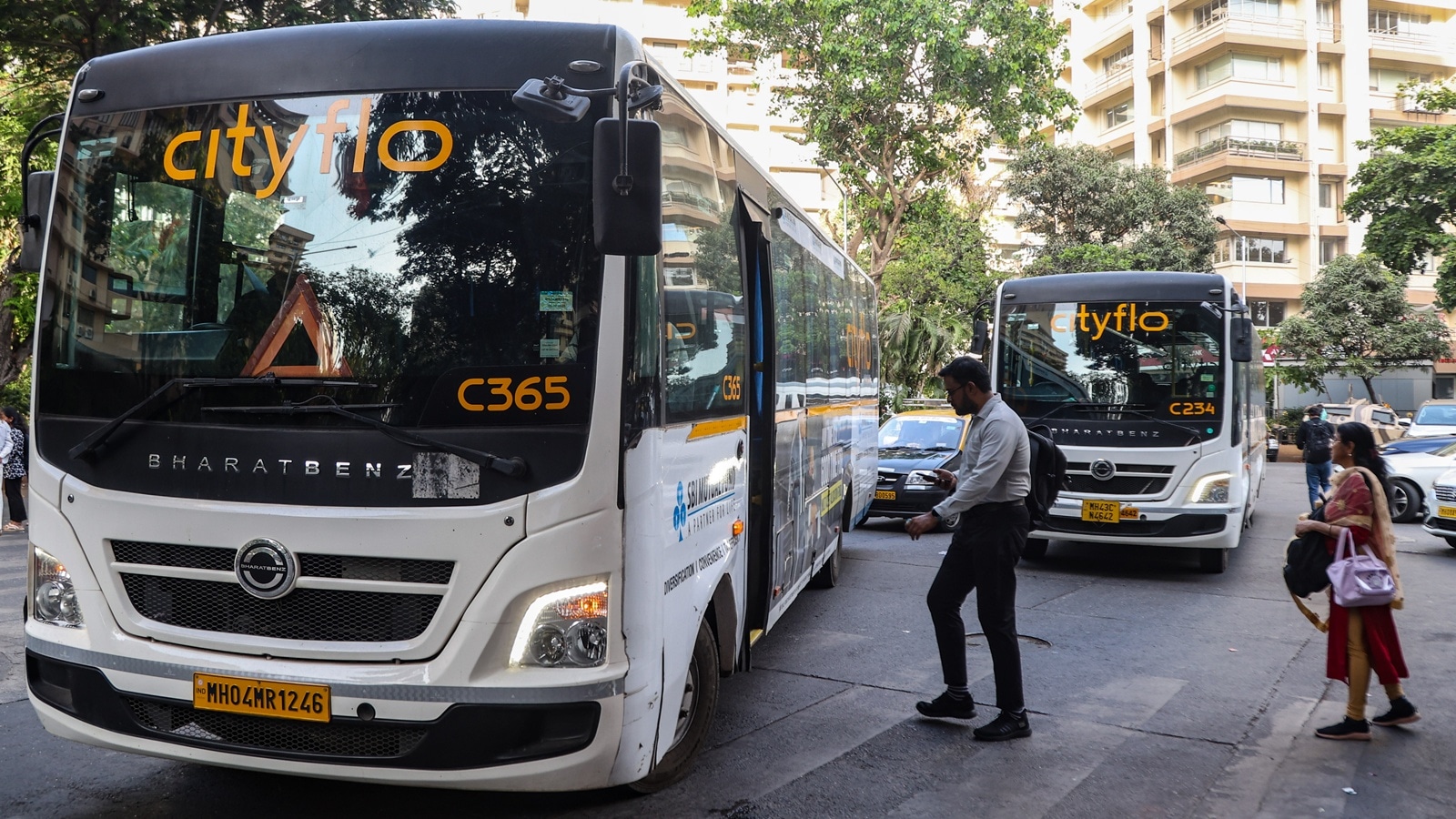
Industry players argue that this emphasis on first- and last-mile connectivity lies at the heart of the premium bus model. According to Cityflo Co-founder and CEO Jerin Venad, route planning is designed around minimising walking distances and reducing the number of interchanges required. “Typically, commuters are within around 400 metres of a boarding point and within about 250 metres of their destination. Short first- and last-mile distances make the service practical. This convenience becomes especially important during peak summer and monsoon seasons,” Venad said.
Industry players argue that this emphasis on first- and last-mile connectivity lies at the heart of the premium bus model. (Express Photo by Akash Patil)
For many users, the appeal lies less in speed and more in reducing the uncertainty associated with daily travel. Unlike conventional public transport systems, which often involve multiple transfers and variable waiting times, premium buses offer pre-booked seats, fixed schedules and limited stops. Twenty-two-year-old Avantika Vishwas said she chooses premium buses despite spending slightly longer on the road. “Unlike local trains, which remain massively packed during peak hours, choosing a premium bus means I have a guaranteed seat with AC service and don’t have to worry about overcrowding,” she said.
Story continues below this ad
When the economics start making sense
Although fares for premium AC buses are substantially higher than those of public transport, commuters argue that the actual difference narrows once additional travel costs are factored in.
For 22-year-old Prithviraj Kalekar, who commuted from Kharghar to South Mumbai during an internship, the economics worked out surprisingly close. “My monthly Cityflo pass cost nearly Rs 4,750, which came to about Rs 119 per ride. Travelling by train would have cost less on paper, but after accounting for autos and taxis at both ends, the overall difference wasn’t very significant,” he said. This calculation is increasingly common among professionals travelling from distant suburbs and satellite cities such as Thane, Navi Mumbai and Panvel to major employment centres like Bandra-Kurla Complex (BKC), Lower Parel, Nariman Point and Andheri.
Built around commuter demand
The formula behind designing premium bus routes differs significantly from traditional public transport planning.
Venad explained that route creation begins with analysing commuter demand between major residential clusters and employment hubs. “We designed our services around micro-markets rather than broad city-to-city routes. Instead of a generic Navi Mumbai-to-BKC service, we created dedicated hubs in places like Kharghar, Panvel and Vashi, tailoring routes according to local commuter demand,” he said.
Story continues below this ad
The demand, he added, existed long before Cityflo’s launch in 2015. “We noticed large residential hubs connected to commercial clusters where office-goers were travelling either by private cars or public transport. We designed the service specifically for office-going car owners and aspirants.”
That strategy appears to have paid off. More than half of Cityflo’s initial users were reportedly individuals who previously drove themselves to work. Over time, the company’s customer base expanded to include professionals aged between 24 and their mid-50s. Today, users under the age of 30 account for nearly 30 per cent of its ridership. The company has also seen a small but growing student segment travelling from Thane and Navi Mumbai to colleges located in Andheri, BKC and South Mumbai. What began as a single route connecting Thane and BKC has evolved into a network of more than 150 routes served by around 600 buses.
Chalo comes into the picture
Alongside Cityflo, Chalo has emerged as another major player in Mumbai’s premium commuter bus segment. The company, which launched its first AC bus in Mumbai in 2022, currently operates app-based premium AC services on more than 35 routes connecting Navi Mumbai and Thane with commercial districts including BKC, Andheri and Colaba.
Unlike Cityflo, Chalo operates through a public-private partnership with BEST. Under the arrangement, Chalo manages routes, schedules, buses and drivers while operating under BEST’s licence and branding. The company shares 4% of its revenue and additionally contributes 3.5% passenger tax with BEST.
Story continues below this ad
In 2024, Chalo announced a 44% expansion of its fleet, citing increasing demand for premium commuter services. It currently operates around 130 buses across both long-distance and feeder routes across MMR against its larger operation in 100 cities globally.
Where public buses fall short
The growth of premium buses also reflects structural limitations within Mumbai’s public bus system. BEST currently operates services on 399 routes across Mumbai. However, its long-distance services remain relatively limited. The undertaking presently runs 104 buses on just 10 long-distance routes connecting various parts of Mumbai and its suburbs. Among these, only a handful of routes, including the Santacruz Depot-CBD Belapur service, directly connect residential hubs with major commercial districts. Route lengths range from approximately 32 km to 45.6 km.
By contrast, much of BEST’s network consists of shorter feeder services. Officials have previously stated that the average BEST commuter travels only around 7 km per trip. A Cityflo commuter, meanwhile, travels an average distance of 27 km over a journey lasting roughly 90 minutes.
BEST’s shrinking fleet has compounded the challenge. At its peak, the undertaking operated over 4,600 buses. Today, that number has fallen to 2,802. Of these, only 249 buses are directly owned by BEST, with the remainder operating under wet-lease contracts. Over the five years leading up to 2024, the undertaking scrapped nearly 2,160 buses while procuring only 37 buses for its own fleet. The growing dependence on wet-lease operators has also attracted criticism over maintenance standards, operational practices and instances of driver negligence.
Story continues below this ad
Officials say resource constraints leave little room for experimenting with new point-to-point services. “We are already grappling with a shortage of buses, making it infeasible to launch services connecting business districts with residential hubs located in distant suburbs. Our priority remains serving commuters within BMC limits,” said a senior BEST official.
The official added that traffic congestion further limits the viability of long-distance bus operations. “BEST runs many services with high frequency, but the same would not be possible on long-distance routes because travel times are significantly affected by road congestion,” he said.
Not a replacement for public transport
This gap has created an opportunity that premium operators continue to exploit. Chalo records an average monthly ridership of between 2.75 lakh and 2.95 lakh passengers. Further its daily passenger count rose from 6,000 in 2024 to 11,000 in 2026. Cityflo, meanwhile, reports around four lakh rides every month across the MMR. For Cityflo, growth has accelerated sharply in recent years. The number of buses operating daily has nearly tripled from 203 to around 600 from 2023 to 2026.
Despite their rising popularity, transport experts caution against viewing premium buses as substitutes for mass public transport. “Premium buses and public transport are complementary and perform distinct functions,” said Urban Transport Planner Bhaumik Gowande, adding that premium buses primarily offer a weekday alternative for car users.
Story continues below this ad
According to Gowande, many passengers using premium buses would otherwise depend on private cars or app-based cabs for their daily commute. Younger commuters also use them to avoid overcrowded trains and buses. However, he stressed that Mumbai’s long-term mobility needs cannot be met through premium services alone. “Meeting mass transit demand requires strengthening the public bus system through higher fleet strength, improved frequency, route rationalisation and electrification. Premium buses can play an important role, but they cannot replace large-scale public transport,” he said.
The road ahead
For premium operators, the focus now is on expansion. Cityflo estimates that among Mumbai’s roughly 50 residential hubs and 15 major commercial nodes, it currently serves only a fraction of potential travel corridors. Beyond Mumbai, the company currently operates on select routes in Hyderabad, Delhi and Kolkata. It has also introduced a small electric fleet in the Delhi-NCR region and is exploring wider electrification opportunities.
Meanwhile, Chalo defines that its key growth area would be catering to all kinds of customers. A Chalo spokesperson explains that the company has been approached by several other cities to run similar services for their urban populations.
As Mumbai’s workforce becomes increasingly dispersed across distant suburbs and satellite cities, the appeal of a predictable, comfortable and direct commute is only likely to grow. For many office-goers, premium buses are not merely a transport service. They represent an attempt to buy back something increasingly scarce in Mumbai’s daily commute — certainty.
View original source — Indian Express ↗
Related stories

Indian Express
TechnologyJun 14, 2026 · 1 min
Google says Chinese cybercrime group used its AI in scams
Indian Express
ABC News
TechnologyJun 14, 2026 · 1 min
Satellite images reveal missing Antarctic ice the 'size of France'
ABC News

Philippine Daily Inquirer
TechnologyJun 14, 2026 · 1 min
Alas Pilipinas loses to Iran, sent to worst finish at AVC Women's Cup
Philippine Daily Inquirer

South China Morning Post
TechnologyJun 14, 2026 · 1 min
Surge in AI-related court cases fuels calls for China to clarify its laws
South China Morning Post