Times of Israel
Bennett to ToI: ‘We’re at an existential moment. Another four years with this government, we won’t have a society’
As the US finalizes its framework deal with Iran on ending the war — apparently set for signing in the coming hours or days — former prime minister Naftali Bennett has launched a fierce attack on Prime Minister Benjamin Netanyahu’s entire strategy for tackling the Iranian regime and its proxies.
In an in-depth interview with The Times of Israel, Bennett denounced Netanyahu’s “whole approach,” critiquing “this very protracted war” on multiple fronts. If elected this fall, he promised, he would advance what he has long called his “Octopus Doctrine” — a multiyear action plan to accelerate the collapse of “a corrupt, old, incompetent, disconnected regime” in Tehran while ensuring it does not acquire nuclear weapons.
“It’s never been Israel’s doctrine to have an ongoing war, which exhausts Israeli society, exhausts the reservists, exhausts the economy, and dramatically hurts our international standing,” he said.
But the problem with the current prime minister, according to Bennett, is not limited to the Iranian arena. Four and a half months before what he said will be one of the most critical elections in Israel’s history, Bennett asserted that Netanyahu has simply lost the ability to govern, to win wars, to restore law and order, to integrate the ultra-Orthodox into Israeli society and to repair Israel’s battered standing in the world.
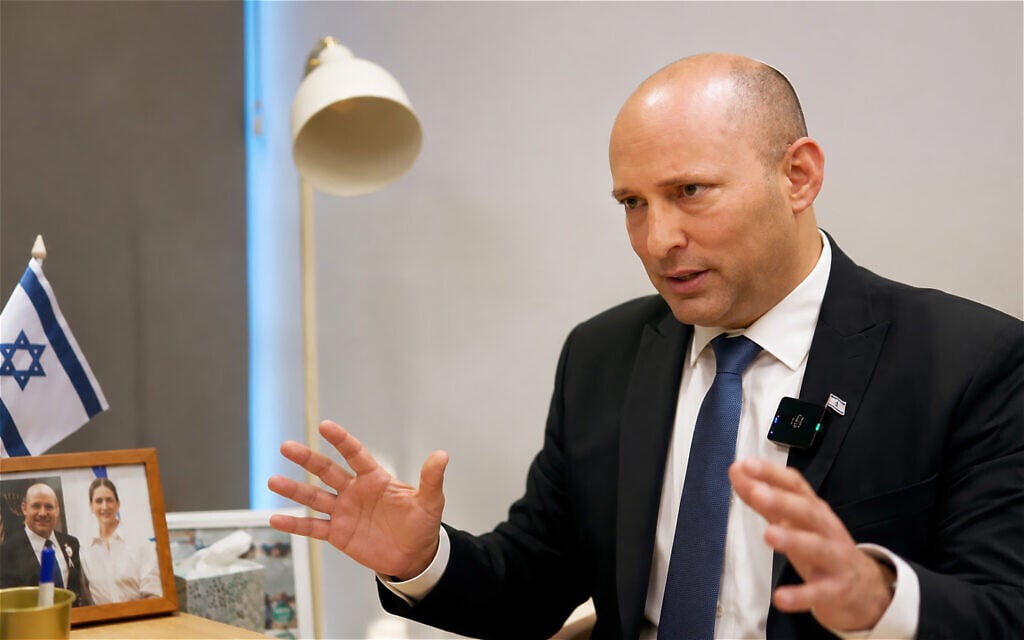
Speaking with ToI on Thursday at the campaign headquarters of Together, the new, merged party he now leads with former prime minister Yair Lapid, Bennett said Israel is facing “an existential moment,” and warned that another term under the current government would leave the country without a functioning economy, society or international position. “Another four years with this government, we won’t have an economy, we won’t have a society,” he charged. “The Haredi issue will just crash us all. We won’t have an international standing anywhere. We have to act now.”
“He simply can’t do it anymore,” Bennett said of Netanyahu. “He can’t win wars. He can’t deal with crime. He can’t bring down prices. He can’t integrate the ultra-Orthodox into Israeli society.”
‘Netanyahu simply can’t do it anymore. He can’t win wars. He can’t deal with crime. He can’t bring down prices. He can’t integrate the ultra-Orthodox into Israeli society’
A journey to the mainstream
The interview took place in the heart of Ra’anana’s high-tech district, in offices that look less like a traditional political campaign headquarters than an Israeli startup: an upper floor, clean windows, open workspaces, sweeping views of the Sharon region and a co-working area filled with campaign staff. The setting is apt for Bennett, a former tech entrepreneur who still speaks about leadership, strategy and government in the language of execution, management and results.
At the entrance, a chance encounter with Yair Zivan, Lapid’s longtime foreign affairs and communications adviser, underscored the nature of the new alliance: the merger of Bennett’s newly formed political vehicle for this fall’s elections, which never adopted a permanent brand name, with Yesh Atid, Lapid’s better-funded and established party machine, with its field organization, sitting lawmakers and campaign infrastructure.
The partnership surprised few. But once it was announced, it was also clear who would helm the ticket. Lapid remains a central figure in the alliance, but Bennett is its candidate for prime minister.
Early polling has offered a note of caution. In the weeks since the merger was unveiled, surveys have indicated that the alliance is not generating a multiplier effect. Rather, some support appears to be shifting away from Together and toward former IDF chief of staff Gadi Eisenkot, head of the new Yashar party and another prominent contender for Israel’s top job.
Inside Bennett’s office, the visual messaging is revealing. On a side table, alongside a small Israeli flag and a framed family photograph, stand miniature figures of Israel’s founding generation: David Ben-Gurion, Golda Meir and Theodor Herzl leaning over the famous Basel balcony. Nearby is a small, vivid painting of Ben-Gurion in bright oranges and blues, the Israeli flag rising behind him over a dramatic landscape.
For a politician who made his name in the leadership of the settlement movement and became Israel’s first kippah-wearing prime minister, the absence of traditional religious-Zionist symbols is striking. There are no portraits of prominent rabbis, no settlement movement imagery, no obvious visual markers of the ideological world from which he emerged. Instead, the office projects the language of mainstream Israeli statehood: the first prime minister, the foundational ideologue, the Declaration of Independence, civic equality, liberal democracy and national institutions.
The knitted kippah remains on Bennett’s head. But as he sits down for the interview, he does not present himself primarily as a religious politician. The room around him sends a clear message: Bennett has completed his journey to the Israeli political mainstream, and he wants voters to notice.
In our conversation, Bennett, who served as prime minister in 2021-2022 after unseating Netanyahu, argued that the current premier’s dependence on far-right coalition partners Itamar Ben Gvir and Bezalel Smotrich has left him unable to act in Israel’s core national interests. Ben Gvir and Smotrich, he said, “bring huge international damage with statements and actions that don’t really promote any interest; it’s just for small politics.”
On Israel’s relationship with Donald Trump, Bennett praised the US president’s record on Israel, citing his recognition of Jerusalem as Israel’s capital, moving the US embassy there, recognizing Israeli sovereignty over the Golan Heights, the killing of Iran’s al-Quds chief Qassem Soleimani and the damage inflicted on Iran. But, he stressed, an Israeli prime minister must be able, when necessary, to “stand up and ensure the security of his people at all costs.”
Bennett said he believed he could forge a strong working relationship with Trump because of their shared background outside career politics. “He was a businessman, not a career politician, same as me,” Bennett said. “His worldview is, let’s get stuff done. Let’s look at results, not process. And that’s precisely my view.”
Torah study bill ‘a desecration of God’s name’
Bennett also sharply criticized the government’s handling of the ultra-Orthodox draft crisis, calling Israel’s decades-long approach to Haredi autonomy a case of “slow-motion national suicide.” He said generations of politicians had allowed “an independent Haredi state to be formed within Israel,” in which many of the Haredi community’s children are not taught English, math, civics, democracy or Zionism.
“I love my Haredi brothers and sisters, but enough is enough,” he said. Bennett said his plan would not include stripping voting rights, jailing draft dodgers or bringing “tanks into Bnei Brak,” but would instead end state funding for schools that refuse to teach the core curriculum, and cancel tax breaks, daycare subsidies and housing benefits for those who don’t serve in the military or work.
He was especially scathing about current coalition efforts to codify Torah study as a national priority in a Basic Law, saying the move was not about honoring Torah but about renewing the flow of state funds to those who refuse to serve or work. “This bill has one goal: to renew the flow of billions of shekels a year to people who deliberately decide not to serve, not to work,” Bennett said. “It uses the Torah as a tool for money.”
Asked about women in combat, Bennett said he supports women serving in the military and in combat roles wherever the IDF determines it is appropriate. Mentioning Captain Or Moses z”l, the deputy company commander at the Zikim training base who was killed on October 7 while trying to rescue a wounded soldier, Bennett said: “No one should tell me that women cannot fight.”
On settler violence, Bennett, a former head of the Settlers Council, stressed that the vast majority of Israelis living in Judea and Samaria are law-abiding citizens who serve in the army and have suffered years of terror attacks. But he condemned violence against innocent Palestinians and against soldiers “in the strongest possible terms.”
“We did not return to the State of Israel, to the Land of Israel, after thousands of years to have militias and vigilantes,” he said. There is no place for that. There must be law and order everywhere in Israel — whether it’s the Negev or Bnei Brak or the Galilee or Judea and Samaria. And I will restore law and order in Israel.”
Bennett said he sees himself, if returned to office, as responsible not only for Israeli citizens but for Jews worldwide, at a time of surging antisemitism and deepening alienation from Israel. He accused the current government of repeatedly “shooting ourselves in the foot,” including through attacks on the Reform movement, the largest Jewish denomination in America.
“My vision for Israel is an exemplary and secure state for the Jewish people in the Land of Israel,” Bennett said. “Let’s be exemplary. Let’s shine among the nations.”
The following is the full transcript of our interview, with the questions and answers lightly edited for clarity.
The Times of Israel: Let’s start with the situation with Iran. Israel needs the United States to be on board [in tackling the Iranian threat], but joining together with Trump has a lot of problematic aspects. Netanyahu is unable to reject or object to anything that Trump says. If you were a prime minister, what would you do differently?
Naftali Bennett: Well, first of all, I want to say that President Trump has truly been amazing for the State of Israel. It started in his previous term, and I don’t forget that. I don’t look only at the past week; I look at the whole track record — of recognizing Jerusalem [as Israel’s capital], moving the embassy to Jerusalem, recognizing the Golan Heights [as sovereign Israeli territory], killing [Iran’s IRGC al-Quds chief] Soleimani, and of course the massive damage that’s been done to Iran.
For an Israeli prime minister, ultimately, there are moments where he has to stand up and ensure the security of his people at all costs, and I’m sure President Trump respects that. Just as he understands that he would do anything to secure the lives of Americans, so we have to secure the lives of Israelis.
On a broader scope, I think that I would be able to forge a very good relationship with President Trump, because of very similar backgrounds. He was a businessman, not a career politician, same as me.
I was not a career politician. I first entered business, got things done. And his worldview is: Let’s get stuff done, let’s look at results, not process, and that’s precisely my view. Regionally, I also believe that business and economy should be the main vector of diplomacy. And again, coming from a business standpoint, I would seek, very aggressively and energetically, regional deals. And I would have a much more positive government and cabinet that would allow us to achieve it.
Because right now, when you have people like [far-right Otzma Yehudit party leader and National Security Minister Itamar] Ben Gvir, who create international crises every three days, and Netanyahu is incapable of even calling them to order, that dramatically hinders the ability to make any progress.
But if Trump is on the phone with you, and he says, ‘Turn your airplanes back now,’ could you have done something differently than Netanyahu has been doing?
The movie doesn’t start there. You’re presenting a specific scene, but the movie begins way earlier.
If the whole picture is one where you have a pragmatic government, that does not cause massive damage to Israel’s international standing for nothing, a business-oriented, technology-oriented, normalization-oriented, execution-oriented government, then, to begin with, American public opinion would be different, the pressures on Trump would be different, the whole thing would be different.
So I refuse to be placed into a scene [like you’ve described] because I will strive to engineer a whole different environment.
Netanyahu understands what you and I understand. He understands that Ben Gvir [and fellow far-right Religious Zionism party leader and Finance Minister] Smotrich bring huge international damage with statements and actions that don’t really promote any interest; it’s just for small politics.
But Netanyahu has lost his capability to win — in many areas, not only there.
For example, we’re fighting what they like to call a seven-front war. We don’t have enough soldiers, but Netanyahu is incapable of conscripting the 20,000 missing Haredi soldiers. The Zionist public is already at full-stretch: 90% of secular and religious Zionists are conscripted. The ultra-Orthodox are close to zero.
We are capturing a position and leaving it, after fighting and bleeding to capture it, and then having to recapture it three times, because we don’t have enough soldiers [to deploy permanently to hold it]. Netanyahu is incapable of bringing the necessary soldiers because the Haredim control him.
So everything would look different with a government under my leadership — a good government, where I’m very strong on security and our national interests. I’ve not changed my opinions. But I don’t have a group of ministers who are acting in such foolish and harmful ways.
Let’s put you into another scene, which may well happen. The US may sign a deal with Iran any day now, according to Trump. The deal may include a 15-year freeze on enriching uranium, the release of some money to Iran, no provisions to deal with their ballistic missiles, and no provisions regarding their terrorist proxies. Something like this might be signed during the summer and then, in October, you might become prime minister and inherit this agreement. You recently said this is the beginning of the “trickling” of Iranian attacks on Israel. But as a prime minister you would not be able to come out against a sitting US president, just as Netanyahu is unable to come out against him.
Well, I’ll share with you my strategy and how I would deal with whatever outcome we’ll have.
Since 2017, I’ve been promoting in the security cabinet, and later on as defense minister, and later on as prime minister, my thesis, which I call the “Octopus Doctrine”. This dates from way before people realized that Iran is the epicenter of most of the problems in the Middle East and of Israel, and that we, over the past 20 years, have been very foolish to keep on focusing on the arms of the octopus, i.e., Hezbollah, Hamas, instead of the head of the octopus. As prime minister, I began the shift of taking many actions against the head of the octopus, not only vis-a-vis nuclear [efforts by Iran], but all aspects.
I view the relationship between Israel and Iran as similar to what we had seen between the United States and the Soviet Union after World War Two, all the way till 1989: We have a vibrant democracy versus a corrupt, old, incompetent, disconnected regime with a good [civilian] nation.
I learned as prime minister that Iran’s regime will ultimately collapse, but I don’t know when. Continuing the analogy, we might be in 1987 right now [shortly before the disintegration of the Soviet Union], but it also might be 1960.
So here’s my strategy: We need to embark on a multi-year, long-term strategy of accelerating the collapse of the regime, not only through kinetic action, while ensuring they don’t achieve a nuclear weapon. With the Mossad and other groups, I began about 30 different actions — not only bombing. I’m talking about economic actions, I’m talking about cyber, about overt and covert actions.
For example, one of the things that I had pushed for that, unfortunately, the next government did not do, was to smuggle into Iran tens of thousands of Starlink receivers, so the next time there’s a local uprising, the regime can’t turn off the internet. This wasn’t done.
I believe that if we embark on a serious mission of accelerating the collapse of this horrible regime, which will collapse, we can advance that collapse. At the same time, we have to ensure they don’t achieve nuclear weapons. All my actions will derive from this simple strategy — simple to explain, but sophisticated to execute.
We don’t know the specifics of the deal that’s taking shape, but there’s clearly been a massive divergence of interests now, because Trump just has to get the Strait of Hormuz open, and you see him moving [to softer positions] on enrichment and the stockpile. You might inherit an arrangement where you’re really concerned that they’re very close, that they have a path to the bomb. You could be in a very difficult situation.
It won’t be the first time I, as prime minister, inherit lousy situations. I think the whole approach of Netanyahu, of this very protracted war, is the wrong approach.
It’s never been Israel’s doctrine to have an ongoing war, which exhausts Israeli society, exhausts the reservists, exhausts the economy, and hurts our international standing dramatically. I fundamentally disagree with this whole approach. I would run things fundamentally differently, with much faster, higher-intensity wars, but get them done. I would also say that a leader has a broad set of tools. War is one of those tools. The army is one of the tools. But you have to use many tools: the economic tool, technology tool, diplomacy tool, public opinion tool.
Do you know that we don’t have a public diplomacy directorate? I, as prime minister, built one, and I appointed one of Israel’s very talented people, Elad Tene, who now runs Yedioth Ahronoth, and it was good, it was quick, it was nimble, it was smart, and they dismantled it. It’s like a carpenter trying to build a cupboard, but all he has is a hammer. You need other tools, and this singularly focused tool of just using kinetic force is a mistake. I’ve fought and killed many Hezbollah terrorists in my life. Definitely after October 7, we needed to act. But his approach of sort of just stretching it out forever is a very wrongheaded approach.
How do you intend to achieve normalization with Saudi Arabia if you become prime minister? And how can you do that without some progress on the Palestinian track?
I intend to advance Israel’s integration into the region by building a regional security and economic architecture, alongside initiatives that foster greater interfaith understanding and cooperation. There are enormous opportunities for Israel in turning eastward. The path to the East runs through the Arabian Peninsula.
As for the Palestinians, we will safeguard Israel’s security while also preserving the dignity and livelihoods of the Palestinian people. They are not going anywhere, and neither are we. We should be smart enough to take steps that improve their daily lives without compromising the security of Israeli citizens in any way. I did that as prime minister, and we can do it again.
Regarding October the seventh: You would have prevented it, definitively? Can you tell us how? And part two, how would you have fought in Gaza afterwards more effectively? You don’t want the Palestinian Authority in Gaza either. What alternative is there? Who’s going to come in there and risk lives against a Hamas that won’t disarm?
Look, the fact is it happened under Netanyahu’s watch. In history, you can never say definitively what would happen on the path not taken. I can tell you what I did, and what I did differently from Netanyahu.
Netanyahu had a policy of containment with Hamas, with Hezbollah. My policy was zero containment. When I came in, I hit Hamas after every single terror balloon, every rocket. We know now that Yahya Sanwar despised me and said he can’t read me, and doesn’t know how to deal with me. With Netanyahu, he knew how to deal. And we now know they had correspondence, the famous correspondence [a reference to a 2018 message from the Hamas terror chief to Netanyahu].
I didn’t let Hamas get even near the fence; they let Hamas live on the fence for many months. I didn’t let Hezbollah get near the fence; they let Hezbollah build tents within Israeli territory. And when Hezbollah even conducted a terror attack at Megiddo Junction, the Israeli government didn’t respond.
I was very diligent on every little piece of information. I would go down to the field, talk to people, talk to officers, talk to the citizens. With Netanyahu, we now know that all the heads of the security organizations came and said, privately and later publicly, we are heading toward a big, big disaster. What they didn’t have was the specific intelligence that it would come the way it did, but there were many indications. And when the IDF chief of staff wants to talk to me, and he says this is a national disaster, he’d be in my room within two minutes. And within an hour I’d get every single intelligence officer from Mossad, the Shin Bet, down to captains; I’d be talking to them. That’s my style — of zooming in, and not just saying, ‘Everything’s okay,’ or something for the record.
We also know that in 2023, prior to October 7, the judicial reform, and what happened in Israel, and the way the government conducted itself — essentially telling half of Israel: We despise you; if you’re liberal, if you didn’t vote for me, we think you’re walking around with Rolex watches, and we’re going to run you over. These are quotes of ministers in the government. You know, we’re going to take revenge on you.
We know now that it dramatically weakened Israel’s immune system. And from week to week Israel became weaker and weaker. And we know that our enemies followed that, and we know our enemies waited for the weakest moment, and, bam, attacked us.
So, would it happen under my leadership? I think the chances are way lower, dramatically lower, because of everything I said. I would not divide Israel. I united Israel. I was diligent. And I had a very much tougher stance on our enemies than Netanyahu.
Regarding the second part of the question, how do you deal with Gaza quickly?
I can go into tactics. I had suggested early on a differential siege. It seemed at the time that it would take longer, but would actually have been much easier. We would isolate areas, apply a full siege on those areas, and let the citizens out and trap the terrorists. I even made this public, I believe, on October 27 of 2023. I thought it would be much smarter. Siege is a tool that’s been used for thousands of years very effectively. I would do it in a smart way: You define half of Gaza as enemy territory, you let the citizens out, but you have a screening process, and then you dry him up and essentially smoke him out of the tunnels.
This was not adopted, which is legitimate. A different approach was adopted. I believe bloodier, but we’ll never know.
This is not my main point. My main point is that running a country is not only the narrow military dimension, but there are many other dimensions.
When you have a minister who stupidly says we’re going to nuke Gaza, you pay a huge, huge international price with zero benefit, and your credit pool empties, and then by the time you actually need it for material, serious stuff, you’ve run out of credit.
I ran a good government. We reduced debt, we moved for the first time in a generation from deficit to budgetary surplus, and reduced crime. I know how to run stuff
Everything would look different when you have a competent, serious government. The government I ran, I think even my biggest critics agree it was an effective government. I ran a good government. We reduced debt, we moved for the first time in a generation from deficit to budgetary surplus, and reduced crime. I know how to run stuff.
Essentially, what I’m telling the Israeli public is that we are at an existential moment. Another four years with this government, we won’t have an economy, we won’t have a society. The Haredi issue will just crash us all. We won’t have an international standing anywhere. And we have to act now.
Another four years with this government, we won’t have an economy, we won’t have a society. The Haredi issue will just crash us all. We won’t have an international standing anywhere. We have to act now
I’ve done something never done before, I believe, as a prime minister hoping to come back a second time. I’m not the first prime minister to come back: Ben-Gurion left and came back, Rabin, Netanyahu, they all come back more politically astute, which I will also. But I spent the past year and a half preparing plans for Israel: How to fix Israel’s core issues, which are the Haredi issue, the Bedouin issue, law and order, the huge crime and chaos issue, the cost of living, the cost of housing and security, education, health. I’ve got all the plans ready. This time, the first 100 days of this government will be 100 days that change history.
You have all the plans; the big question is, will you have a coalition to go with them? You probably expected that I would ask about [Ra’am party leader] Mansour Abbas [a key partner in the 2021-22 Bennett-Lapid coalition], because he says, I’m willing to draft people to national service, I believe in the Jewish and democratic character of this country (even though he is a religious Muslim), I believe in the values of the Declaration of Independence. If the ultra-Orthodox would tell you, We believe in Zionism, we are agreeing to the Jewish and democratic character of Israel, we are agreeing to draft [in the IDF], you would love to sit with them [in your coalition]. But when he says them, because he is a Muslim, he is being struck out by you and your colleagues [as a potential coalition partner].
I don’t decide to bring or not bring people [into my coalition] based on their color or race. I set principles, and the principles are you have to be Zionist, so support Israel as a Jewish and democratic state, support the draft for all, support establishing a constitution based on the Declaration of Independence, support a state commission of inquiry into October 7. And right now Mansour does not meet some of those elements.
He meets them, and he is also not going to sit with Balad [in a Joint List of Arab parties].
Look, I will not talk about people, I will talk about the principles. Any party that supports what I just said, supporting Israel as the home of the Jewish people in a democratic state, all those principles, that’s what will define it.
So, if he says all of those things, clearly, you’re going to sit with him?
I talk about all the principles I stated. Currently, he does not, but anyone who supports what I just said. As I said, it’s not about race. If there’s an Arab who’s Zionist and supports going to the army, that’s something else. I’m talking about principles, not people.
Do you think that people who did not draft to the military as legally required should be stripped of their voting rights and/or their right to be elected?
I think we have to be realistic, and I have a very clear plan, which I developed over the past year and a half. It does not include that component, because it’s unnecessary.
I’ll tell you what it does include. The issue of the Haredim is way, way beyond the draft. I would almost say that the main issue is much broader, much bigger than that.
We, generations of politicians, for the past 49 years, have allowed an independent Haredi state to be formed within Israel, a state within a state. In this state, right now, as we speak, 30% of Jewish kids are not being taught English and math at school. They are being taught [it’s better to] die than go to the army. They are being educated against Zionism, against democracy, against our core values. The [refusal to] draft is just a result of that.
We are in a slow-motion national suicide. And I just want to give you another data point. When my kid, David, will be my age, almost 50% of 18-year-old kids will be Haredi.
He’s 15 now?
He’s 14.
It’s sort of like an iceberg, because you know, it doesn’t happen in a moment. And now 14% of Israelis are Haredi.
I love my Haredi brothers and sisters, but enough is enough. I want to give you another data point. Every Zionist family, meaning Jewish, non-Haredi family, pays on average NIS 6,000 more to the government than it gets back in services every month. Every Haredi family gets NIS 4,000 more than it pays. And the camel’s back is about to break. Now is the moment.
So, this is not only about the draft, this is about saving Israel’s future. This is the last moment we can act.
And here’s my plan: It’s not to put them in jail, and it’s not to bring tanks into Bnai Brak, and it’s not to bring policemen to force kids to learn democracy. That won’t work. I don’t believe in coercion.
I will not fund a school that does not teach all of the core curriculum… I will not give you a shekel in allowances if you don’t work, don’t go to the army
Something very simple: We will not fund an independent [Haredi] state. We, I will not fund a school that does not teach all of the core curriculum — not only math and English, which I used to think is the main thing, but it’s not only that. Math, English, civics, democracy, Zionism.
You want to teach your kids, ‘We’ll die and we won’t enlist’. Fine, go find a plot of land, buy it, build a school, hire teachers, do it at your own cost. Build a private school; we will not fund it.
You want to not go to work your whole life. Fine, I can’t force you to work. I will not give you a shekel in allowances, in reduced municipal taxes, in reduced mortgages, in daycare subsidies. Not one shekel. You don’t go to the army, fine. I will not fund a shekel.
At the same time, what I will do, and this has never been tried, is what I call the Brooklyn Model. In Brooklyn, there are Haredim. The United States of America, to the best of my knowledge, does not give them allowances for yeshiva study, daycare subsidies; it does not offer them reduced mortgage programs, does not give them anything. So we’ll bring the Brooklyn Model to Bnai Brak. And it works.
We have developed something so distorted, so crazy, but it’s been normalized, because we live in it, and we never woke up to say, What the heck have we done here? So now’s the moment.
What I will do: In each of those three paths, which are education, employment, and the service, we will have a beautiful and compelling on-ramp.
We’re not fighting the Haredim; we’re saving the Haredim. The on-ramp will be amazing. State Haredi schools where 60% of their curriculum is what I said, and 40% is Talmud study. Every school in Israel will have a 40% [range of specialty subjects such as] cyber, music, nature studies, but every kid will learn English, math, Bible studies, civics, and Zionism. By the way, Jews and Arabs alike. Everyone will learn that basis. You don’t want to? You can build your private school.
Same with work. What we’re going to have are job-training programs for these people. And in the army, a bit of out-of-the-box thinking.
Let me give you one thought that I’m promoting, one plan: Build Haredi yeshivas along the Jordan border and the Sinai border. Every 100 kilometers, you have a yeshiva, they study eight hours, they guard the border eight hours and free up our reservists, and sleep eight hours. So we can accommodate them.
I’m dati, I’m a man of faith. I believe. I learn Torah. I love the Torah. This is not against the Torah. This is for the Torah. What they did on Wednesday, [advancing] that Basic Law that Torah study [is equivalent to national service] is the biggest harm the Torah can ever have. We’ve had the Torah for 3,300 years without a Basic Law.
Spell it out. Why is it foul and an assault on the Torah to claim that somebody who’s studying Torah full time is making the same essential contribution to the Jewish state as a soldier in the army?
I don’t recall a battle in the Torah where the enemy is running towards us, and we go and learn Torah, and somehow we’re saved. We always fight. Our biggest heroes were fighters
First of all, Judaism and the Torah itself never claimed that learning Torah will save you from enemies. I’m a big student of the Torah. I can tell you all about Joshua’s battles, Abraham’s battles, Gidon, Yiftah, King Saul, King David. I’m yet to see, I don’t recall, a battle in the Torah where the enemy, the Midianites or the Philistines, they’re running towards us, and we go and learn Torah, and somehow we’re saved.
We always fight. Our biggest heroes, all of those that I mentioned, were big fighters.
This whole talk about a society that isolates itself from the world and solely learns Torah. It’s a new, distorted view of the Torah. It’s nonsense, and it’s a desecration of God’s name
All our biggest heroes worked – Abraham worked, Moses worked, Rashi, Rambam. Rashi was a winery guy, Rambam was a doctor, Rabbi Yohanan was a shoemaker. They all worked. This whole talk about a society that isolates itself from the world and solely learns Torah. It’s a new, distorted view of the Torah. It’s nonsense, and it’s a desecration of God’s name.
All our great rabbis, including Rambam, say that using the Torah for money is the biggest desecration of God’s name. The Haredim don’t need a bill to set a special status for Torah. They don’t care about Israel’s laws. Now they’re claiming it’s just a symbolic bill. It’s not symbolic at all. This bill has one goal: to renew the flow of billions of shekels a year to people who deliberately decide not to serve, not to work. That’s all the bill is. It uses the Torah as a tool for money. That’s the biggest desecration of God’s name that you can have.
Some rabbis say if you are a man enlisted into the military to do combat, you cannot serve together with women. Recently, Smotrich said, I think at a faction meeting, ‘If my daughter will ask me what to do, I will tell her, Do not serve in the military at all, specifically not in combat roles’. You have two daughters. What would you tell your own daughters? Would you recommend them going into the military? To serve in combat roles? What do you think about women in combat? Some rabbis are saying don’t serve in tanks because of women.
First of all, I support women serving in the military, and women serving in combat wherever the IDF determines that it’s the right thing. I studied October 7 and met hundreds of soldiers and officers and civilians that fought on that day; I investigated it, and time and again I encountered remarkable female fighters who saved lives — both on October 7 and subsequently.
For example, Captain Or Moses z”l, the deputy company commander at the Zikim training base. She and the officers serving alongside her told the soldiers in training at the base that day: ‘Get into the miguniot shelters. We will protect you.’ They then went out to fight and killed dozens of terrorists. At one point during the battle, a soldier near Or was wounded. She shouted, ‘I need covering fire. I’m going in to get him. She ran out to rescue him and was killed during the attempt.
So no one should tell me that women cannot fight. I know our history. I know the stories of the Palmach (the elite fighting force of the Haganah pre-state militia), of Hannah Senesh, and of Sarah Aaronsohn of the NILI underground.
Now you have to do this sensibly — [having women in combat roles] where the IDF judges it is appropriate. My daughters are going to the army for sure.
You are a former head of the Settlers Council. Shabbat after Shabbat, and other days as well, people set out from settlements, and they attack innocent Palestinians. That’s terrible, and the Settlers Council does not denounce it. What has become of this movement? And more broadly, Orthodox Judaism, the liberal side of it, is in such remission in Israel. Where are they? Is there a silent majority of Judaism as a religion of tolerance and love of your fellow man?
I want to be clear. The vast majority of the Israelis living in Judea and Samaria are normative, are good citizens. They serve in the army, they abide by the law, and they don’t apply violence. That’s the vast, vast majority of about 550,000 Israelis, and they throughout the years have encountered grave terrorism.
I condemn in the strongest terms violence against innocents, against soldiers, and the breaking of the law. We did not return to the State of Israel, to the Land of Israel, after thousands of years to have militias and vigilantes. There is no place for that. There must be law and order everywhere in Israel — whether it’s the Negev or Bnai Brak or the Galilee or Judea and Samaria. And I will restore law and order in Israel.”
I will point out that this current government has doubled the number of Israelis murdered in criminal killings, Jews and Arabs. I took this on as a personal project as prime minister. We reduced the number of murders by 20%. There were 148 murders in 2022, the first full year of my government, as a result of a special law and order cabinet that I set up, and I ran it personally. Then they brought in this clown…
You mean Ben Gvir…
… and he took apart the team that I put together. Within one year, in 2023, 300 Israelis were murdered in criminal killings. I’m not talking about October 7; I’m not talking about nationalistic killings. And it is growing year by year.
I was a CEO in my previous life, and it gives me a huge advantage. If one of my managers brought such horrible results. I’d kick him out. But, again, Netanyahu can’t. He simply can’t anymore. He lost the ability to run Israel. He can’t achieve anything. He has his credits from the past. I don’t hate him or anything. But after 30 years since he first became prime minister, he simply can’t do anything. He can’t win wars. He can’t tackle crime. He can’t bring down prices. He can’t integrate the ultra-Orthodox into Israeli society.
I have plans. I have the best team in Israel: I’ve brought outstanding women leaders [into my party]: Keren Turner, the legendary former director-general of both the Transportation Ministry and the Finance Ministry, and Liran Avisar. In fact, women make up the majority of my team. On average, I believe they are better managers and leaders. I genuinely believe that. And I believe that together we won’t just fix Israel. We can bring about a renaissance for Israel and for the region. We have the ability to change the future of the State of Israel for the better.
A question about antisemitism. We see recent Pew Research saying 67% of respondents in almost 40 countries around the world have an unfavorable view of Israel. That’s horrific data, and it projects in the way that Jewish communities worldwide are suffering from attacks and aggression. Men can’t walk around with kippot on their heads. Swastika graffiti. Attacks on synagogues. You were diaspora affairs minister. What would you do? Practically, not just statements.
As a boy who grew up in the States for a couple of years, in Teaneck, New Jersey, and as someone who lived in America for years, I did not think, ever, we would have this sort of antisemitism. Throughout the years, there were organizations dealing with antisemitism, and I was supportive, but I had barely encountered antisemitism.
October 7 is the big massacre, and October 8 is the big day where we saw — way before, you know, Ben Gvir, and all of that — how this huge wave of anti-Israel and antisemitism started before the war, even. It’s a result of many things. One of them is a massive, state-funded [effort] — primarily by Qatar and Iran — that invested for years and years in universities and in the media to prepare for that day.
There’s a real battle, a real war for the hearts and minds of the world and the public. The problem with that war is it’s a one-sided war. Israel is not there. The Israeli government is not there. I’m giving interviews almost every single day, on, you name it, CNN, NBC, BBC. I’ve been to almost 100 campuses over the past three years. I’m out there, but alone, or there are a few other individuals who try their best. Israel is not there.
Not only is Israel not there, but this government keeps on shooting ourselves in the foot. So, for example, when a minister in the Israeli government talks about the biggest Jewish stream in America, the Reform Movement, and says that they marry dogs. And I know these people, and so many of them have been fighting for Israel, are huge Zionists that care about Israel, and then [Minister May Golan] goes and basically spits on them in such a careless and callous way. And again Netanyahu doesn’t do anything.
He knows the huge damage, he knows how wrong it is, but he’s lost his capability to do anything, because he depends on her. So we’re going to have to fix this, big time.
As prime minister of Israel, I have two hats: One is I’m prime minister and leader of all Israeli citizens, Jews and non-Jews alike. But secondly, I’m leader of the Jewish people. They aren’t citizens, I know, but I view every Jew in the world as someone who has a stake in Israel, some form of ownership in Israel. Less than us — using an analogy of business, we Israelis hold preferred shares; they hold common shares. We have to respect them, we have to work together. My vision for Israel is an exemplary and secure state for the Jewish people in the Land of Israel.
Exemplary in how we manage ourselves. And we are far from that right now. We are now despised by many. Much of it is unfair. As I said, October 8 was before the government did all the nonsense they did. But a lot of it is up to us. Let’s be exemplary. Let’s shine upon the nations. Let’s run ourselves as a beautiful country that handles itself domestically in a beautiful way. That handles all its citizens. I will be a prime minister to those who vote for me and those who didn’t vote for me. For Arabs, for Druze, for Haredim. I will never hate any of my citizens, and I don’t want any citizen in Israel to feel that I’m against him, like half of Israel now feels.
And you can galvanize enough of the electorate?
Yes, yes. Two, three times a week, I’m doing big Town Halls across Israel, whether it’s in Shoham or Karmiel or Beersheba or Netanya, all these places. Anywhere between 500 and 1,000 people come. I’ve built a very strong grassroots organization. I showed that I don’t only talk unity, but I do unity. I united with Lapid as a signal: We don’t share all opinions. We, in fact, have disagreements, but that’s precisely my message. We will have to unite to be able to fix Israel. And we will fix Israel.
View original source — Times of Israel ↗
Related stories

The Punch
PoliticsJun 14, 2026 · 1 min
Tinubu reviving abandoned South-East road projects, says Umahi
The Punch
The Punch
PoliticsJun 14, 2026 · 1 min
Declare state of emergency in Rivers community, groups urge FG
The Punch

Daily Trust
PoliticsJun 14, 2026 · 1 min
Police Arrest 4 Suspected Cultists in Kwara
Daily Trust

Al Jazeera
PoliticsJun 14, 2026 · 1 min
Romanian president picks Liberal former mayor as PM to form new government
Al Jazeera