BBC
BBC··4 min read
'He's a life saver': The miniature therapy horse that travels by taxi
'He's a life saver': The miniature therapy horse that travels by taxi
4 hours ago
Maddie LakeLondon
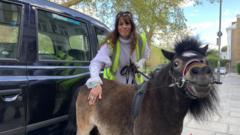
It is not every day you see a horse in a taxi, but in the heart of south-west London, there is an exception for one special resident. At just a few feet tall, he may not look like your average therapist, but to owner Maria, he is everything.
Rusty is a three-year-old Falabella – one of the world's smallest horse breeds – and he now has his own taxi to get around London.
"He gives me a life," says Maria Johal, who has spent most of her life suffering from panic attacks after she developed post-traumatic stress disorder from childhood neglect.
The 50-year-old became so debilitated by the panic attacks that she was unable to work, so she began looking for ways to help treat her anxiety.
After researching equine therapy, Maria learned a horse's heartbeat can sync with a human's, which she says helps to regulate her breathing.
"Panic attacks can be really horrible; he's really given me a life," she says. "I was so isolated, now I'm meeting so many more people in my community."
As a registered therapy animal, Rusty is allowed on public transport but he has been too nervous to do this, so instead Maria has given him a private mode of transport.
Maria hopes his new ride will allow them to travel further, with plans to visit a special needs centre and a hospice.
For Rusty's next trip, he is going to the dentist with her.
"He's a magnet, people just gravitate towards him," Maria says. "Dogs are amazing, but after researching equine therapy, it's the right decision for me. You meet your whole community and people outside of it.
"When I walk Rusty, he's good for the soul. He helps you if you feel blue, if you just need some clarity or perspective on the trials and tribulations of life, he gives you that. But he's cheeky like any three-year-old."
The next time I visit Maria, there is another familiar face. He looks a lot like Rusty, but is much smaller. Enter Tayto.
He is 10 months old and has been adopted by Maria's friend, Seamus. They have reconnected after losing touch in their teenage years.
The two hope he will also become a therapy horse, although Tayto has had a difficult start in life.
Maria says: "When we got him, we had to shave him because he was riddled in itchy mites. We found burn marks on his back. With any rescue animal, it's all about trust; baby steps and love."
Rusty, it seems, is also a therapy horse for other horses.
"Rusty guards him at night, grooms him, and wants to protect him. He's [Tayto] learning from him all the time," Maria says.
"My horse is a therapist for this other little horse now. Every day he blossoms."
Maria says she now receives Christmas cards for Rusty and people from all walks of life stop to see him.
She says: "In London, it can take a good few years to meet your neighbours. For centuries, horses have been known to be magical creatures, and it's true - he gives me life."
Maria hopes people seeing Rusty will invite conversations about mental health.
"I think there are so many people struggling and not enough resources; anyone can become unwell," she says. "You can develop certain disorders, you don't always need to have trauma to develop them.
"Not everyone's dream comes true, not everyone gets to have the children, the Christmas tree and the labrador - life is complex and complicated for every individual. For me, it's about finding solutions.
"With Rusty, I feel proud; he's my everything."
Seamus, 54, used to be a bricklayer and now he trains horses. He has been studying equine therapy and helping train Rusty.
"Maria called me and asked if I'd help her train Rusty. I never imagined I'd be walking a horse in London," he said.
Leah is one of the many children who volunteer with Rusty. She says her confidence has grown as a result and she has learned to walk horses.
"I enjoy playing with Rusty a lot," Leah says. "I just love him so much. It's amazing seeing a horse in London; you don't see them unless you go to the stables."
Maria says lots of children get the opportunity to pet Rusty and learn to walk him, something which brings joy to the local area.
Dr Tracy King, a chartered clinical psychologist, says animal therapy can create the foundation for later talking therapy because once someone is more regulated and stabilised, they may feel safer and more able to explore difficult emotions or experiences.
"For many people, especially those who are anxious, traumatised, grieving, lonely, neurodivergent, or emotionally overwhelmed, talking about their experiences can feel too much at first," Tracy says.
"Animals can offer a calming, non-judgemental presence that helps a person feel safer, more grounded and more connected.
"Stroking an animal can also stimulate the release of oxytocin, often called the bonding hormone, which is linked to feelings of trust, safety, warmth and connection."
After spending some quality time with Rusty, I can absolutely say he might be small, but the joy he brings is enormous.
Related stories

The Punch
SportsJun 14, 2026 · 1 min
FIFA names Côte d’Ivoire 2026 World Cup youngest squad
The Punch
The Punch
NewsJun 14, 2026 · 1 min
Diri urges peace, cultural revival at Bayelsa community yam festival
The Punch
The Punch
SportsJun 14, 2026 · 1 min
VIDEO: ‘I love Nigeria’, Thierry Henry clears up World Cup joke with IShowSpeed
The Punch
The Punch
PoliticsJun 14, 2026 · 1 min
June 12, symbol of democracy — Abia LP
The Punch