Philippine Daily Inquirer
Philippine Daily Inquirer··3 min read
eGov app: a digital government, halfway there
The Philippine government has spent years talking about digital transformation. For many Filipinos, however, that promise still feels distant: long lines remain common, multiple government websites require separate logins, and physical documents and photocopies are still treated as necessities.
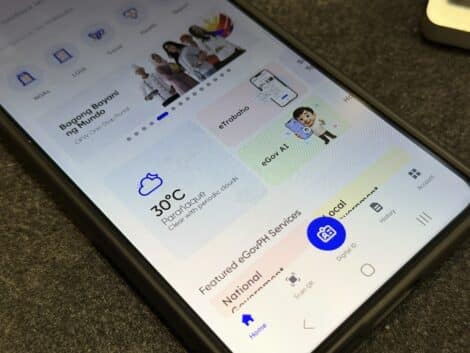
Yet hidden in plain sight is a platform that has quietly become one of the country’s most ambitious digital government projects: the eGov app.
Ask around, and many Filipinos either have never heard of it or have little interest in downloading it. Some assume it is just another government application that offers little value. Others worry about privacy and security.
Article continues after this advertisement
As a result, the app remains largely outside the public conversation despite steadily expanding its capabilities. That is unfortunate because the eGov app has evolved into much more than a simple government portal.
FEATURED STORIES
TECHNOLOGY
TECHNOLOGY
TECHNOLOGY
Today, it serves as a digital wallet for several government-issued credentials. Users can access their National ID, driver’s license, NBI Clearance, PhilHealth ID, PRC ID, and most recently, their Tax Identification Number. Instead of carrying multiple cards or printed copies, many of these documents can now be stored and presented directly from a smartphone.
The app’s usefulness goes beyond digital IDs. Citizens can access government portals such as SSS, PAG-IBIG, and PhilHealth. Complaints can be filed through the platform. Some local government units have also begun integrating services into the system. Travelers can process eTravel requirements. Job seekers can search for opportunities. Filipinos can apply for grants, medical assistance, and other government programs without navigating a maze of separate websites and offices.
For a country that has long struggled with bureaucratic inefficiencies, the idea is difficult to criticize. The government has already built a platform that brings together services previously scattered across multiple agencies, yet technology alone does not guarantee adoption.
Article continues after this advertisement
One of the biggest obstacles facing the eGov app is acceptance. Digital IDs are a good example. The government has repeatedly promoted them as valid credentials. In practice, however, acceptance remains inconsistent.
I recently used a digital National ID from the eGov app to encash a check at a major bank without any issues. The process was straightforward, and the institution recognized it as a legitimate form of identification. Yet during another transaction involving a government-owned and controlled corporation, the same digital ID was rejected. Instead, I was instructed to produce a photocopy of the digital credential.
That experience raises an obvious question: What is the point of digital identification if users are still expected to print it? A digital government cannot function effectively if its own institutions apply different standards. Every time a digital credential is rejected, public confidence takes a hit. Citizens are encouraged to embrace digital services and are reminded to keep physical backups nearby, just in case.
Article continues after this advertisement
Awareness is another challenge. Despite its growing list of features, the eGov app remains surprisingly unknown to many Filipinos. Government agencies regularly promote individual services, but there has been far less emphasis on explaining why the platform itself matters and how it can simplify interactions with government.
Then there is the issue of sustainability. Recent reports have highlighted the need for additional funding to strengthen and expand the eGov platform. Service interruptions earlier this year exposed the pressures that come with a growing user base and an expanding list of services. If the government wants more agencies, local governments, and citizens to rely on the platform, it must also ensure that the infrastructure supporting it can keep pace.
This is where the conversation should be focused.
The eGov app does not need to prove its usefulness. It already is. Many people are amazed that their Digital IDs are synced to their accounts one by one. Many are thankful for the app being a one-stop shop for government transactions. The bigger challenge is ensuring that government agencies consistently recognize digital credentials, that citizens are aware of the services available, and that sufficient resources are allocated to keep the platform reliable and secure.
Your subscription could not be saved. Please try again.
Your subscription has been successful.
The Philippines does not lack digital government services. Increasingly, they are being brought together in a single platform. The challenge now is ensuring that citizens know about it, institutions recognize it, and the government continues investing in it. Without those three pieces falling into place, the eGov app risks becoming a powerful solution that remains underused.
View original source — Philippine Daily Inquirer ↗
Related stories

Philippine Daily Inquirer
NewsJun 14, 2026 · 1 min
... Keep on reading: Tuldok, June 15, 2026
Philippine Daily Inquirer

The Punch
NewsJun 14, 2026 · 1 min
Gen Rabe’s death a painful blow to nation’s security – Atiku
The Punch

ESPN
SportsJun 14, 2026 · 1 min
After a 53-year wait, the NBA title belongs to the...
ESPN
The Punch
NewsJun 14, 2026 · 1 min
Hamzat denies links to suspect in Oyo robbery raid, claims smear campaign
The Punch