Times of Israel
Times of Israel··4 min read
Four men indicted over Haredi riot outside home of Supreme Court Justice Sohlberg
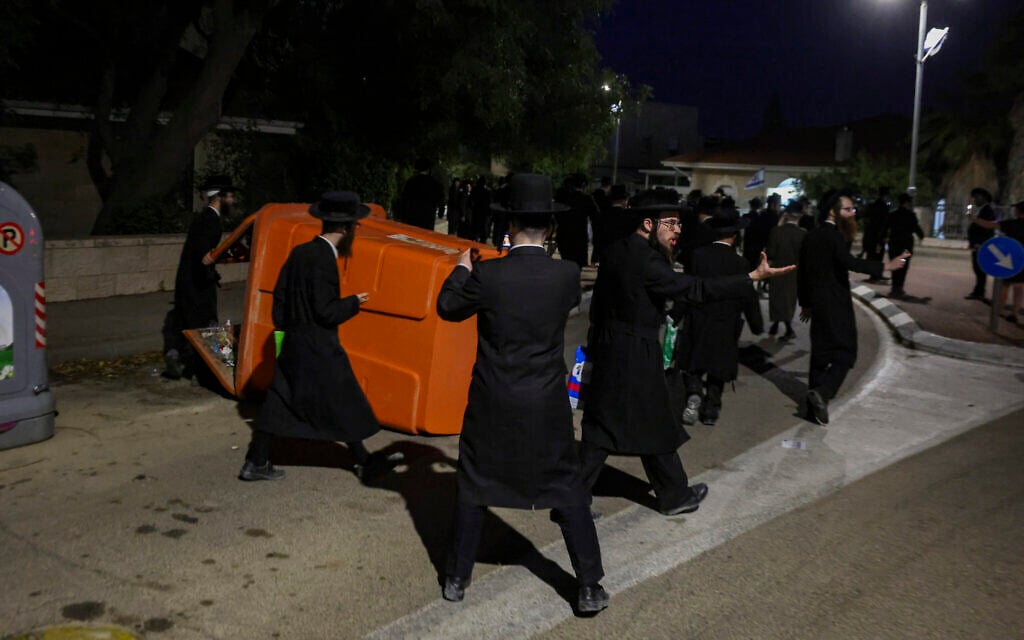
Prosecutors on Sunday indicted four men from Beit Shemesh for rioting outside the home of Deputy Supreme Court President Noam Sohlberg in the West Bank settlement of Alon Shvut on June 3.
The four are the first to be indicted over the destructive demonstration against the judge, who enraged Haredi leaders with a November ruling that called for criminal sanctions on draft-evading yeshiva students. Police have nabbed dozens of suspected rioters from the demonstration.
The defendants were identified as Nachman Platnik, 20; Abraham Fried, 20; Gershon Hanoun, 21; and Shimon Atep, 41. All have been in custody since the day of the riot, according to the indictment, and prosecutors informed the court they would seek prison sentences. The defendants will remain in custody until the court says otherwise.
All four defendants were charged with rioting, and Platnik and Fried were also charged with trespassing in order to commit a crime.
Posters announcing the riot were plastered on roads and synagogues in the Haredi city of Bnei Brak on the day of the incident, said the indictment, which was filed in the Jerusalem Magistrate’s Court.
Get The Times of Israel's Daily Edition
by email and never miss our top stories
By signing up, you agree to the terms
But prosecutors don’t know who led the riot, or who paid for the two buses and minibus that shuttled over 100 men, including the defendants, from Bnei Brak, near Tel Aviv, to Alon Shvut, the indictment said.
Sohlberg and his wife were at home at the time of the riot, which sought “to deter Justice Solberg with regard to his rulings as a judge in petitions related to the issue of conscripting yeshiva students,” prosecutors said.
“Many dozens” of rioters blocked Sohlberg’s street, yelled derogatory chants including “Nazi” and brought small Israeli flags with a swastika instead of a Star of David, according to the indictment.
They also stoned the judge’s home, and smashed windows, potted plants in the entrance and the windshield of the judge’s car, prosecutors said.
Some of Sohlberg’s neighbors mistook the riot for a terror attack and entered safe rooms, the indictment said. It added that some neighbors also tried to confront the rioters, and one neighbor was attacked by rioters and had his kippah snatched.
A police car that arrived at the scene “was forced to distance itself after participants in the incident ran toward it while shouting various slogans,” prosecutors said.
Some rioters stormed the front yard and tried to break into Sohlberg’s home through a back door, according to the indictment.
The two defendants charged with trespassing entered the judge’s driveway “with the aim of intimidating, insulting, taunting or committing a crime,” the indictment said.
Police initially arrested 65 suspects who had boarded a bus to flee the scene of the riot, and brought 62 for remand hearings in court.
Roi Politi, one of the lawyers representing the dozens of suspects, said all but the four who were indicted Sunday have been either freed or transferred to house arrest.
Politi, who represented the defendants in the indictment hearing, also stressed the relatively light charges leveled against his clients.
“The indictment filed does not attribute to the defendants property damage, attempted break-in to the house or assault,” he noted.
Politi also disputed prosecutors’ allegation that the riot sought to deter Sohlberg from fulfilling his role as a judge.
According to the lawyer, the defendants did not understand where they were being taken or whom they were protesting that evening.
Extremist Haredim regularly hold rowdy protests against efforts to penalize their failure to perform mandatory military service. A rush-hour Thursday protest effectively shut down central Israel’s highway and railroad traffic for about two hours. Several recent riots were triggered by criminal procedures against people who rioted outside Sohlberg’s house.
The protests have escalated over the government’s failure to pass a law regulating Haredi enlistment, as required under a June 2024 Supreme Court ruling that there was no constitutional basis for the community’s decades-long exemption from military service.
Haredi leaders have demanded the exemption be codified and withheld support for the government over the stalled legislation and the repeal, by order of the judiciary, of social benefits due to draft evaders.
Meanwhile, the Israel Defense Forces has repeatedly warned of an urgent manpower shortage amid the regional war that began with the Hamas-led onslaught of October 7, 2023.
Over the past two years, the military has sent out tens of thousands of enlistment orders to members of the ultra-Orthodox community following the 2024 Supreme Court ruling. Most have ignored the orders, leading to large numbers of young men being classified as evaders and being subject to arrest or other sanctions.
View original source — Times of Israel ↗
Related stories

ESPN
SportsJun 14, 2026 · 1 min
Every team's odds to win the World Cup: Brazil's o...
ESPN

The Punch
NewsJun 14, 2026 · 1 min
Power debt: Atiku slams ₦4tn bond, demands accountability
The Punch

ESPN
SportsJun 14, 2026 · 1 min
Koepka WDs from Canadian Open with hand injury
ESPN
The Punch
NewsJun 14, 2026 · 1 min
Why I wore black to Alex Ekubo’s funeral — Daddy Freeze
The Punch