
The Hill
Trump, Hegseth lean on GOP to move defense dollars
Skip to content
President Trump and Defense Secretary Pete Hegseth are in a full court press to sell GOP lawmakers on a massive funding injection for the Pentagon’s budget.
Hegseth this past week spoke with senior House Republicans in at least two separate conversations to discuss military spending, with the most recent taking place Thursday at the Pentagon. And Trump called on Congress Wednesday night to approve $350 billion in defense funding as part of a third reconciliation bill — a path that would allow Republicans to sidestep the required 60 votes needed to pass regular spending bills in the Senate.
The stepped-up messaging reveals a tense dispute over how to reach Trump’s desired $1.5 trillion defense budget, with some Senate Republicans and virtually all Democrats in no mood to back a massive budget reconciliation bill for the Pentagon amid strong public disapproval of the war with Iran.
The president hopes to get to that historic figure through a $1.15 trillion base budget and $350 billion pushed through in the reconciliation legislation.
Also in the mix is an expected supplemental funding request from the White House to backfill depleted munitions used in the U.S. air campaign against Iran and maintain military readiness. The Trump administration initially signaled it would need $200 billion for that effort before the officials reportedly decided to scale it back to an expected $80 billion to $100 billion.
Hegseth on Tuesday reportedly told top congressional defense hawks, including House Armed Services Committee Chair Mike Rogers (R-Ala.), that the Pentagon hoped to “fill the hole” created by U.S. operations in Iran and Venezuela via a supplemental.
That request has not been sent by the White House to Congress, even though House Appropriations Committee Chair Tom Cole (R-Okla.) last month said the Pentagon would need it by August.
Hegseth also during a Thursday morning meeting at the Pentagon with senior House Republicans, including Budget Chair Jodey Arrington (Texas) and Republican Study Committee Chair August Pfluger (Texas), pushed the military funding portion of the next potential reconciliation bill.
The problem for Hegseth and Trump is that pushing both a reconciliation package and an Iran supplemental bill is a hard sell. As a result, it is sparking speculation that the two ideas could be combined in some way.
Sen. Jack Reed (D-R.I.), ranking member on Senate Armed Services Committee, said Democrats should not vote to “subsidize” the military conflict with Iran by passing a defense supplemental spending bill until Congress votes to authorize continued military action against Iran.
“Until they authorize this conflict, I don’t think we should subsidize” it, Reed told The Hill on Thursday.
He speculated that the Trump administration hasn’t submitted a request for a defense supplemental spending package because they’re embarrassed to acknowledge the mounting costs of the conflict.
“I think they’re really afraid that when the total number comes out, which is probably over $200 billion now, it will increase the public disfavor of their operations,” Reed said.
The conflict in Iran, now well past its 100-day mark, cost roughly $29 billion as of early May, according to Pentagon officials. The administration hasn’t released a new figure since then, but Rogers on Thursday estimated it is in the mid-$30 billion range, Punchbowl News reported.
The administration’s most recent cost estimate does not include the dollars needed to repair the damaged air bases and other U.S. outposts in the Middle East, likely putting the price of the conflict far higher.
Senate Armed Services Committee member Richard Blumenthal (D-Conn.), likewise, had reservations over the administration’s lack of congressional authorization for the conflict.
“I’m always open to a conversation, but there is no reason and no justification for a supplemental on a war that he has refused to come to Congress as required by the Constitution,” Blumenthal told The Hill. “I see no path forward for a supplemental for an illegal order.”
Sen. Tim Kaine (D-Va.), also a member of the Armed Services panel, said it’s “very hard” for Democrats to support a defense supplemental spending package “given how big” the top line is for total defense spending in the National Defense Authorization Act.
Kaine said that “just before you get to what’s in the supplemental” it’s “hard to imagine” that Democrats would agree to an emergency spending request when Trump is already floating $1.15 trillion in the annual defense authorization bill and another $350 billion through the budget reconciliation process.
“There’s a case to be made for more investment but a 40-percent increase in defense investment in one year, I think it’s going to be really hard,” he said.
Republican senators, meanwhile, are weary after toiling over an overnight, 18-hour series of votes last week to pass a $70 billion funding package for immigration enforcement operations. A third such process for defense may not even reach the necessary 50 votes.
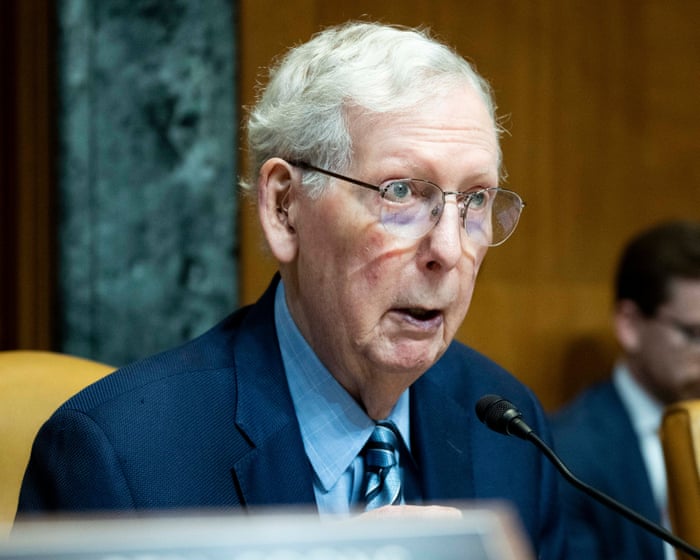
Senate Appropriations Defense Subcommittee Chair Mitch McConnell (R-Ky.) and panel member Susan Collins (R-Maine) warned as much Tuesday, saying the administration shouldn’t rely on that possibility for defense funding that should have been baked into the base budget.
“I think it’s safe to conclude there will not be another reconciliation bill, so it’s really not an option,” McConnell said.
“I agree with that assessment,” Collins replied.
Even Senate Majority Leader John Thune (R-S.D.) has given a lackluster endorsement for a third reconciliation bill.
“We’re, as I’ve said before, open to using reconciliation if we make the calculation that we can achieve an outcome that [it’s] something we can get 50 votes for and 218 for,” Thune said Thursday, according to Politico. “I’ve said before, at the moment I’m not sure what that is.”
But Trump isn’t letting up, calling on Republicans in Congress “to IMMEDIATELY advance and pass” the forthcoming reconciliation bill, what he referred to as “Recon 3.0,” which would fund the Golden Dome missile defense system, launch his so-called Golden Fleet for the Navy, subsidize the new F-47 fighter jet and B-21 bomber, replenish munitions stockpiles and pay for costly investments in space and drones.
“This is a GENERATIONAL Investment in our Military, will include THE SAVE AMERICA ACT as well,” he wrote Wednesday on Truth Social. “No games, no delays, and no weak compromises! Do this ASAP.”
Tags
Donald Trump
fiscal 2027 budget request
House GOP
Iran war funding
Jack Reed
Jodey Arrington
John Thune
Mike Rogers
Mitch McConnell
Pentagon budget
Pete Hegseth
Reconciliation
Richard Blumenthal
Senate GOP
Susan Collins
Tim Kaine
Tom Cole
Trump administration
Copyright 2026 Nexstar Media Inc. All rights reserved. This material may not be published, broadcast, rewritten, or redistributed.
View original source — The Hill ↗
Related stories

France 24
PoliticsJun 14, 2026 · 1 min
Putin and Zelensky hold separate calls with Trump on his birthday
France 24
The Guardian
PoliticsJun 14, 2026 · 1 min
Mitch McConnell receiving medical care after being admitted to hospital
The Guardian

TASS
PoliticsJun 14, 2026 · 1 min
Putin talks to Trump over phone, congratulates him on his 80th birthday
TASS

Daily Trust
PoliticsJun 14, 2026 · 1 min
Black Sunday: CAN Demands Urgent Action on Insecurity, Commends Community Policing Bill
Daily Trust