The Guardian
Trump calls for restraint after Israel launches fresh airstrikes on Beirut
Donald Trump was forced to call for restraint on Sunday after Israel launched fresh airstrikes on Beirut as mediators sought to conclude negotiations on a preliminary peace deal between Iran and the US that would bring the three-month war in the Middle East to a definitive end.
Trump played down new Israeli strikes but said “all sides should stand down”.
“We are very close to a Deal that will bring peace to the region, including to Lebanon ... There should be no more attacks by Israel anywhere in Lebanon, but there should also be no more attacks by any other party, including Hezbollah, against Israel. This could be the beginning of a long and beautiful peace – Let’s not blow it!” the US president posted to his social media site.
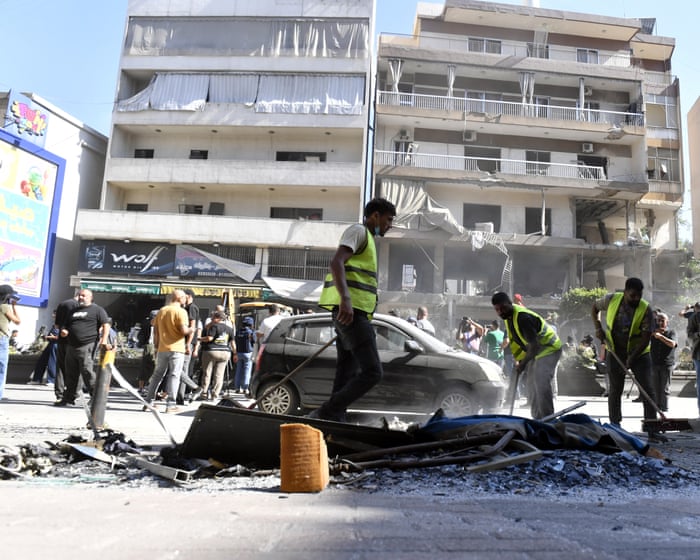
Trump had previously suggested the US could sign an agreement with Iran on Sunday, but as the evening came in the Middle East, there was no sign of a breakthrough. Instead, Iranian officials threatened a military response to the Israeli attack on Beirut, which destroyed a building in the Lebanese capital’s southern suburbs, killing three and injuring six.
Israel said it had targeted senior Hezbollah commanders after the militant Islamist organisation – which has close links with Tehran – launched three projectiles into northern Israel.
A strike on Beirut by Israeli forces a week ago triggered a short but intense new round of fighting between Iran and Israel, momentarily destabilising negotiations between Tehran and Washington.
Mohammad-Bagher Ghalibaf, a lead negotiator for Tehran and Iran’s parliamentary speaker, wrote on X on Sunday that Israel’s strikes on Beirut showed “America either lacks the will to fulfil its commitments or the ability to do so”, warning that the strikes could imperil the final stage of talks.
Gen Mohammad Jafar Asadi, the deputy commander of Iran’s joint command headquarters, said: “These crimes will not go unanswered,” according to the official Mizan news agency.
Tehran has insisted that any peace agreement must cover “all fronts” and so include the fighting in Lebanon, where Israel has launched a broad offensive and occupied a swath of the south.
“The Iranians do not trust the Americans and are not convinced that the Americans will hold the Israelis in check. I don’t think the Iranians care about Lebanon but they do care about Hezbollah … and they have spoilers on their own side who don’t want a deal,” said HA Hellyer, a regional expert at the Royal United Services Institute thinktank in London.
Regional officials said Qatari mediators traveled to Tehran on Sunday to finalise terms of a memorandum of understanding, which is expected to be signed electronically.
Unconfirmed reports suggest this preliminary agreement will oblige Iran to reopen to all shipping the strait of Hormuz, which before the war carried about a fifth of the world’s oil and liquid gas supplies. At the same time, the US would lift its own blockade of Iran and allow Tehran to sell oil, providing some relief for Iran’s fast-deteriorating economy.
However, the memorandum does not appear to address the most contentious issues, such as Iran’s nuclear programme, which would be addressed during a 60-day period leading to a more comprehensive deal.
Observers have expressed scepticism that complex negotiations could be successfully concluded in less than two months, pointing out that the 2015 US-Iran deal that restricted Tehran’s nuclear programme in return for sanctions relief took almost 10 times longer and the negotiations were conducted by large teams of technical experts.
“I doubt we are going to see all this hammered out in 60 days,” said Alia Brahimi, of the Washington-based Atlantic Council.
Reaction in Israel to the broad outlines of the emerging deal has been sharp, with widespread concern at the absence of terms in the draft agreement that would force Iran to restrict either its ballistic missile arsenal or support for regional militant movements such as Hezbollah. Benjamin Netanyahu, Israel’s prime minister, has publicly supported Trump but faces a tough re-election battle later this year.
Hezbollah fired missiles into Israel on 2 March, two days after the US and Israel attacked Iran, killing the then supreme leader, Ayatollah Ali Khamenei. Israeli troops have since pushed their invasion of Lebanon deeper than at any point in over a quarter-century.
“This is a colossal failure. A full-blown collapse. Iran has undisputedly emerged as the big winner,” wrote Avi Ashkenazi in the mass-market Maariv newspaper.
Jacob Nagel, a former national security adviser to Netanyahu, called the draft deal a “big mistake”.
Critics in Trump’s own Republican party, which is struggling with high fuel prices and an unpopular war ahead of the midterm elections, have also criticised the emerging deal.
Even if the strait of Hormuz is reopened, relief for the world economy will only come slowly, analysts say. Safe passage for shipping trapped in the narrow waterway is far from assured and infrastructure damaged during the conflict will take months to fully repair.
Trump is expected to discuss de-mining the strait during the G7 summit that starts on Monday.
View original source — The Guardian ↗
Related stories

France 24
PoliticsJun 14, 2026 · 1 min
Putin and Zelensky hold separate calls with Trump on his birthday
France 24
The Guardian
PoliticsJun 14, 2026 · 1 min
Mitch McConnell receiving medical care after being admitted to hospital
The Guardian

TASS
PoliticsJun 14, 2026 · 1 min
Putin talks to Trump over phone, congratulates him on his 80th birthday
TASS

Daily Trust
PoliticsJun 14, 2026 · 1 min
Black Sunday: CAN Demands Urgent Action on Insecurity, Commends Community Policing Bill
Daily Trust