CNA
How Singapore's growing trail running community is powering a 165km ultramarthon in the country
SINGAPORE: Spanning about 50km from east to west, Singapore is not the first place one would expect to host a 165km ultramarathon.
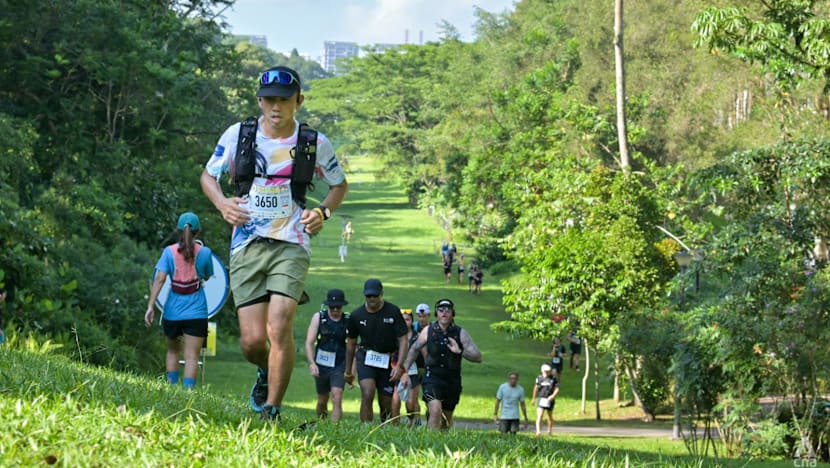
But earlier this month, more than 1,300 runners took part in the annual Ultra Trail Singapore (UTSG) event, with distances ranging from 20km to 165km.
While larger countries often draw trail runners with mountains and hundreds of kilometres of rugged terrain, Singapore is better known as a concrete jungle - its tallest natural point, Bukit Timah Hill, stands at just 164m. By most measures, the country should not be considered a natural ultra or trail running destination.
But Singapore’s growing trail running community would beg to differ.
UTSG drew about 300 runners in its first edition in 2023. This year, it attracted more than 1,300 participants from 30 countries.
Runners told CNA that trail running has been buoyed by Singapore’s wider running boom, as more trail running clubs emerge and existing groups grow in size.
Mountain Goat Running Group, which organises UTSG, had just 12 members when it started in 2021. It now has about 600.
One of them is 28-year-old Ament Chia, who started trail running in 2023 and took part in the 80km race on Jun 6, followed by the 20km race on Jun 7.
Mr Chia began training at MacRitchie Reservoir for overseas ultramarathon races. While he felt “underprepared” and struggled during his first trail race in East Malaysia, the challenge sparked a love for the sport.
To prepare for UTSG, he ran five to six times a week and trained for elevation by doing repeated climbs up Bukit Timah Hill. He also joins weekend runs with other trail runners, weaving through Singapore's hilliest areas.
He said it is the people he runs with that motivate him to push harder during races.
"For the race, after a certain point, it will be a mental game, and that's where the community really comes in, because of how vibrant and encouraging everyone is, that's a big part of getting you to the finish line," he said.
WHAT TRAILS?
Held over three days, UTSG runners tackled Singapore’s hilliest roads, muddy trails and, for many, the toughest hurdle of all - the oppressive heat. In the 165km race, runners climbed 5,246m of elevation, roughly the height of Mount Everest Base Camp.
While not all trail races are ultramarathons - a term reserved for races longer than 42.2km - the two are often used interchangeably, as many trail events go beyond the marathon distance.
In their search for elevation, organisers designed one section of the race where runners had to take an MRT train from Labrador Park station to Botanic Gardens station - allowing them to go from the hills of Mount Faber to the slopes of Bukit Timah.
Race organiser Edi Huang told CNA that to maximise elevation gain, the course includes its fair share of repeated climbs and U-turns.
“Just for us to be able to clock the elevation, or to gain more elevation, we have to do a lot of repeats,” he said. “Some people say UTSG is U-turn SG.”
For some race categories, runners had to climb and descend Lorong Sesuai at Bukit Batok Nature Park up to 10 times, gaining about 65m with each ascent.
However, the race route does not pass through popular trail areas such as the Central Catchment Nature Reserve, which includes MacRitchie Reservoir, or Bukit Timah Nature Reserve, which includes Bukit Timah Hill.
Mr Huang said UTSG could not be held within these nature reserves as permission was not granted by the National Parks Board (NParks), which manages them.
Responding to CNA’s queries, Mr Lim Liang Jim, group director of conservation at NParks, said a permit is required for any activity involving 30 or more people in NParks’ nature reserves and nature parks.
NParks assesses each application to ensure that the “potential impact to biodiversity and visitors is kept low”.
“As there is high visitorship in the Nature Reserves, Nature Parks and Rail Corridor during weekends and public holidays, group activity permits may not be issued for these days,” he added.
Mr Lim said large groups, such as those in mass running events, tend to generate significant noise, which could have negative effects on flora and fauna in the forest.
Mass-participation sporting events may also lead to the trampling of undergrowth and widening of trails, which can cause erosion, he added.
UTSG’s significance extends beyond Singapore. The race is part of the Asia Trail Master, a regional trail-running circuit featuring official races across Asia.
For competitive runners, the 60km race category offers a chance to earn points towards qualification for the Asia Trail Master Championship Final, which will be held in Vietnam later this year.
Everyday runners can also take on the Asia Trail Master Grandmaster Quest. To become a Grandmaster, runners must complete six different qualifying races across Asia within two years. One of the criteria is for the race to be at least 70km long, which UTSG’s 80km category fulfils.
Mr Huang said this is one reason overseas runners are drawn to the event, as it can help them work towards larger trail running goals.
"A VERY EMOTIONAL THING"
CNA observed the start of the 35km race on Jun 6, as hundreds of runners were flagged off from Coliwoo Bukit Timah Fire Station.
They ran down a steep trail off Dairy Farm Road, which led to a grassy path stretching towards Woodlands. Competitors then looped back near the start line to complete seven ascents of Lorong Sesuai before making their way to the finish.
Singaporean runner Sadiq Mansor was first across the line after the gruelling climbs.
The 36-year-old freelance illustrator said that in the lead-up to the race, he ran every day, clocking between 100km and 120km a week.
Once a chain smoker, Mr Sadiq began running in 2020 during the COVID-19 pandemic to kick the smoking habit. He joined his first trail race in Vietnam in 2023 and has been hooked since.
When asked why the trail running scene is growing in Singapore, Mr Sadiq pointed to what he described as Singaporeans’ “tahan” culture - the Malay word for endurance.
“It's less about talent, I feel. If you do ultras, it is more about your willpower and your determination, or if you want to prove a point or something like that,” said Mr Sadiq, who will represent Singapore at the Southeast Asia Trail Running Cup in Jakarta in July.
“It’s a very emotional thing to do an ultra, because you put yourself through so much and then you finish it, sometimes I cry.”
Foreign runners, even those used to tougher and hillier routes, found Singapore’s version of trail racing no less challenging.
Frenchman Julien Prodhon, who finished second behind Mr Sadiq, said he was used to trail races in France that featured mountains and rugged terrain, rather than Singapore’s gentler hills and staircases.
But it was Singapore’s late-morning heat that pushed the 26-year-old software engineer hardest.
“The urban heat of Singapore makes it very hot … you need to hydrate a lot, take in electrolytes, and take proper nutrition,” he said.
“Compared to running back in France, this is a whole new different challenge.”
COMING BACK FOR MORE
Trail runners said it was the community spirit and the hunger to break physical boundaries that drew them to the sport, and kept them coming back for more.
Ms Kar-Lyn Tan, who is part of UTSG’s organising committee, said that while the sport may appear solitary once runners are out on the trails, the running scene in Singapore is deeply community-driven.
Since moving to Singapore about four years ago, she has seen more runners join trail groups, take part in races in Malaysia, and organise overseas trips for training and races.
“What makes it unique in Singapore is that there is a really supportive community locally,” she said.
That support, she added, has helped bring newcomers into the sport - from runners with little trail experience to hikers looking to take on longer distances.
She also pointed to the growing number of women entering the sport, particularly in shorter-distance events, and hopes to see more female runners take on longer trail races in the years ahead.
The journey is not smooth sailing for all runners, with no guarantees of completing a race due to the arduous distances and conditions.
For Mr Chia, his 80km race was cut short when he experienced knee pain and began feeling unwell in the afternoon heat.
Despite the setback, he decided to take part in the 20km race the next day.
“It's honestly quite easy to go down a slippery slope with thoughts like ‘maybe I'm not cut out for this’ ... but I know that I will regret it if I don't go again the next day, whatever the outcome might be,” he said.
He added that his running friends encouraged him throughout the race and never made him feel like he was not cut out for the sport.
“Sometimes I feel that others are more confident in what I can do, than I am myself,” he said.
Days after the race, he was still wondering if he could have pushed through the pain and completed the 80km event. But he already has his sights set on another trail race in Malaysia at the end of the month.
“It’s just a lesson to know what to improve on, and come back stronger,” he said.
Source: CNA/jx(mi)
Related stories

ESPN
SportsJun 15, 2026 · 1 min
UFC White House LIVE: Results and analysis for Ili...
ESPN

ESPN
SportsJun 14, 2026 · 1 min
Japan justify dark-horse credentials with dramatic...
ESPN

ESPN
SportsJun 14, 2026 · 1 min
NBA futures: Runners-up one year, champions the ne...
ESPN
ESPN
SportsJun 14, 2026 · 1 min
Gina Kim, Yana Wilson team to win Dow for first LP...
ESPN