CNA
The rise of the AI ‘token economy’ and China’s big bet on scale
SINGAPORE: The future of artificial intelligence may hinge on something surprisingly small.
Not huge data centres or the latest wave of AI agents, but tiny units of data called tokens, which AI models use to process information and generate responses.
Just like how electricity is measured in kilowatt-hours and mobile data in gigabytes, tokens are increasingly becoming the unit used to measure and price AI services.
And as AI adoption accelerates worldwide, governments and tech companies have been paying closer attention.
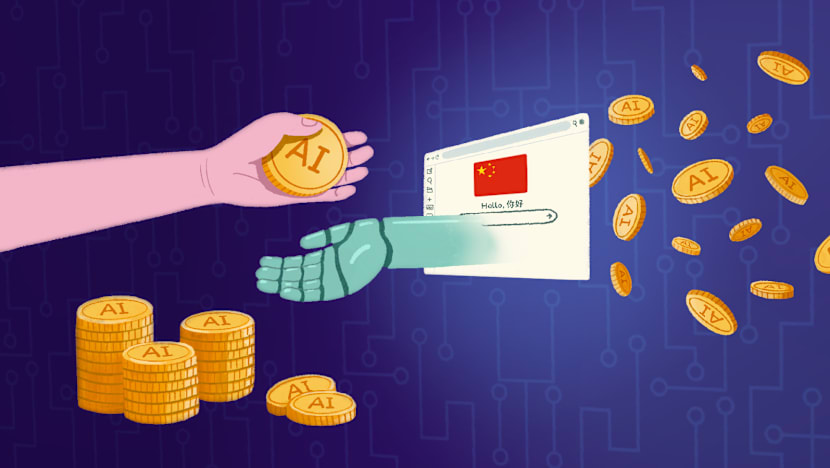
China, in particular, has been rapidly expanding its AI infrastructure to support rising token consumption, observers say - underscoring how its AI sector is evolving into a full-fledged “token economy”.
“There is a rising emphasis on the token economy in China,” said Qian Zilan, a research associate at the Oxford China Policy Lab - noting that Chinese state telecom giants have launched token services and subscriptions for both everyday users and developers.
In the first of a two-part series, CNA explores the rise of tokens and how their explosive growth is shaping China’s AI future and creating new business opportunities, as well as security risks, for the world’s second-largest economy and beyond.
THE BUILDING BLOCKS OF AI
Behind every chatbot response, AI-generated summary and image prompt are tokens.
In simple terms, a token is a small unit of data that AI models process when reading, interpreting or generating information.
A short word such as “dog” may count as a single token, while a longer one like “thunderstorm” would be broken down into multiple tokens.
Tokens are also not limited to words. Anything that can be typed on a keyboard - including numbers, spaces, punctuation marks, symbols and even emojis - can be converted into tokens for AI systems to process.
“They are the operational unit of generative AI and determine how much input a model can process, how fast it responds, how long an answer can be and how much computing power is used,” said James Pang, an analytics and operations professor at the National University of Singapore (NUS) and director of the NUS Business Analytics Centre.
“Think of them as Lego bricks or building blocks that an AI platform uses to read and write.”
And the more tokens an AI model has to process, the more resources it consumes, Pang said, which can have significant implications for computing costs and infrastructure demand.
The way tokens are counted also differs across languages and AI systems - a distinction experts said can significantly affect computing costs as businesses scale up AI usage across millions of queries and interactions.
Chinese, for instance, is often more semantically dense than English, meaning fewer characters can convey the same idea, said Pang.
A four-character Chinese idiom, for example, may require far fewer characters than an entire English sentence expressing similar meaning.
But he cautioned against oversimplifying the comparison.
“Different AI models use different tokenisation methods,” Pang said, noting that Chinese-optimised AI models may process Chinese text more efficiently, while English-centric models would split the same text into a larger number of tokens.
Wong Qi Han, an independent AI researcher and builder, told CNA that token efficiency depends heavily on how a model is trained.
“If a model is trained predominantly on English, its tokeniser compresses English text efficiently. But for other languages, the model breaks text into smaller, less efficient pieces,” Wong said.
“A model optimised for Chinese or English won't necessarily tokenise Tamil, Bahasa Indonesia or Vietnamese efficiently,” he added.
On a larger scale, small differences in token usage would translate to significant differences in computing costs.
Overall AI costs still depend on factors such as model size, inference architecture, caching, batching, output length and task complexity, Pang said.
“So fewer tokens do not automatically mean better reasoning or better business value.”
CHINA’S BET ON THE “TOKEN ECONOMY”
China’s use of AI has rapidly surged, with more than 600 million people using generative tools as of December 2025.
Younger and more educated users accounted for the bulk, according to an October 2025 report by the China Internet Network Information Center (CNNIC) - with those under 40 comprising more than 74 per cent of users and 37.5 per cent holding higher education qualifications.
And as AI becomes increasingly embedded into daily routines, powering everything from ordering food to transport, travel and shopping, token consumption has also risen exponentially.
Daily token usage surpassed 140 trillion in March, according to China’s National Data Administration (NDA) - more than 40 percent higher than 100 trillion recorded at the end of last year.
China's AI industry is “evolving from basic chat functions to more sophisticated systems capable of decision-making and task execution”, NDA chief Liu Liehong said during a Mar 25 press briefing, describing tokens as both a key indicator of AI growth and a potential new export frontier.
The growing importance of tokens was further underscored that month when China formally adopted the term ciyuan for AI tokens - combining the Chinese translation for “word” with the country’s currency unit, the yuan.
Observers said the naming reflects how tokens are increasingly being viewed not just as a technical measure of AI activity, but as a unit of economic value within China’s emerging AI economy.
Liu said the next step would be the creation of a “national computing network” - aimed at turning AI infrastructure into a public utility as token consumption continues to surge.
02:07 Min
Large token consumption figures suggest that China is “moving from experimentation into mass deployment”, said Pang from NUS, who also pointed to “substantial investment in data centres, cloud platforms, AI model-serving systems, optimisation engineering and energy supply”.
The country's massive digital ecosystem also gives it an advantage at “integrating AI into operational systems”, said Pang.
“Chinese firms have also been aggressive in lowering inference cost, releasing open-weight models, optimising for limited hardware, and embedding AI into cloud services, mobile apps and industrial workflows,” he added.
“If access to the most advanced chips is limited, software efficiency becomes a strategic necessity.”
Chinese telecom operators are already moving to monetise that shift.
Earlier this month, China Telecom, one of three major state-backed mobile operators in mainland China, unveiled nationwide token-based pricing plans aimed at a broad range of customers - from casual users to developers and businesses.
Consumer plans designed for everyday AI tasks start at 9.9 yuan (US$1.45) a month for 10 million tokens, rising to 49.9 yuan for 80 million tokens.
Depending on the task, a subscription package of say 10 million tokens could support thousands of AI-assisted searches, chatbot prompts and conversations and generating translations.
Enterprise-focused packages supporting applications such as coding assistants and AI agent deployment range from 39.9 yuan to 299.9 yuan per month and include between 15 million and 250 million tokens.
“Tokens are becoming to AI what kilowatt-hours are to electricity or gigabytes are to mobile data - the practical unit by which usage is measured and priced,” Pang said.
SECURITY RISKS OF CHINA’S TOKEN BOOM
But while token-heavy AI ecosystems create opportunities for new business models and greater efficiency, they also introduce risks.
New cyber scams are also emerging, with some “repackaging tokens as investment products”, Chinese officials said.
Authorities have begun warning about potential security threats linked to their rapid growth.
The Ministry of State Security issued a public advisory in April, highlighting risks including token theft, forgery, tampering and fraud schemes involving low-cost token packages and AI-related resale programmes.
“If token security is breached at scale, the impact may spill over from personal privacy and financial loss to broader data security and even economic security,” said Huang Daoli, a state researcher at China’s Ministry of Public Security, who added that tokens should be treated as highly sensitive credentials, no less important than payment tools.
“Token-heavy AI ecosystems bring opportunities … However, they can also create new challenges and vulnerabilities around data leakage or infrastructure attacks,” said Heng Wang, a law professor at Singapore Management University (SMU).
As AI systems process ever larger volumes of data and tokens, cybersecurity risks could also “increase substantially”, Wang said, adding that “more data protection is likely needed if more data is processed”.
The issue is not simply the volume of tokens being consumed, but also how deeply AI systems are becoming integrated into real-world workflows, said Pang from NUS.
“Token-heavy AI ecosystems expand the attack surface because they process more prompts, documents, logs, user data” - while increasingly connecting to external systems like databases, email platforms and business software to perform actions and retrieve information, he added.
Risks include cyberattacks and sensitive data leaks and malicious attempts to manipulate AI systems as well as corrupting training data and overwhelming systems.
The challenge becomes even greater as AI agents gain access to email accounts, calendars, databases, payment systems and enterprise software.
“The more AI systems are linked to real workflows and sensitive data, the more consequential failures become,” said Pang.
In many systems, tokens are not only used to measure computing activity but can also function as credentials for identity verification, access control and API usage, making them attractive targets for cybercriminals if security protections are weak.
Governments and organisations should increasingly treat AI as critical software infrastructure, Pang said - with safeguards such as access controls, data governance policies, model-risk assessments and clear rules on what information can be shared with AI systems.
Long-term success in AI may depend as much on governance as technological capability, said SMU's Wang.
“Looking ahead, the AI system with adaptive and robust governance arrangements is likely to succeed in the long run,” he said.
“If one system can process intelligence most efficiently at scale but lacks a resilient governance arrangement, a crisis may erode trust and incur high monetary and reputational costs.”
Additional reporting by Collin Furtado.
Source: CNA/ht(kl)
Related stories

The Guardian
TechnologyJun 14, 2026 · 1 min
UK hypermobility sufferers wait up to 21 years for diagnosis, study suggests
The Guardian

The Guardian
TechnologyJun 14, 2026 · 1 min
Globally significant volcanic event formed Giant’s Causeway, scientists find
The Guardian

The New York Times
TechnologyJun 14, 2026 · 1 min
Trump Claims Strait Will be ‘Permanently Toll Free’ Under Agreement With Iran
The New York Times

TechRadar
TechnologyJun 14, 2026 · 1 min
How to watch Sweden vs Tunisia: Free Streams & TV Channels for FIFA World Cup 2026
TechRadar