Indian Express
Coming up, Iran on US soil: Tension, security – and divided fans
Los Angeles has another name. Iranians call it Tehrangeles, home to the largest concentration of Iranians outside Iran itself. On Monday evening, it stages a football match unlike any in World Cup history: involving a country engaged in a military conflict with the host nation until a day before the game. Iran face New Zealand on Monday while a peace deal between Iran and USA was agreed on Sunday.
The deal notwithstanding, Iranian players will cross over into the US from their base in Mexico’s Tijuana the day before their games, play the match, and return to Mexico the same night. These are the logistics of war, in a tournament built for peace.
“I’ve been to three World Cups and they always say, once you get off the plane and enter the host country, there’s just a unique atmosphere of friendliness and globalness,” striker Mehdi Taremi, who will play in his third World Cup, said from Tijuana last week. “Unfortunately, I’m not feeling it right now. There’s a lot of tension. You feel it in the atmosphere.”
Iran’s Mehdi Taremi (left) and head coach Amir Ghalehnoy attend a press conference ahead of their FIFA World Cup match against New Zealand. (AP Photo)
Three days ago, at this same stadium, Iran’s flag was met with sustained boos from the American crowd during the opening ceremony. Players were issued visas at the eleventh hour. The team moved its camp from Arizona to Tijuana, citing unfair treatment on US soil. Fifteen federation officials were denied entry, Iran’s ticket allocation was revoked, and fans who had bought seats found them cancelled. The security operation around a single group-stage fixture already resembled something other than football.
The tensions had been building since December, when Iran threatened to boycott the World Cup draw in Washington after senior federation officials were denied visas. They reversed course days later, sending coach Amir Ghalenoei with a skeleton delegation, insisting pointedly that the attendance did not constitute a withdrawal of their protest.
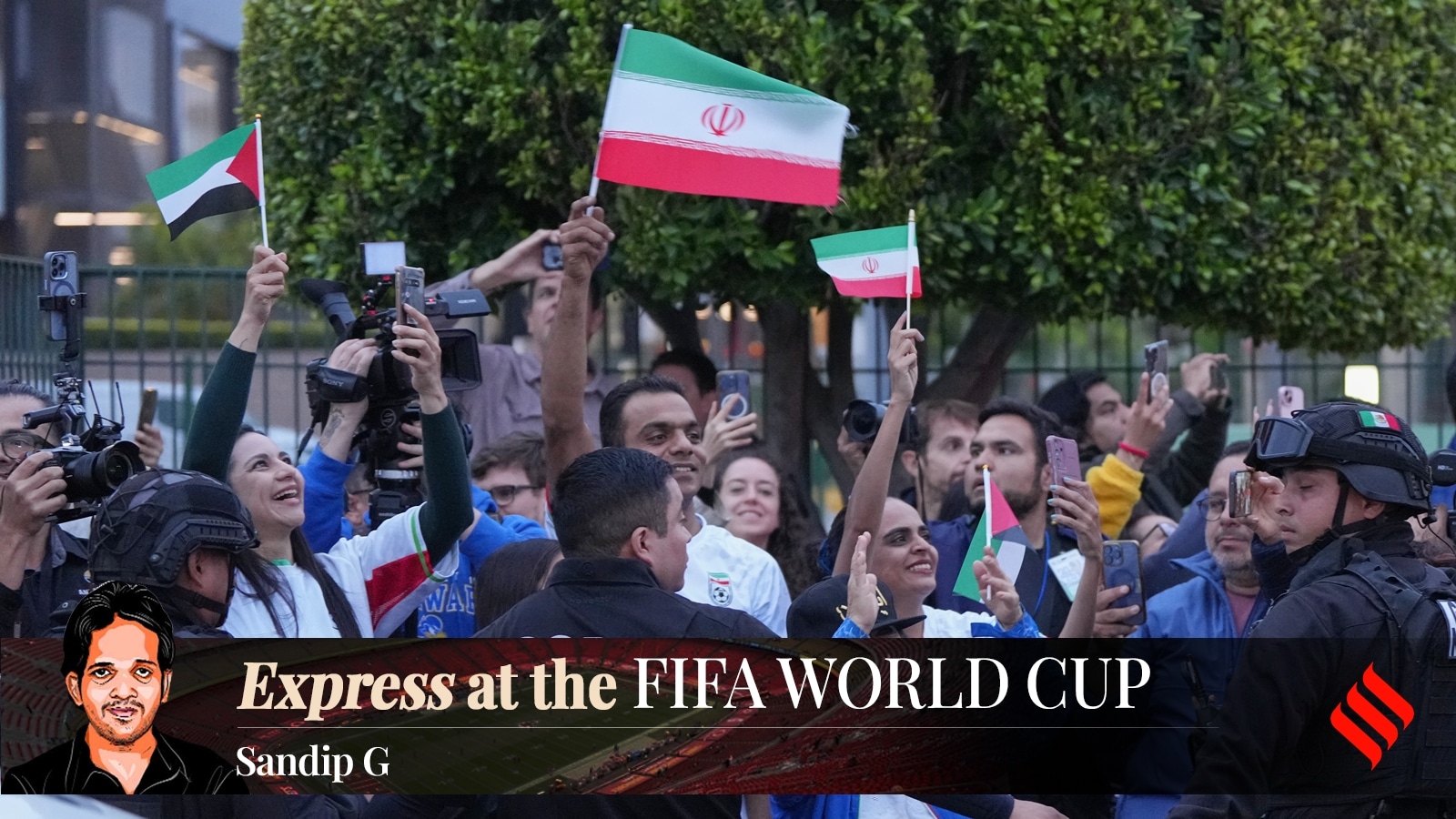
Outside the stadium last week, people waved pre-revolutionary Iranian flags, the lion-and-sun emblem of opposition to the Islamic Republic. FIFA banned them inside venues, a move challenged in court on First Amendment grounds.
“For the majority of Iranians, the distinction between Iran and the Islamic Republic is very important and that’s what this flag represents,” Nicole Sadighi of the Institute for Voices of Liberty has been quoted as saying in media reports.
Story continues below this ad
“They are not supporting the regime. They’re using this World Cup to express their resentment towards it.”
The question of who the diaspora is cheering for has no clear answer. In 2022, after the death of Mahsa Amini, a young woman, in police custody that sparked nationwide protests, Iranians cheered their own team conceding goals in a 6-2 defeat to England. When Iran were knocked out by the United States days later, people danced in the streets of Tehran, Mashhad, Isfahan and Karaj.
Raha, a 28-year-old sociological researcher, traces the disillusionment to the players’ conduct during the Woman, Life, Freedom protests.
“People were fighting in the streets, and right before the World Cup, the players were laughing, joking, taking photos looking utterly joyous. I will never forget those pictures,” she told The New Arab. She might still watch. But a loss won’t upset her, and a victory won’t bring her joy.
Story continues below this ad
Saman, a professional runner and coach, recently invited friends over to watch the tournament. Two declined. “They said it would just cause arguments. They believe that supporting the current national team is equivalent to supporting the government,” he told The New Arab. As a child, he says, all they needed were four stones for goalposts and a neighbour’s colour TV. What was once sacred is now contested.
US President Donald Trump, asked in March whether he cared if Iran showed up for the World Cup, was brief. “I really don’t care. I think Iran is a very badly defeated country. They’re running on fumes.”
For Faramarz, who skipped afternoon classes to watch Iran qualify for the World Cup in 1997 and danced on Karim Khan Zand Street when the final whistle blew, the distance between then and now is not measured in years. Nearly three decades on, he is not sure he will even watch.
“It truly breaks my heart,” he told The New Arab.
Story continues below this ad
The Iranian fans remember the victory over the United States at France 1998. They have been waiting for a sequel ever since.
In Tijuana, superfans Reza Mansoor and Mostafa Pourmand, who between them have attended 11 World Cups, believe this is the best squad Iran has ever sent. “There is a really high chance we’re going to advance. Best chance we’ve ever had.”
If they do, it opens a possibility that would have seemed fictional six months ago: Iran against the United States, on American soil.
Tonight is not that sequel. This is something stranger. It begins in Los Angeles, at 6 pm.
View original source — Indian Express ↗
Related stories

ESPN
SportsJun 15, 2026 · 1 min
The jock, the nerd and the Stanley Cup championshi...
ESPN

ESPN
SportsJun 15, 2026 · 1 min
Hurricanes' Staal, 37, oldest Conn Smythe winner
ESPN

ESPN
SportsJun 15, 2026 · 1 min
Keys to the offseason: Free agency plans for Hurri...
ESPN

ESPN
SportsJun 15, 2026 · 1 min
Hurricanes win Game 6, raise Cup for second time
ESPN