Indian Express
Kiren Rijiju at Idea Exchange: ‘Anybody can create a political party but don’t undermine and ridicule Indian democracy’
Kiren Rijiju, Union Minister of Parliamentary Affairs and Minority Affairs, on the need for the Constitution Amendment Bill, attacks on minorities, why most Bills do not get passed in Parliament and the major crisis facing the government. The session was moderated by Liz Mathew, Deputy Editor
Liz Mathew: As the NDA marks 12 years in governance, recently the Constitution Amendment Bill was defeated in Parliament. Were you prepared for this?
We were very upset that the Women’s Reservation Bill was defeated.
Liz Mathew: The Women’s Reservation Bill was not defeated.
Its implementation was. You can name it the Constitution (131st Amendment) Bill but basically it was the implementation of women’s reservation in the Lok Sabha and the Assemblies. We were upset because the actions of the Opposition parties were unexpected on two accounts. Number one, the same bill, the Nari Shakti Vandan Adhiniyam in 2023, supported by all the Opposition parties, was passed unanimously.
And it was mentioned that the Bill will be implemented on the basis of the population census conducted after 2026. Since the caste-based census is going to take a long time, we have to refer to the 2011 census, so that requires amendment. Without that, we can’t incorporate the necessary things to be included in the implementation of the Nari Shakti Vandan Adhiniyam Bill. Secondly, it is not that we brought the Bill suddenly, we had consultations with all the stakeholders, especially the bigger political parties. Except for the Congress, Trinamool and AAP, the other parties have joined, they have agreed.
Liz Mathew: The main contention of the Opposition parties was that you had not called an all-party meeting. Then you brought the Bill two days ahead of the session and that you did not mention about what you had promised to other parties which is the 50 per cent increase, you only mentioned the number of seats in the Lok Sabha. The Congress had said that they were ready if you delinked it from the women’s reservation. What do you have to say?
Story continues below this ad
While the first part of the Parliament session was on, we had started the consultation process. The demand for all party meetings was much later. Mallikarjun Kharge wrote three letters to me. The first demanding the all-party meeting be kept for later, when I already completed the consultation with most of the political parties, with DMK, Samajwadi Party, Shiv Sena, with all other parties. What is the point of calling for all-party meeting when we have finished the consultation process? We met 70 per cent of the Opposition parties. The Congress then out of blue asked for an all-party meeting, that was basically a ploy.
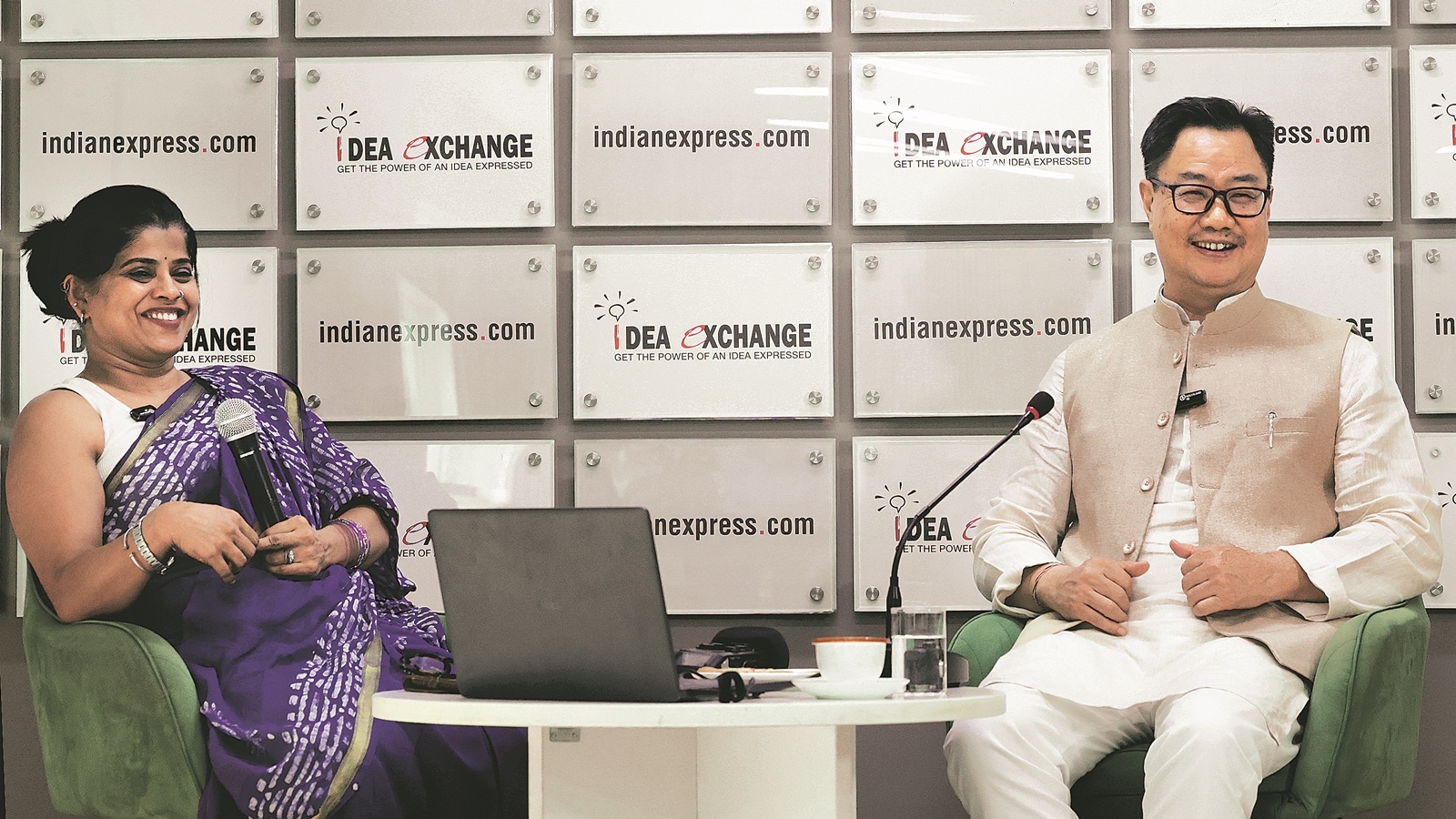
Kiren Rijiju, Union Minister of Parliamentary Affairs and Minority Affairs (right), in conversation with Liz Mathew, Deputy Editor, The Indian Express. (Photo: Renuka Puri)
Liz Mathew: What is the way forward?
I can’t commit anything right now because unless it’s placed in the Cabinet and a decision is taken.
Liz Mathew: With the CBSE evaluation and the NEET paper leak, many students have been affected. Has the government failed in this?
Story continues below this ad
You cannot say that the government has failed. But we should concentrate on how to get the students justice. There are so many steps taken from re-evaluation to re-assessment. Now, portals have being created. Many students have registered and have sent in their queries. Despite cyber attacks, the government has taken necessary steps to fix them. The primary objective is to make the system transparent so that in future such frauds are prevented. If we all sit together and ensure that reforms take place, the careers of students will be better.
On the delimitation bill | When the first part of the Parliament session was on, we had started the consultation process… We met 70 per cent of the Opposition parties. The Congress then out of blue asked for an all-party meeting, that was a ploy
Liz Mathew: Don’t you think that somebody from the government has to be held accountable for this ?
First of all, at any level, if a person has made a deliberate attempt to hijack the system, action should be taken. To build the confidence of the students, the CBSE chairman and the secretary have been shifted. New proposals to change the system are in place. The education minister has already said that he takes moral responsibility. He is not running away from the error, whoever has committed it, he has rather taken it up as a challenge to fix the problem. The demand for the resignation of the education minister is an effort to drive political mileage out of the problems faced by the students.
Manoj CG: Had the BJP been in the Opposition, would you not have demanded the resignation of the education minister?
Story continues below this ad
There is a difference. If the fraud is committed by the minister or minister’s staff, then the minister is responsible. But if a problem happens within an autonomous body, then they are answerable. The CBSE is an autonomous body. Then there is NTA, these are not directly monitored by the minister daily.
When we were in Opposition, every month there were scams against ministers. In the last 12 years, there is no direct charge against any minister for taking bribes or commission or manipulation of the system… So, bifurcate the difference between what Congress did and what we have done.
On attacks on minorities | If there are incidents against churches, there are incidents against Hindus, in Kashmir, Assam, Bengal, Karnataka… it can happen anywhere. One incident doesn’t make it a national one
Shyamlal Yadav: Manmohan Singh had launched a 15-point programme in the interest of minorities and in 2014-15 there were 8.71 per cent minorities appointed in all Central government jobs. What percentage of minorities has been appointed in the Central government after 2014-15 until now?
I will not look at appointments in a few organisations. See it in totality. Minorities are better in India, 12 years after Modi ji has become the prime minister. It’s the Congress and the Left ecosystem that keep hammering these slogans of minorities not being safe. Sabka saath, sabka vikas means every scheme is for everybody. Can anyone name a person who has left India because of religious persecution? You are maligning the character of the nation by saying that Muslims are not safe in India. Hindus and Sikhs from Afghanistan have come to India, from Pakistan, too.
Story continues below this ad
When problems started in 1959 in Tibet, why did they (Tibetans) come to India? It shows that India is inclusive. It’s not only because of BJP, the character of the Indian society is such. But we have made it very clear that we will not accept illegal migrants. We will not accept anybody who is creating trouble in our country.
As for appointments, deserving people wherever they are, will be appointed. We don’t believe in appeasement of anybody. Our philosophy is simple, justice to all, appeasement to none. There is no deliberate attempt to bar anybody from getting appointment in any of the bodies.
Kiren Rijiju, Union Minister of Parliamentary Affairs and Minority Affairs
Aaron Pereira: In February, the Catholic Bishops Conference of India (CBCI) wrote to the prime minister about attacks on Christians, especially during mass but nothing happened. Also, what is your response to Foreign Contribution (Regulation) Act (FCRA) given that over 20,000 institutes have lost their licences, so far.
Aakash Joshi: And if we look at what happened after the massive win in Bengal, Suvendu Adhikari, who became chief minister, said: ‘Muslims did not vote for me, I will work for Hindus’. What do you make of such political statements?
Story continues below this ad
First of all, I have a responsibility towards looking after the welfare of the minority communities, but law and order is not the subject of the minority affairs ministry. To give an example, though, just before the 2015 Delhi elections, there was news that churches were attacked in Delhi. I called the Delhi Police Commissioner who gave me the statistics; there were four incidents. I asked for incidents across three months. There were more than 300 incidents related to temples, around 150 related to gurdwaras and some 100 incidents related to mosques. But the news was only about churches being attacked. And then right after the Delhi election was over, there was no news. Can you afford to run this kind of campaign in a secular country? If there are incidents against churches, there are incidents against Hindus also, like in Kashmir, in Assam, in Bengal and in Karnataka… it can happen anywhere. One incident doesn’t make the incident a national one. As for FCRA, someone said it cost the BJP more than five per cent votes in Kerala. We are not doing anything for the sake of votes. A major amendment of the FCRA was done in 2010 by the UPA government. It was already in existence.
On the West Asia crisis | The government has had to bear a significant burden because of the crisis. The reduction of Rs 10 in excise duty has cost us more than one lakh crore. India is among the few countries where the increase has been around five per cent
Liz Mathew: But, you are doing it seven days ahead of the election.
No. Implementation has continued. More than 20,000 FCRAs were cancelled in the last 12 years… There were many cancellations but platforms are being provided. If the cancellation seems arbitrary or they have not been given enough time to be heard, then that will violate the necessary course of justice. That will be looked into. But it is not targeted at anybody. This is not a law which is meant for any religious group. It is a law for everybody. The only thing is if a complaint is coming from the Christian community we will definitely address it, but the thing being said that the campaign is made only to target missionaries is wrong.
Kiren Rijiju, Union Minister of Parliamentary Affairs and Minority Affairs
Srirupa Goswami: Manipur is still burning. Why is it so difficult for the government to tackle this violence that has been going on for almost three years now?
Story continues below this ad
Unfortunately, Manipur has witnessed violent incidents numerous times in the past as well. The conflict between Nagas and Kukis has taken thousands of lives in the past. Any violence is unfortunate. In Manipur, they are used to being in a bunk hole for months. When BJP came to power, peace prevailed for six-seven years and the valley and hills were well connected. There was a dialogue, there was normal development taking place. Then unfortunately, violence erupted due to various reasons, largely because of mistrust between Meitei, Kukis and Nagas. As a country, we have to collectively come together, give up violence and come and sit and negotiate and learn to live with each other.
Harikishan Sharma: The government proposed to increase seats of Lok Sabha from 543 to 816, roughly an increase of 272 seats. Can you give us an idea of the financial burden it will have on the government and the people? Secondly, if the government genuinely feels that women should be given reservation, what is stopping you from giving them reservation with the present number of seats?
In almost 80 per cent of the states and union territories, MLAs have higher salary than MPs. The burden will come to the state exchequer on the payment and other facilities for the elected members. India, as a growing country, will not have difficulties in carrying out this responsibility. Of course, smaller states will have a larger burden but for bigger states it would not be much of a matter because it will cost a few crores in terms of salaries. An MP draws only one lakh as salary. I don’t get a salary as a minister so there’s not much of a burden.
Kiren Rijiju, Union Minister of Parliamentary Affairs and Minority Affairs
As for the total representation and why it is necessary, in places like Uttar Pradesh, an MLA represents nearly four lakh people which is equivalent to 20 MPs in Europe. If the elected representative is unable to cover the entire area or meet people, it is a deficiency which must be taken care of.
Story continues below this ad
In fact, if you are concerned about democracy then you should be questioning why only 850.
Tista Roy Chowdhury: What are your thoughts on the Cockroach Janta Party (CJP) and the protests they have been organising?
Anybody can create a political party. But don’t undermine and ridicule Indian democracy. The CJP only poses a challenge to the Congress party. They need to worry.
Vandita Mishra: The Congress has three state governments in the country and the Left has none. So why does it pose such a formidable challenge for the BJP in the 12th year of its power?
The Congress and Left should understand that the people of India do not buy their argument or their leadership. Despite that they say that Modi is a failure and the BJP is a failure. They should stop running this campaign that the government has failed. People have accepted the government… They are powerful in paper and on social media but we are countering them.
Kiren Rijiju, Union Minister of Parliamentary Affairs and Minority Affairs
Liz Mathew: But does Opposition have a space in democracy?
If they are rejected by the people, how are we to be blamed for that?
Damini Nath: In the last many years, we’ve seen that though productivity is high during Parliament, the number of bills that go to committees and that are passed in a short duration is increasing. Is this a cause of concern and how would you address this?
You are right in certain aspects. The numbers of bills passed in the last few years, of course, the numbers are not less but the amount of time given for discussion is less because from the beginning (of the session) the Congress party jumps into the Well of the House and starts shouting ‘Your prime minister is a thief’, they keep shouting slogans.
The bills are, therefore, becoming the victims of this. How are the bills to be referred to if discussions are not allowed? First of all, you have to allow debates and discussions. During that time, if necessary, you send or refer the bills to the Parliamentary standing committee or JPC. That has to be decided by the House. But the moment the House resumes it is adjourned again because MPs come with placards.
Shalini Langer: You’ve said that they hold placards in front of the prime minister but the PM is rarely there in the House.
For any important debate or discussion, the Prime Minister is always there. But he cannot sit in the House throughout. He has to run the affairs of the government. Even ministers have got a roster. I decide which minister should be present on which date in which House and at what time. Theseare all decided by the parliamentary affairs minister.
Liz Mathew: The NDA government is entering its 13th year. When it comes to governance, what are your real concerns?
Right now, it’s the West Asia crisis. It is a reality that 80 per cent of our oil and gas comes through the Strait of Hormuz. The prime minister has already stated in the Lok Sabha and the Rajya Sabha that we have diversified our energy sources. We are taking all possible steps towards a transition to green and clean energy.
Because of the West Asia crisis, the government has had to bear a significant burden. The reduction of Rs 10 in excise duty has cost us more than Rs 1 lakh crore.
India is among the few countries where the increase has been only around five per cent. Despite that, Opposition parties continue to raise an outcry. In a crisis like this, everyone should support the government. It has always been the tradition that when there is an external or internal crisis, people stand with the government.
Liz Mathew: What about youth aspirations? We are seeing increasing disenchantment among young people. Doesn’t that concern you?
Youth aspirations have certainly gone up. Young people in India are more aware of their needs and rights. But alongside their that, they also should be aware of their obligations and duties towards the country. Young people are the country’s greatest asset and their participation is essential for India’s growth.
View original source — Indian Express ↗
Related stories

The Punch
PoliticsJun 15, 2026 · 1 min
Shettima, govs for APC mega rally for Oyebanji’s reelection — Council
The Punch
Philippine Daily Inquirer
PoliticsJun 15, 2026 · 1 min
Rapper-turned-PM tests limits of reform in Nepal
Philippine Daily Inquirer
ABC News
PoliticsJun 15, 2026 · 1 min
Vacant, underused land to make way for housing in next phase of land activation
ABC News

France 24
PoliticsJun 15, 2026 · 1 min
Middle East live: Trump to meet with G7 leaders following announcement of memorandum with Iran
France 24