Indian Express
Indian Express··4 min read
Oil falls 4% as US, Iran reach deal to reopen Strait of Hormuz
News
World
Oil falls 4% as US, Iran reach deal to reopen Strait of Hormuz
US President Donald Trump confirmed the initial agreement and authorized an end to the US naval blockade of Iranian ports.
4 min readJun 15, 2026 10:15 AM IST
First published on: Jun 15, 2026 at 09:47 AM IST
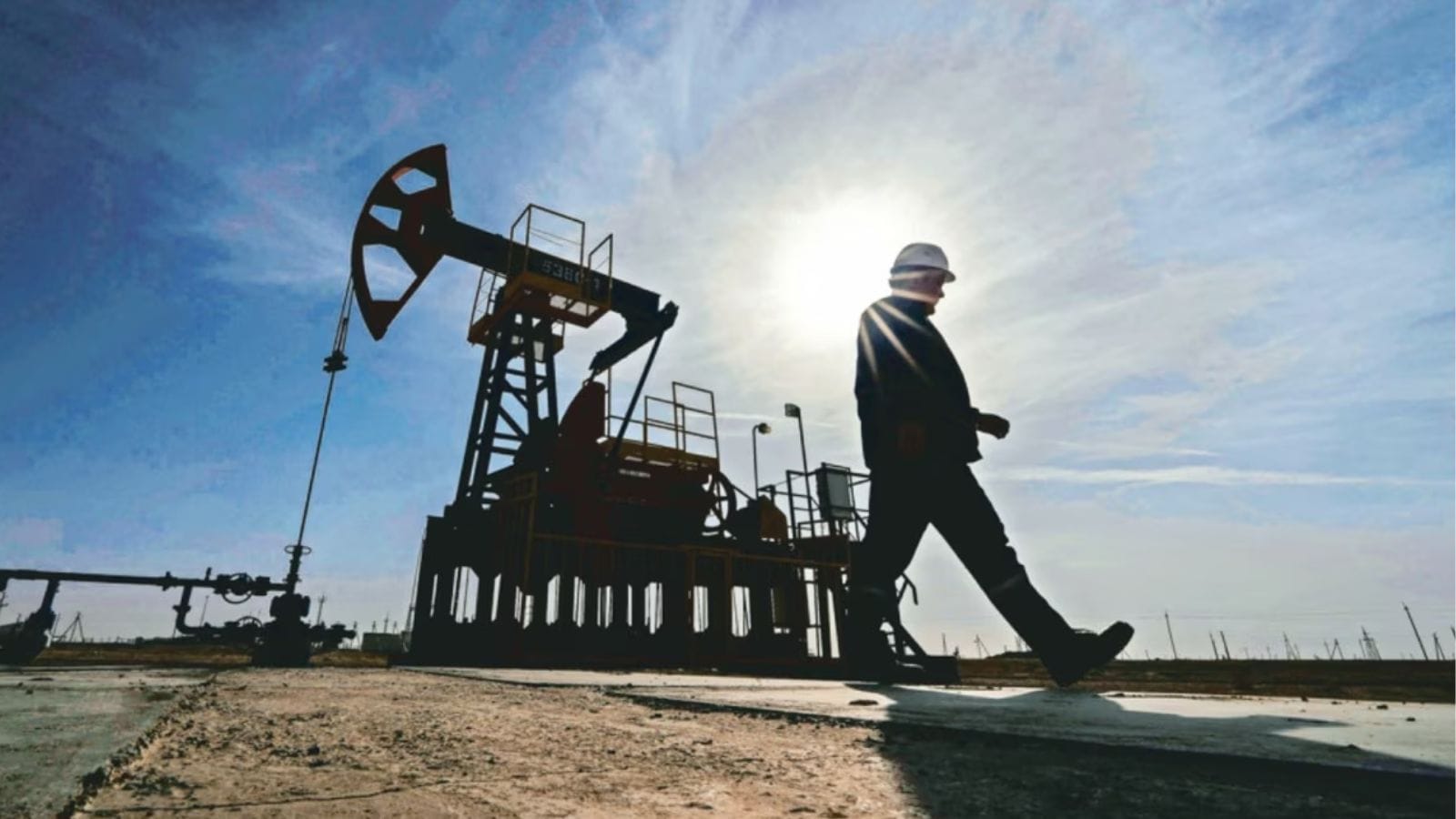
Share prices soared Monday in Asia after a deal was announced on ending the Iran war and reopening the Strait of Hormuz. (File Photo)
Oil prices slid to their lowest level since March on Monday, news agency Reuters reported, after US President Donald Trump and Iran’s deputy foreign minister said the two countries reached an initial agreement to end their war and restore traffic through the Strait of Hormuz.
Brent, WTI tumble to three-month lows
Brent crude futures dropped $3.58, or 4.1 per cent, to $83.75 a barrel by 0004 GMT (5.34 am IST), while US West Texas Intermediate fell $4.01, or 4.72 per cent, to $80.87 a barrel, according to Reuters data. Both benchmarks had already shed more than 3 per cent on Friday, extending a sharp pullback in crude prices.
Asian shares rally, Wall Street set to follow
The relief extended well beyond oil markets, news agency AP reported. Tokyo’s Nikkei 225 jumped 5.1 per cent to a fresh record high of 69,367.06, with technology and AI-linked stocks leading the advance, while Seoul’s Kospi surged 5.6 per cent to 8,577.62. Australia’s S&P/ASX 200 added 1.4 per cent and Taiwan’s Taiex gained 2.6 per cent.
Futures pointed to a higher open on Wall Street too, with contracts tied to the S&P 500 up 1 per cent and the Dow Jones Industrial Average up 0.8 per cent. Monex chief strategist Takashi Hiroki told AP that foreign investors were driving the rally on hopes of easing Middle East tensions, with falling crude prices adding to the optimism.
MOU to be signed in Switzerland on Friday
Story continues below this ad
Pakistan Prime Minister Shehbaz Sharif, whose country mediated the talks, said the US and Iran would sign a memorandum of understanding in Switzerland on 19 June. Trump said on Sunday that the Strait of Hormuz would reopen toll-free and that Washington would end its naval blockade of Iranian ports, Reuters reported.
Iran’s semi-official Mehr news agency separately reported that the draft agreement provided for the strait to reopen within 30 days, under arrangements set by Tehran.
Markets unwind war risk premium
The Strait of Hormuz is a chokepoint for around a fifth of the world’s oil and liquefied natural gas supplies, and the region has lost millions of barrels of output over the more than three months it has remained closed, Reuters said.
Tim Waterer, chief market analyst at KCM Trade, told Reuters that the geopolitical risk premium built into crude prices was now unwinding sharply as traders priced in the prospect of restored oil flows.
Recovery pace, nuclear talks remain key
Story continues below this ad
Investors are also watching how quickly Middle Eastern producers can restart output and exports after war damage, and whether shipping traffic will return to the region, according to Reuters.
Commonwealth Bank of Australia commodities strategist Vivek Dhar said in a note cited by Reuters that while these uncertainties pointed to some upside risk to the bank’s year-end Brent forecast of $80 a barrel, flows through the strait would only need to recover to 60-70 per cent of pre-war levels to push markets back towards pre-war oversupply conditions.
Iran’s deputy foreign minister, Kazem Gharibabadi, said a more comprehensive agreement would be negotiated over a 60-day ceasefire period, Reuters reported. Separately, Britain, France, Germany and Italy said on Sunday they were prepared to lift sanctions on Iran in exchange for steps on its nuclear programme.
IG market analyst Tony Sycamore told Reuters that given the uncertainty around the coming 60 days of talks particularly on the nuclear issue crude prices were unlikely to fall much further in the immediate term.
The Express Global Desk at indianexpress.com which delivers authoritative, verified, and context-driven coverage of key international developments shaping global politics, policy, and migration trends. The desk focuses on stories with direct relevance for Indian and global audiences, combining breaking news with in-depth explainers and analysis.
A major focus area of the desk is US immigration and visa policy, including developments related to student visas, work permits, permanent residency pathways, executive actions, and court rulings. The Global Desk also closely tracks Canada’s immigration, visa, and study policies, covering changes to study permits, post-study work options, permanent residence programmes, and regulatory updates affecting migrants and international students.
All reporting from the Global Desk adheres to The Indian Express’ editorial standards, relying on official data, government notifications, court documents, and on-record sources. The desk prioritises clarity, accuracy, and accountability, ensuring readers can navigate complex global systems with confidence.
Core Team
The Express Global Desk is led by a team of experienced journalists and editors with deep expertise in international affairs and migration policy:
Aniruddha Dhar – Senior Assistant Editor with extensive experience in global affairs, international politics, and editorial leadership.
Nischai Vats – Deputy Copy Editor specialising in US politics, US visa and immigration policy, and policy-driven international coverage.
Mashkoora Khan – Sub-editor focusing on global developments, with a strong emphasis on Canada visa, immigration, and study-related policy coverage. ... Read More
© IE Online Media Services Pvt Ltd
# Oil prices
Loading Recommendations...
01
02
03
04
05
Live Blog
View original source — Indian Express ↗
Related stories

The Punch
PoliticsJun 15, 2026 · 1 min
US, Iran reach deal to end war, reopen Hormuz
The Punch

Japan Times
PoliticsJun 15, 2026 · 1 min
Japan welcomes U.S.-Iran peace deal
Japan Times
ABC News
SportsJun 15, 2026 · 1 min
Aussie swimming great McKeown weighing up Olympic future
ABC News

CNA
BusinessJun 15, 2026 · 1 min
Musk says SpaceX could bring $1 trillion in revenue by 2030
CNA