The Guardian
Oil price falls to three-month low and markets rally after US-Iran peace deal – business live
From
40m ago
Introduction: Oil falls to three-month low
Good morning, and welcome to our rolling coverage of business, the financial markets, and the world economy.
The peace deal agreed between Iran and the US is sending a wave of relief through the markets today.
Oil has tumbled 4%, and markets across the Asia-Pacific region have jumped, as investors anticipate the reopening of the strait of Hormuz.
Although it is unclear exactly what has been agreed – with the final text of their memorandum of understanding unpublished - Donald Trump’s claim that “oil will flow on both ends again for the region, and the world” is pushing down energy prices – a relief for busineses, consumers, politicians and central bankers alike.
Brent crude has fallen as low as $83.04, its lowest since 10 March, after the prime minister of Pakistan announced the US and Iran will sign a memorandum of understanding in Switzerland on Friday.
That still leaves Brent above its pre-war price of $72.48 a barrel, though.
Trump has indicated that the opening of the strait is contingent upon the signing of the peace deal, scheduled for Friday.
Iran’s Mehr state news, though, reported that the agreed memorandum of understanding calls for the reopening of the strait within 30 days under “Iranian arrangements” – an indication that Tehran hasn’t surrendered its control of the waterway.
Chris Weston of IG points out that there are still obstacles to overcome:
The probable reopening of the Strait of Hormuz later this week would represent a significant positive development. Markets had increasingly questioned how long inventory draws could offset supply disruptions and whether physical dislocations would begin weighing more heavily on risk assets. The focus now shifts towards understanding what normalisation of logistics could realistically look like, and how quickly shipping volumes can return to pre-conflict levels of 120 to 140 commercial vessels transiting eastbound and westbound each day.
There are still obstacles to overcome. Mines may need to be cleared, and there may be structural damage to refineries and export facilities around the region that will take time to repair and come back to pre-conflict capacity.
The agenda
10am BST: Eurozone trade balance for April
1.30pm BST: NY Empire State Manufacturing Index
Key events
55s ago
BP and Shell's shares slide
2m ago
FTSE 100 index hits eight-week high
8m ago
UK house prices dip in June
39m ago
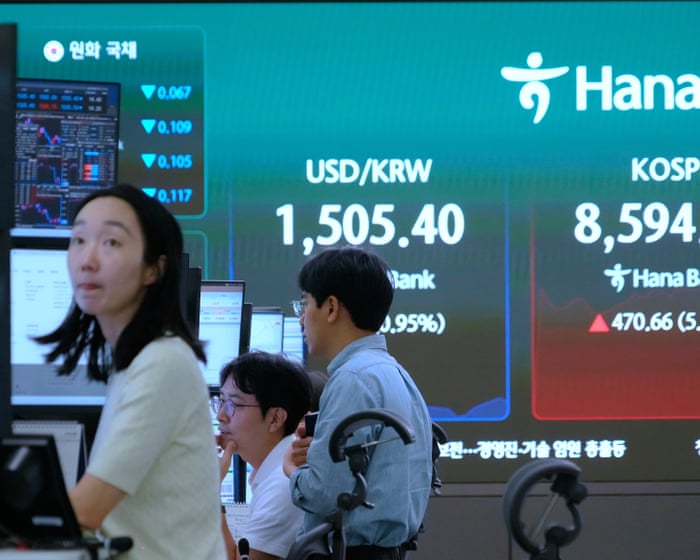
Markets rally across Asia
40m ago
Introduction: Oil falls to three-month low
BP and Shell's shares slide
Shares in oil companies are falling, though – BP and Shell are both down 3.7%, as investors anticipate an end to their earnngs boost from the Iran war.
FTSE 100 index hits eight-week high
Boom! Britain’s stock market has hit a near-two month high at the start of trading, as investors welcome the breakthrough between the US and Iran to end the Middle East conflict.
The FTSE 100 blue-chip share index has jumped by 99 points, or almost 1%, at the start of trading to 10,570 points, its highest level since 21 April.
Engineering firm Rolls-Royce, which makes and services jet engines, is the top riser on the FTSE 100, up 5.5%, followed by British Airways parent company IAG, up 4.8%.
UK house prices dip in June
Gwyn Topham
Two bits of good news for Britons who don’t own their homes have been revealed, with data showing a drop in house prices in June as well as fewer tenants facing rent hikes last month.
Figures from Rightmove showed the average price of property coming on the to market fell by 0.6% or £2,113 to £376,191, the biggest June fall in fourteen years, with prices 0.5% below this time in 2025. The biggest drops were seen in southern England and Wales, and in asking prices for flats rather than houses.
The property site said the number of homes for sale was still at historically high levels for summer, making it more of a buyer’s market. Mortgage affordability has also improved slightly this month, with the average two-year fixed rate deal dropping about 0.1 percentage points to 5.07%, it said.
Meanwhile, figures suggest that the introduction of the Renters Right Act may already be seeing results in terms of keeping rents down for tenants.
The new law came into force at the start of May and means landlords can only increase rents for sitting tenants once a year. According to Hamptons monthly lettings index, the number of tenants who saw their rent rise was down 23% from the same month last year. Hamptons said if the rest of the year saw similar change, it would expect only 31% of sitting tenants to face increases, compared to 40%-50% in previous years.
However, the agency warned that rent rises in Scotland, where landlords have been operating under a similar system for longer, exceeded the national average. Sitting tenants who faced rent rises had an average increase of 5.4% in May, but the figure reached 7.7% in Scotland, albeit for a lower absolute rent - £952 – than the Great Britain average of £1375.
Speaking of the ECB, their president Christine Lagarde has been warning that inflation pressures are spreading in the euro area.
In an intervew with broadcaster France Culture, Lagarde warned that high energy prices are starting to feed through to other parts of the economy, saying:
“Indirect effects of inflation, we have absolutely started to see that more or less everywhere in recent weeks.”
The US-Iran agreement is well-timed for the Bank of England, which is due to set UK interest rates on Thursday.
If the strait of Hormuz does reopen, and oil flows return towards pre-war levels, there will be less inflationary pressure – and thus less need for interest rate rises.
The European Central Bank raised its interest rates last week, but this week is the turn of the BoE, the US Federal Reserve and the Bank of Japan.
Kathleen Brooks, research director at XTB, says:
Over the past month, the price of oil is down by more than a fifth, and the Brent crude price is now back at levels from early March. This is good news for inflation, which should start tumbling monthly from June, and it could ease concerns about price pressures as we lead up to some major central bank action this week. The decline in the oil price also raises questions about whether the ECB was too hasty in raising rates last week.
European stock markets are on track to jump when trading begins, in just over 20 minutes.
Germany’s DAX share index is up 1.65% in the futures market, Reuters reports, with the UK’s FTSE 100 0.75% higher.
The US dollar is weakening, as investors shift into riskier currencies.
The pound is its highest in over a week, at $1.3438.
Markets rally across Asia
There are strong gains across Asia-Pacific markets today, as investors welcome the deal between the US and Iran.
Japan’s Nikkei share index has leapt by 5%, as has South Korea’s KOSPI, while China’s CSI300 index is 1.9% higher.
Jim Reid, market strategist at Deutsche Bank, says:
Whilst the deal is very good news for markets it looks like tough conversations will have occur in the 60-day window to ensure the peace is sustainable. As an example, the Senate needs to approve any extensive sanction relief for Iran.
For now the can kicking exercise has been very well received by markets even after a strong US close on Friday where hopes were raised of a weekend signing
Introduction: Oil falls to three-month low
Good morning, and welcome to our rolling coverage of business, the financial markets, and the world economy.
The peace deal agreed between Iran and the US is sending a wave of relief through the markets today.
Oil has tumbled 4%, and markets across the Asia-Pacific region have jumped, as investors anticipate the reopening of the strait of Hormuz.
Although it is unclear exactly what has been agreed – with the final text of their memorandum of understanding unpublished - Donald Trump’s claim that “oil will flow on both ends again for the region, and the world” is pushing down energy prices – a relief for busineses, consumers, politicians and central bankers alike.
Brent crude has fallen as low as $83.04, its lowest since 10 March, after the prime minister of Pakistan announced the US and Iran will sign a memorandum of understanding in Switzerland on Friday.
That still leaves Brent above its pre-war price of $72.48 a barrel, though.
Trump has indicated that the opening of the strait is contingent upon the signing of the peace deal, scheduled for Friday.
Iran’s Mehr state news, though, reported that the agreed memorandum of understanding calls for the reopening of the strait within 30 days under “Iranian arrangements” – an indication that Tehran hasn’t surrendered its control of the waterway.
Chris Weston of IG points out that there are still obstacles to overcome:
The probable reopening of the Strait of Hormuz later this week would represent a significant positive development. Markets had increasingly questioned how long inventory draws could offset supply disruptions and whether physical dislocations would begin weighing more heavily on risk assets. The focus now shifts towards understanding what normalisation of logistics could realistically look like, and how quickly shipping volumes can return to pre-conflict levels of 120 to 140 commercial vessels transiting eastbound and westbound each day.
There are still obstacles to overcome. Mines may need to be cleared, and there may be structural damage to refineries and export facilities around the region that will take time to repair and come back to pre-conflict capacity.
The agenda
10am BST: Eurozone trade balance for April
1.30pm BST: NY Empire State Manufacturing Index
View original source — The Guardian ↗
Related stories

Euronews
BusinessJun 15, 2026 · 1 min
Ibex 35 jumps on Iran deal and hits record 19,000 points
Euronews
Bloomberg
BusinessJun 15, 2026 · 1 min
US and Iran Agree to Halt Near Four-Month War
Bloomberg

Bloomberg
BusinessJun 15, 2026 · 1 min
Anthropic Restricts Mythos After US Order
Bloomberg

Bloomberg
BusinessJun 15, 2026 · 1 min
US Orders Anthropic to Block Foreign Access to Mythos
Bloomberg