Indian Express
Indian Express··5 min read
Denied terrace access after buying flat, homeowners awarded Rs 40,000
5 min readNew DelhiJun 15, 2026 01:30 PM IST
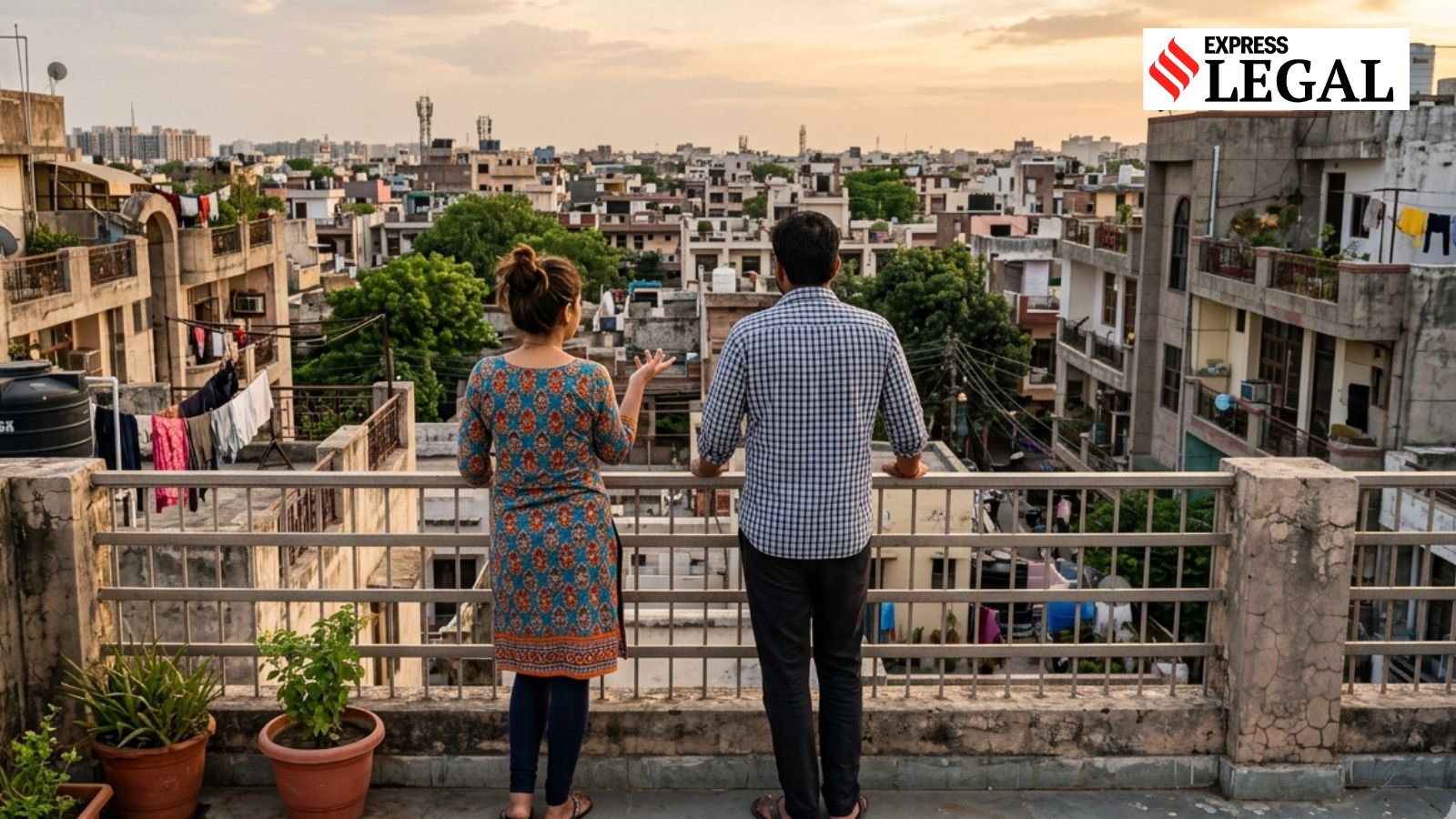
The flat owners had alleged that at the time of purchase, it was not disclosed to them that the terrace rights were restricted. (Image generated using AI)
The District Consumer Disputes Redressal Commission-I, Hyderabad, has directed a landlord and a builder to pay a compensation of Rs 30,000 and Rs 10,000 as costs to a flat owner who was denied access to the terrace of a residential building.
A bench of president B Uma Venkata Subba Lakshmi, and members C Lakshmi Prasanna and V Janardhan Reddy observed that the complainant is entitled to terrace rights, considering the specific clause in the sale deed.
“The complainants are genuinely entitled for usage of the terrace rights under clause 4 of sale deed wherein it was stated ‘that the rights, titles interest, easements/privileges, appurtenances, liberties, enjoyments and possessions are hereby transferred and subsist in favour of the vendees absolutely and forever,” the commission held in its order dated June 5.
Access denied
The complaint was filed by a couple alleging that although no restriction on terrace access was disclosed at the time of purchase, the landlord later prevented them from using the terrace, claiming that it was reserved for his exclusive use.
They further contended that buyers are entitled to use the building’s common areas, including the terrace, as per general property ownership norms, and added that if this clause had been disclosed at the time of the sale, the complainants could have reconsidered their decision to purchase the flat.
According to the complainants, the terrace formed part of the common amenities available to all residents.
The landlord failed to file a written defence within the prescribed period, leading to forfeiture of his right to contest the complaint.
The builder, however, argued that he had already sold all flats falling in his share under the development agreement and was not involved in the dispute.
He further claimed that terrace access had been restricted primarily for safety reasons and that there were no specific restrictions on its use.
The builder clarified that he was not aware of the dispute that arose between the landowner and complainant with regard to the usage of the terrace and common rights to the residential flat owners of the property.
The landlord argued that the complainant was not paying maintenance and had rented the said flat to bachelors, and were creating a nuisance over the terrace.
Deficiency in service
After examining the sale deed and evidence on record, the commission noted that the opposite parties had failed to produce any material proving that the terrace exclusively belonged to the landlord.
It observed that the sale deed expressly transferred all rights, interests, easements, privileges and enjoyments associated with the property to the purchasers.
The commission held that the complainants were entitled to use the terrace as part of the common amenities attached to their flat and that the landlord had no authority to prevent such use.
It found that denying access to the terrace constituted a deficiency in service under the Consumer Protection Act.
Story continues below this ad
“In view of the facts and circumstances of the case, there is a deficiency of service in not allowing rights of the complainants for usage of terrace. Hence, we direct the opposite parties No.1 and 2 to allow the complainants for usage of common amenities including the usage of terrace as per standard housing norms,” the commission ordered.
Allowing the complaint in part, the commission directed the landlord and builder to permit the complainants to use the terrace and awarded Rs 30,000 as compensation for mental agony and inconvenience and Rs 10,000 towards costs.
“As the complainants have suffered a lot of inconvenience, mental agony in not allowing the usage of terrace rights and he was forced to file the present complaint, hence, the complainants are entitled for compensation of Rs 30,000 besides the costs of Rs 10,000,” the commission ordered.
Compensation for overcharging
In another case, a Kerala consumer commission has directed the Kerala State Beverages Corporation (KSBC) to pay Rs 25,000 in compensation and costs to a customer after finding that it charged Rs 10 more than the Maximum Retail Price (MRP) printed on a beer bottle.
Story continues below this ad
The order passed by a bench comprising president George Baby and member Nishad Thankappan noted that charging excess MRP constitutes ‘unfair trade practice‘ and ‘deficiency in service’.
“Charging excess of MRP by opposite party constitutes “unfair trade practice” and “deficiency in service” as per Consumer Protection Act, 2019 and in our considered view adequate compensation should be levied on the opposite party to change this trend,” the Consumer Disputes Redressal Commission, Pathanamthitta, noted in its order dated June 3.
Ashish Shaji is a Senior Sub-Editor at The Indian Express, where he specializes in legal journalism. Combining a formal education in law with years of editorial experience, Ashish provides authoritative coverage and nuanced analysis of court developments and landmark judicial decisions for a national audience.
Expertise
Legal Core Competency: Ashish is a law graduate (BA LLB) from IME Law College, CCSU. This academic foundation allows him to move beyond surface-level reporting, offering readers a deep-dive into the technicalities of statutes, case law, and legal precedents.
Specialized Legal Reporting: His work at The Indian Express focuses on translating the often-dense proceedings of India's top courts into clear, actionable news. His expertise includes:
Judicial Analysis: Breaking down complex orders from the Supreme Court and various High Courts.
Legal Developments: Monitoring legislative changes and their practical implications for the public and the legal fraternity.
Industry Experience: With over 5 years in the field, Ashish has contributed to several niche legal and professional platforms, honing his ability to communicate complex information. His previous experience includes:
Lawsikho: Gaining insights into legal education and practical law.
Verdictum: Focusing on high-quality legal news and court updates.
Enterslice: Working at the intersection of legal, financial, and advisory services. ... Read More
Tags:
builder
consumer court
consumer protection act
View original source — Indian Express ↗
Related stories

The Punch
PoliticsJun 15, 2026 · 1 min
Reps extend 2025 capital budget implementation to September
The Punch
The Punch
PoliticsJun 15, 2026 · 1 min
Avoid political influence, Adeleke warns corps members ahead of Osun poll
The Punch
The Punch
PoliticsJun 15, 2026 · 1 min
Reps aspirant sues NDC for N5bn over ‘scrapped’ primary
The Punch
The Punch
NewsJun 15, 2026 · 1 min
Ojukwu varsity dismisses two profs, three others for gross misconduct
The Punch