CNA
CNA··5 min read
Former Changi chalet among growing number of state properties given new lease of life
Singapore
Over 20 tenders were launched in Singapore last year to repurpose state properties, signalling a rise in interest in redeveloping old buildings rather than demolishing them.
New: You can now listen to articles.
This audio is generated by an AI tool.
15 Jun 2026 04:12PM
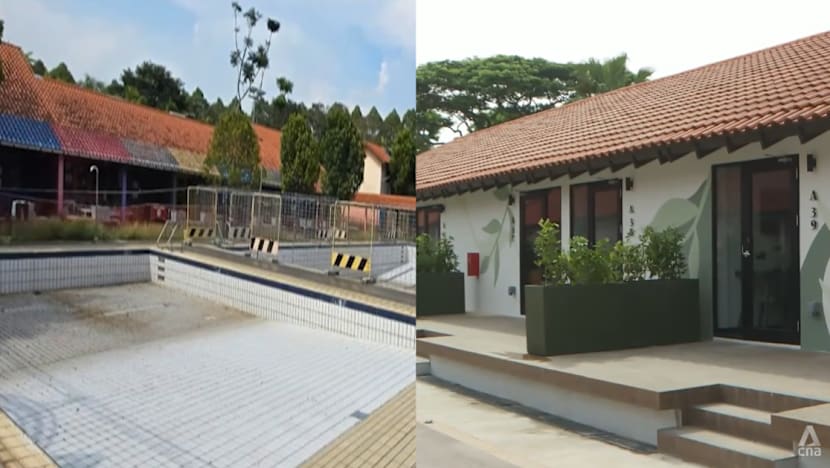
SINGAPORE: A popular holiday chalet along Jalan Loyang Besar sat disused for years after having last served as a temporary workers’ dormitory.
Now, the site in Changi – which is around 40 years old – is undergoing restoration and redevelopment into a co-living resort, with operators seeking to preserve much of its original character.
Timber screens that once separated the chalets have been repurposed into tables and chairs. Developers are also keeping its roofs – made of terracotta clay tiles – and about 40 per cent of the existing landscape, said Coliwoo’s executive chairman and CEO Kelvin Lim.
The Coliwoo Resort Changi, which emphasises sustainability and harmony with nature, is expected to open in August.
"If you were to build it brand new, it would take at least three years. For us, a restoration takes around 10 months and that is already a fast-track programme," Mr Lim told CNA.
Such interest in repurposing ageing buildings rather than demolishing them has been growing in Singapore, with urban planning experts saying that these projects reflect a broader shift towards adaptive reuse.
According to the Singapore Land Authority (SLA), more than 20 tenders were launched in 2025 to repurpose state properties, with former offices, schools and other buildings being transformed into co-living spaces, community hubs and lifestyle destinations.
The agency said it recorded a 50 per cent increase in the number of social entities repurposing state properties for community uses between 2021 and 2024, compared with the previous three-year period.
"In a high-rise, high-density city like Singapore and others around the world, efficiency and sustainability are critical,” noted Ms Elaine Tan, research director at the Centre for Liveable Cities.
“Adaptive reuse demonstrates that retrofitting can be both economically and environmentally advantageous because it delivers quicker returns while strengthening long-term resilience.”
The practice can help cities preserve cultural heritage, retain shared memories and rejuvenate neighbourhoods, she added.
A COMPLEX UNDERTAKING
Among the better-known examples are Temasek Shophouse – a social impact hub along Orchard Road – as well as New Bahru, a cluster of shops and eateries at the former Nan Chiau Girl's High School campus.
Another is The Foundry, a former Elections Department building that now serves as a hub for social impact startups.
But while adaptive reuse offers environmental and social benefits, transforming old buildings remains a complex undertaking.
"Old buildings are not easy. Ageing wears them down and it's made worse by Singapore's very punishing weather,” said SLA CEO Calvin Phua.
In order to adapt them, people who understand the constraints of old buildings need to be roped in, he added.
"It takes quite a lot of investment to do up old buildings and to maintain them. The people must be able to put it to a use that is viable, and that means a clear market demand for delivered value, and then you can justify your investment you need to put in to transform the old spaces," he pointed out.
One of the most challenging sites under consideration is the Old Kallang Airport.
Singapore's first airport opened in 1937 and ceased aviation operations 18 years later. Today, the conserved landmark remains vacant while agencies explore potential future uses.
In 2024, the Urban Redevelopment Authority (URA) began seeking input on the site. Among its key suggestions was repurposing the site for “lifestyle, recreational and community uses".
"It's been very challenging to figure out a use that is viable enough to justify the level of investments that are required to make the building work,” said Mr Phua, noting certain conservation requirements that require “a significant amount of investment”.
"The spaces within the building are also quite customised, so you do need to be able to figure out and reimagine how you can turn those old spaces and make good spaces work in the new use,” he added.
“I think a lot of thought is put in to decide what to conserve, what to preserve, what to keep and you do need to respect those conservation requirements.”
Mr Phua said demolition remains a last resort and is considered only when a building's condition or highly specialised design makes reuse impractical.
He added that SLA discusses this with its partner agencies, including URA.
ADDRESSING SOCIAL NEEDS
SLA is also exploring how adaptive reuse can help address emerging social needs, including ageing and community care.
One example is Commune at Henderson, a former school that was converted into a co-living community for seniors and youths.
"Because of the nature of our spaces, we can afford to experiment a little bit, and one area is community care. These are co-living spaces for the aged to age well and live well,” Mr Phua pointed out.
"We have to do our part in talking to people and in lining up the proposed uses for the old properties and to try to get people to reimagine what is possible."
Mr Phua said adaptive reuse is ultimately about helping Singapore respond to changing needs in a land-scarce environment.
"The reality is that we are a land-scarce country. We don't have infinite amounts of land to put to new uses, so we do need to adjust … (and) we do need to create new spaces to meet new needs and priorities. That transition from the old to the new is always challenging,” he added.
While people have a “certain affinity” for old spaces, reimagining them can get the community to interact with these spaces in a different way, said Mr Phua.
"By making the old buildings available to future generations, we are already providing an opportunity for the stories to be told and the connection to the history and the past of the place,” he added.
Source: CNA/lt(dn)
Related stories

The Punch
PoliticsJun 15, 2026 · 1 min
Reps extend 2025 capital budget implementation to September
The Punch
The Punch
PoliticsJun 15, 2026 · 1 min
Avoid political influence, Adeleke warns corps members ahead of Osun poll
The Punch
The Punch
PoliticsJun 15, 2026 · 1 min
Reps aspirant sues NDC for N5bn over ‘scrapped’ primary
The Punch
The Punch
NewsJun 15, 2026 · 1 min
Ojukwu varsity dismisses two profs, three others for gross misconduct
The Punch